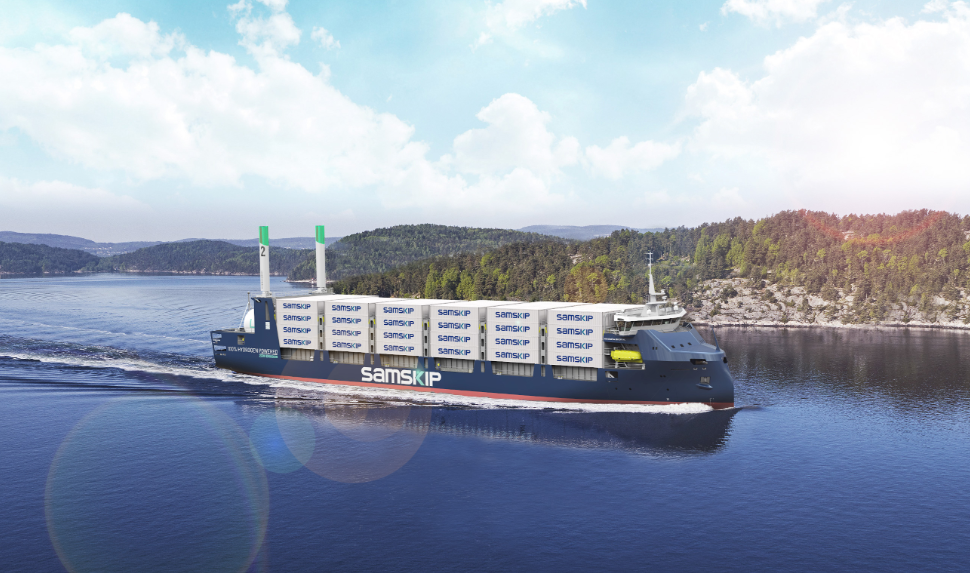
Three hydrogen-powered containerships — Samskip’s SeaShuttle, Edge Navigation’s modular hydrogen container ship, and the EU-funded Energy Observer 2 — are converging in 2026, marking the emergence of liquid hydrogen propulsion as a viable commercial technology for short- and medium-sea trades.
⚡ TL;DR
- What: Three hydrogen-powered containerships are progressing simultaneously: Samskip's SeaShuttle (Rotterdam–Oslo, Q2 2027), Edge Navigation's modular ocean-capable hydrogen container ship, and Energy Observer 2 (1,100 TEU, €40M EU grant, 2029 target).
- Why it matters: SeaShuttle is a real commercial vessel on a real route — not a demonstrator. Its 2027–2028 operations will produce the first dataset on LH2 containership economics: bunkering time, boil-off, fuel cell endurance, total cost.
- Key data: SeaShuttle: Norwegian Hydrogen confirmed as LH2 supplier (Jan 2026). EO2: CMA CGM as operating partner, Air Liquide for supply chain, LMG Marine hull design, Bureau Veritas class.
- Timeline: SeaShuttle delivery end 2026, commercial ops Q2 2027. EO2 commercial ops 2029.
- Watch for: LH2 bunkering network. Rotterdam is committed; everywhere else is not. Replication across European ports is the multi-year constraint.
SeaShuttle: Rotterdam to Oslo on Liquid Hydrogen
Samskip’s SeaShuttle project is the furthest along. The first vessel entered construction in early 2024 at an Indian shipyard, with delivery expected at the end of 2026. After LH2 bunkering and systems integration at the Port of Rotterdam, the ship is scheduled to begin commercial service on the Rotterdam–Oslo short-sea route in Q2 2027.
The vessel is designed as an autonomous ready, zero-emission container feeder. Key specs:
- Propulsion: LH2 fuel cells (no diesel backup)
- Route: Rotterdam ↔ Oslo (~1,000 km, 4–5 day round trip)
- Autonomy: Ready for future upgrades
- Developer: Samskip
- LH2 supplier: Norwegian Hydrogen (selected as preferred supplier, January 2026)
Norwegian Hydrogen’s selection as preferred LH2 supplier is significant. It locks in a green hydrogen supply chain for the vessel: hydrogen produced from Norwegian hydropower, liquefied, and bunkered at Rotterdam. This is the first time a complete, commercial-scale LH2 maritime supply chain has been contracted end-to-end for a container vessel.
The route choice is strategic. Rotterdam–Oslo is a well-established short-sea corridor with predictable port calls, manageable distances, and political will on both the Dutch and Norwegian sides to support green shipping infrastructure. It also avoids the cold-weather LH2 handling challenges that would complicate more distant routes.
Technical Analysis: Why LH2 for Hydrogen-Powered Containerships?
LH2 has a specific energy density of approximately 120 MJ/kg — roughly three times that of marine diesel by weight. The challenge, always, has been volumetric density: liquid hydrogen at −253°C occupies about four times the volume of an equivalent diesel cargo. For a containership, this means significant tank space is consumed by fuel.
SeaShuttle addresses this through its short-route design: the vessel doesn’t need to carry fuel for long ocean crossings. A single LH2 bunkering in Rotterdam covers the round trip, keeping tank volume manageable without compromising container capacity.
The fuel cell propulsion system avoids combustion entirely, producing only water vapour as exhaust. This eliminates NOₓ, SOₓ, and particulate emissions — meeting not just IMO’s 2050 decarbonisation targets but the emerging FuelEU Maritime requirements for zero-emission port calls, which several northern European ports are already considering.
Edge Navigation: Scaling Up
Where SeaShuttle focuses on short-sea routes, Edge Navigation is developing a larger, ocean-capable LH2 containership concept targeting medium-range European trades. The company has been developing a vessel design with higher TEU capacity and greater range, intended to demonstrate that LH2 propulsion is viable beyond the feeder sector.
Edge Navigation’s approach centres on modular LH2 tank architecture — vacuum-insulated Type C pressure vessels arranged to allow flexible cargo/fuel ratios depending on route length. This could allow the same hull design to operate on both 800 km feeder runs and 3,000+ km medium-range routes by adjusting the tank/container split at build time or between voyages.
The company received funding support through Norwegian green shipping initiatives and has been collaborating with classification societies on type approval for its cryogenic fuel systems. As of early 2026, Edge Navigation has not yet announced a construction contract, but the technical development programme is active.
Energy Observer 2: EU Innovation Fund Backs a 1,100 TEU LH2 Containership
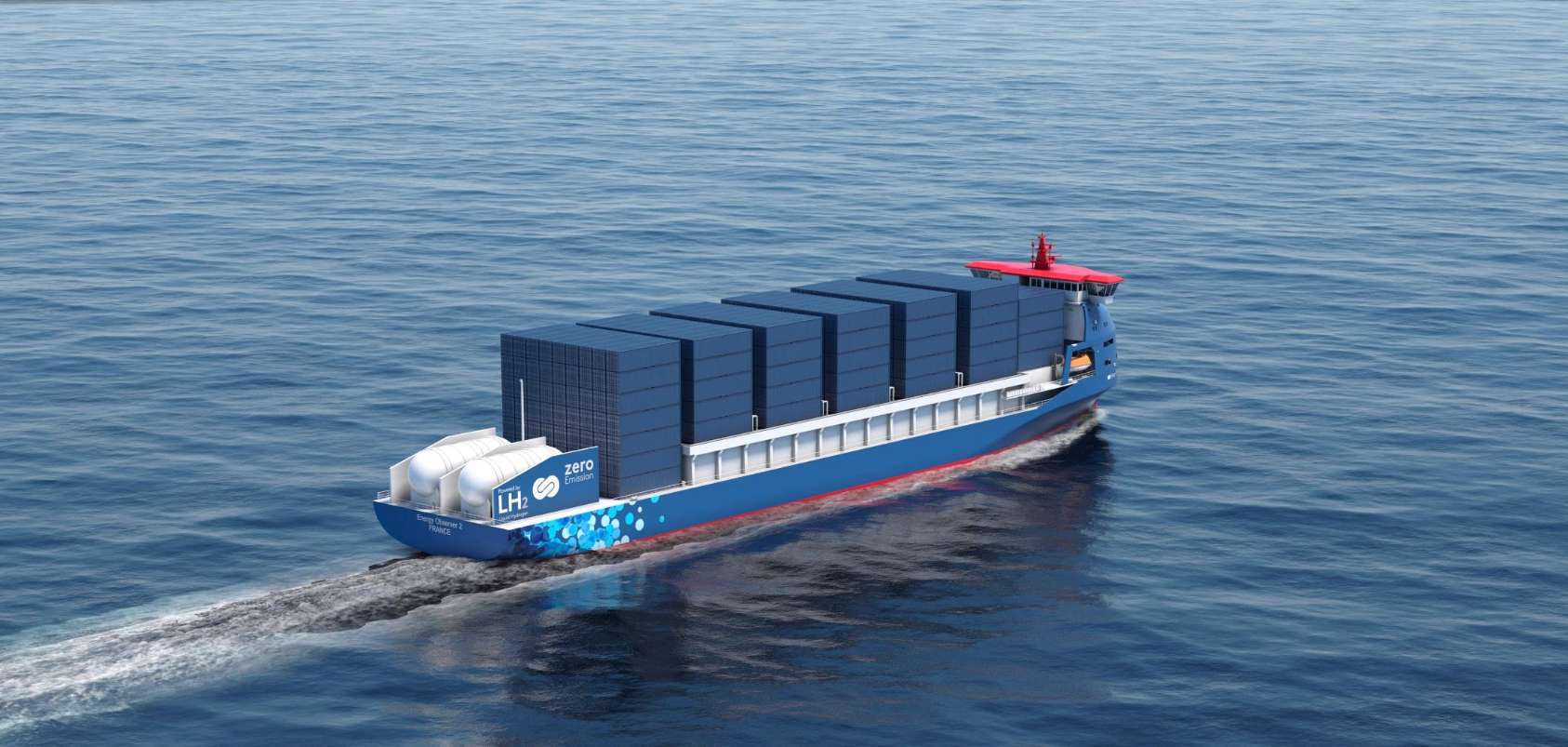
A third LH2 containership project is advancing with EU backing. Energy Observer 2 (EO2) is a 160-metre, 1,100 TEU vessel developed by EOConcept — the commercial shipping arm spun out of the Energy Observer clean-energy demonstrator project — with a consortium of industrial and maritime partners.
The vessel’s propulsion architecture builds on EODev’s marine fuel cell system, developed with Toyota, and previously certified by Bureau Veritas for the 1.2 MW unit installed on the original Energy Observer catamaran. EO2 scales this to 4.8 MW of installed fuel cell capacity, driving electric motors to a target service speed of 12.5 knots with a range of 1,600 nautical miles — sufficient for Atlantic and Channel coast trades without intermediate bunkering.
Key project specs:
- Vessel: 160 m LOA, 1,100 TEU capacity
- Propulsion: 4.8 MW LH2 fuel cell system (EODev / Toyota technology)
- Range: 1,600 nm at 12.5 knots
- Target route: European Atlantic and Channel coasts
- Funding: €40 million EU Innovation Fund grant (selected from 85 competing projects)
- Target commercial operations: 2029
- Projected CO₂ avoided: 112,250 tonnes over 10 years
The project consortium is notably broad: CMA CGM (Europe’s largest container carrier) is a shipowner partner, Air Liquide handles LH2 supply chain expertise, LMG Marine designed the hull, Bureau Veritas provides classification, Dassault Systèmes contributes digital design tools, and Chart Industries supplies cryogenic equipment.
CMA CGM’s involvement is particularly significant. The carrier operates one of the world’s largest container fleets and has been publicly cautious about committing to specific alternative fuels at scale. Its participation in EO2 as an operating partner — not just a bystander — suggests real commercial confidence in the LH2 containership concept.
The EU Innovation Fund grant of €40 million, awarded through CINEA, reflects the programme’s strategic focus on high-impact first-of-a-kind projects. EO2 was selected from a competitive field specifically because it combines novel propulsion technology with a credible path to commercial replication — a requirement that distinguishes Innovation Fund projects from research grants.
Industry and Regulatory Context
These projects arrive at a critical regulatory juncture. The IMO’s revised GHG Strategy commits to net-zero shipping by 2050, with 20–30% emissions reductions targeted by 2030. FuelEU Maritime (effective January 2025) introduces a greenhouse gas intensity trajectory for ships calling at EU ports, with escalating penalties for non-compliance.
For short-sea operators like Samskip, LH2 is increasingly competitive versus alternatives:
| Fuel | C-Factor (CO₂eq/t fuel) | Well-to-wake GHG | EU ETS cost (2026) |
|---|---|---|---|
| HFO | 3.114 | High | High |
| LNG | 2.750 | Medium (methane slip) | Medium |
| Green methanol | 1.375 | Low | Low |
| Green LH2 | 0.000 | Near-zero | Minimal |
Green LH2 scores zero on direct CO₂ emissions and near-zero on well-to-wake GHG (subject to electrolysis energy source). As ETS prices rise — currently around €60–70/tonne CO₂ — the carbon cost advantage of LH2 grows relative to conventional fuels.
The main barrier remains bunkering infrastructure. Rotterdam’s Port Authority has committed to installing LH2 bunkering capacity ahead of SeaShuttle’s 2027 operational date, but replication across the European port network will take years.
Why This Matters
SeaShuttle is not a demonstration project. It is a commercial vessel on a commercial route, operated by one of Europe’s leading short-sea carriers. If the Rotterdam–Oslo service runs reliably at commercial capacity through 2027–2028, it will provide the shipping industry’s first real-world dataset on LH2 containership operations: bunkering time, boil-off management, fuel cell endurance, and total cost of ownership.
That dataset will be worth more than any feasibility study. It is the missing proof that large-scale LH2 shipping is operationally viable — not just technically conceivable.
Edge Navigation’s parallel development, if it reaches construction, would extend that proof to larger vessels and longer routes. Energy Observer 2 adds a third data point: a vessel backed by a major liner operator, a mainstream EU funding mechanism, and a 2029 commercial timeline. Together, the three projects define the frontier of what 2026–2030 hydrogen shipping can look like — and provide converging evidence that LH2 containership propulsion is not a single-project experiment.
Challenges and Open Questions
- LH2 bunkering speed: Cryogenic transfer is slower than conventional bunkering. Port turnaround times will be a key operational variable.
- Boil-off gas management: LH2 at −253°C generates boil-off gas during storage and transfer. SeaShuttle’s systems for capturing or consuming boil-off will be closely watched.
- Green hydrogen supply scale: Norwegian Hydrogen’s capacity is currently limited. Scaling green LH2 production to serve multiple vessels will require significant electrolyser and liquefaction investment.
- Cost parity timeline: LH2 propulsion has higher CAPEX than conventional alternatives. At what carbon price — and LH2 production cost — does it break even? Current modelling suggests €80–100/tonne CO₂ and €4–6/kg LH2.
- Edge Navigation funding: Without a confirmed construction contract, the larger vessel remains at risk of delay.
- EO2 timeline: A 2029 commercial operations target is ambitious. Between now and then, EO2 must complete detailed design, secure a construction contract, build out LH2 bunkering on the Atlantic/Channel coast, and obtain all regulatory approvals. The EU grant de-risks the funding side; execution risk remains.
Sources
- Samskip: Hydrogen-Powered SeaShuttles
- Norwegian Hydrogen selected as preferred LH2 supplier for SeaShuttle
- Construction starts on world’s first green hydrogen-powered shortsea boxship — Offshore Energy
- SeaShuttle autonomous containership project set to move ahead — Marine Log
- Energy Observer 2 — EU Innovation Fund project fiche (CINEA, project 101191276)
- LMG Marine: Energy Observer 2 vessel design