Netherlands Maritime Masterplan
Complete guide to the Netherlands Maritime Masterplan (MMP): €165M budget for hydrogen inland and short-sea shipping. Includes the 2026 subsidy round — up to €8M per project, application window May 19 – November 3, 2026.
Netherlands Maritime Masterplan
Greening Inland Waterways and Short-Sea Shipping
€165 Million Total Budget (2023-2030) · Up to 40% Coverage Rate
Program Overview
Administering Body: Netherlands Enterprise Agency (RVO)
Total Budget: €165 million (2023-2030)
Coverage Rate: Up to 40% of eligible costs
Primary Focus: Inland vessels, short-sea shipping, infrastructure
Application Cycle: Annual
Geographic Scope: Netherlands and Dutch-flagged vessels
The Dutch Maritime Masterplan focuses on greening inland waterways and short-sea shipping. With strong emphasis on hydrogen bunkering infrastructure and demonstration projects, it targets the Netherlands’ extensive inland shipping sector.
The Netherlands has one of the world’s largest inland shipping fleets, with over 5,000 vessels operating on its extensive network of rivers and canals. The Maritime Masterplan aims to accelerate the transition of this fleet to zero-emission propulsion, with hydrogen as a key technology pathway alongside battery-electric solutions.
2026 Subsidy Round — Now Open
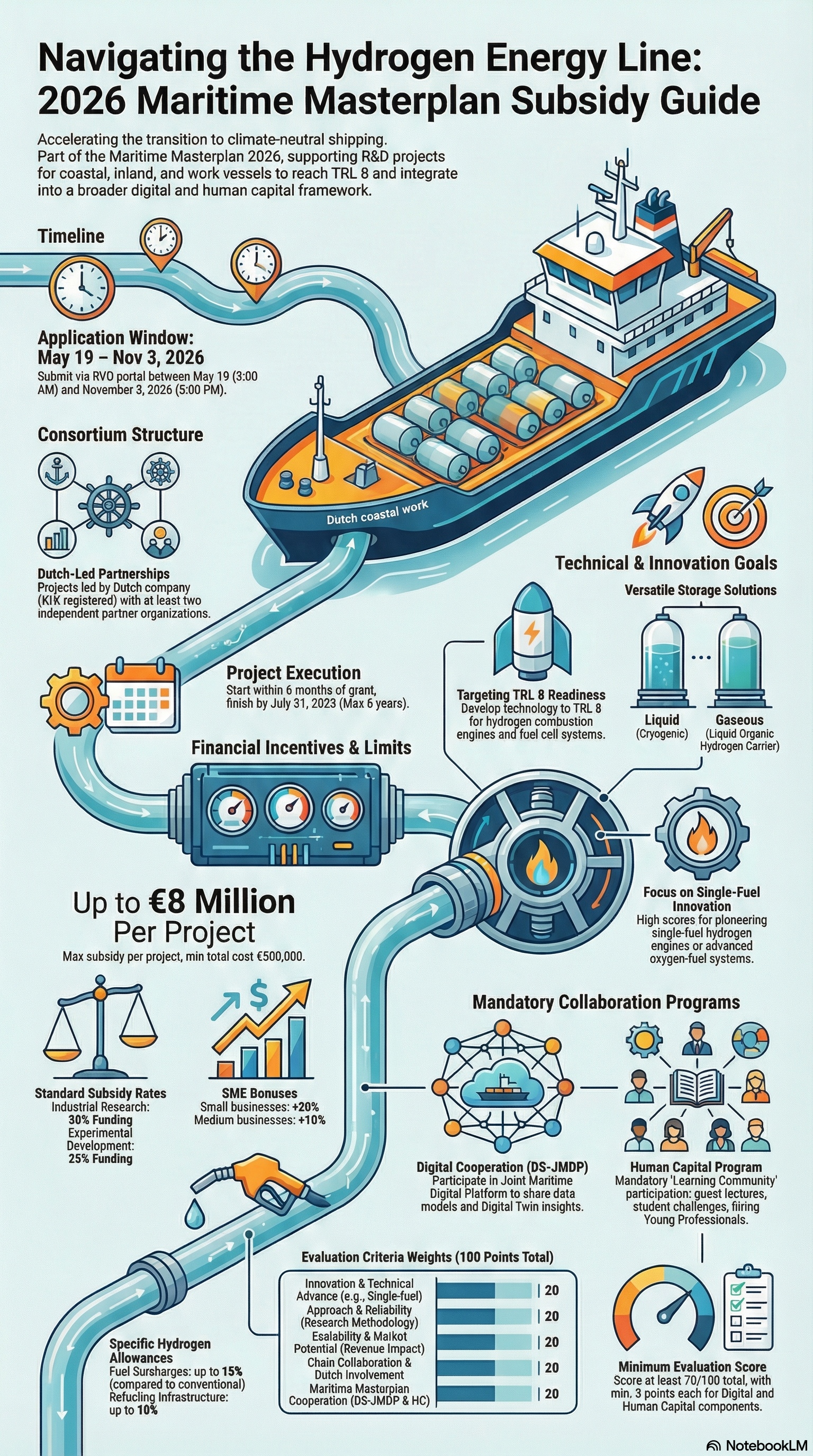
Application window: May 19 (03:00) – November 3, 2026 (17:00) Submit via the RVO portal. Dutch KvK-registered lead partner required.
The Temporary Subsidy Scheme Maritime Masterplan 2026 has been officially published. This round targets hydrogen projects at TRL 5–7, funding the critical phase where innovation moves from laboratory to real-world maritime operations, with a goal of reaching TRL 8 readiness for hydrogen combustion engines and fuel cell systems.
Energy Line 1 — Hydrogen
This is the dedicated hydrogen track within the 2026 round. Key focus areas:
- Versatile storage: both Liquid (Cryogenic) LH2 and Gaseous hydrogen (including Liquid Organic Hydrogen Carriers / LOHC) are eligible
- Single-fuel priority: projects pioneering dedicated single-fuel hydrogen engines receive higher innovation scoring
- Bunkering infrastructure: funding available for construction of bunkering infrastructure directly required for a demonstration vessel
Financial Incentives
| Category | Rate / Limit |
|---|---|
| Max subsidy per project | Up to €8 million |
| Industrial Research | 30% funding |
| Experimental Development | 25% funding |
| SME Bonus — Small enterprise | +20% |
| SME Bonus — Medium enterprise | +10% |
| Fuel Surcharge Allowance | Up to 15% vs. conventional fuel costs |
Depreciation benefit: The scheme allows accelerated depreciation of innovative energy systems — 10 years for inland shipping, 15 years for seagoing vessels — significantly improving the business case.
Consortium Requirements
- Project must be led by a Dutch company (KvK registered)
- At least two independent partner organisations required
- Project must start within 6 months of grant award
- Project must be completed by July 31, 2032 (maximum 6 years)
Evaluation & Scoring
Projects are scored on a 100-point scale. A minimum of 70 points is required to qualify. Criteria include:
- Innovation & technical novelty
- Approach & reliability
- Scaling potential
- Economic impact
- Chain collaboration
- Dutch involvement
- DS-JMDP & Human Capital cooperation
Mandatory Collaboration Programs
Digital Cooperation (DS-JMDP) Participation in the Joint Maritime Digital Platform is mandatory. Projects must share data models and Digital Twin insights within the platform.
Human Capital Program Projects must join a Learning Community, which includes guest lectures, student challenges, and commitments to hiring young professionals.
Eligibility Criteria
Who Can Apply
- Dutch-registered shipping companies
- Inland waterway operators
- Short-sea shipping companies with Dutch operations
- Port authorities and infrastructure developers
- Technology providers and shipyards in the Netherlands
- Consortiums with Dutch-based lead partners
Eligible Project Types
- Inland Vessels: Hydrogen-powered newbuilds and retrofits for river/canal operations
- Short-Sea Shipping: Coastal vessels with hydrogen propulsion
- Infrastructure: Hydrogen bunkering facilities at Dutch inland ports
- Demonstration: Pilot projects proving commercial viability
- Container Swap Systems: Swappable hydrogen container infrastructure
What’s Covered
| Cost Category | Eligible? | Typical Coverage | Notes |
|---|---|---|---|
| Vessel Construction | Yes | Up to 40% | Additional costs vs. conventional |
| Fuel Cell Systems | Yes | Up to 40% | Maritime-approved systems |
| Hydrogen Storage | Yes | Up to 40% | CH2 or LH2 systems |
| Bunkering Infrastructure | Yes | 30-40% | Inland port facilities |
| Engineering & Design | Yes | 30-40% | Additional hydrogen-specific design |
| Operational Costs | No | 0% | Not eligible |
Funded Projects
Notable projects supported by the Maritime Masterplan include:
- H2ESTIA — First liquid hydrogen dry bulk carrier, managed by Van Dam Shipping
- Multiple inland vessel hydrogen retrofit projects
- Bunkering infrastructure development at key Dutch inland ports
Application Process
- Preparation (2-3 months): Develop technical concept, gather cost estimates, calculate emission reductions, identify consortium partners (KvK lead + ≥2 independents)
- Submission: Apply through the RVO portal during the open window — May 19 to November 3, 2026
- Evaluation (3-4 months): Technical and financial assessment by RVO; minimum 70/100 score required
- Award: Formal decision and grant agreement; project must start within 6 months
Get in Touch
Whether you’re planning a hydrogen inland vessel or developing bunkering infrastructure in the Netherlands, expert guidance can help navigate the application process.
Email: hello@hydrogenshipbuilding.com
Additional Resources
| All Funding News | EU Innovation Fund | Norway Enova | Ships Database |