As we navigate through 2026, the maritime industry has moved past the “proof of concept” phase. For shipbuilders and naval architects, the conversation has shifted from if hydrogen is viable to how we size and integrate a hydrogen-powered ship’s onboard generation system to meet the rigorous demands of deep-sea commercial operations — the onboard hydrogen generator itself is now the central design decision, not an afterthought bolted onto a conventional hull.
⚡ TL;DR
- What: A technical breakdown of hydrogen-powered ship onboard generation — how the onboard hydrogen generator and its supporting architecture are sized for commercial vessels in 2026
- Why it matters: The industry has moved from pilot projects to multi-megawatt commercial designs — PEM fuel cells, LH2 storage, and hybrid systems are now mainstream engineering decisions
- Key data: 6 MW PEM arrays; LH2 at −253 °C; triple hybrid architecture saves 40% engine room volume vs. early compressed H₂ designs on a 50,000 DWT vessel
- Technology: A hydrogen-powered ship's onboard generator is typically a triple hybrid (fuel cell + battery bank + dual-fuel backup) with BOG capture for hotel load; onboard reforming via ammonia/methanol emerging
- Watch for: Onboard reforming as the next design frontier — solving energy density without sacrificing the zero-carbon profile
The Shift to Multi-Megawatt Fuel Cell Systems
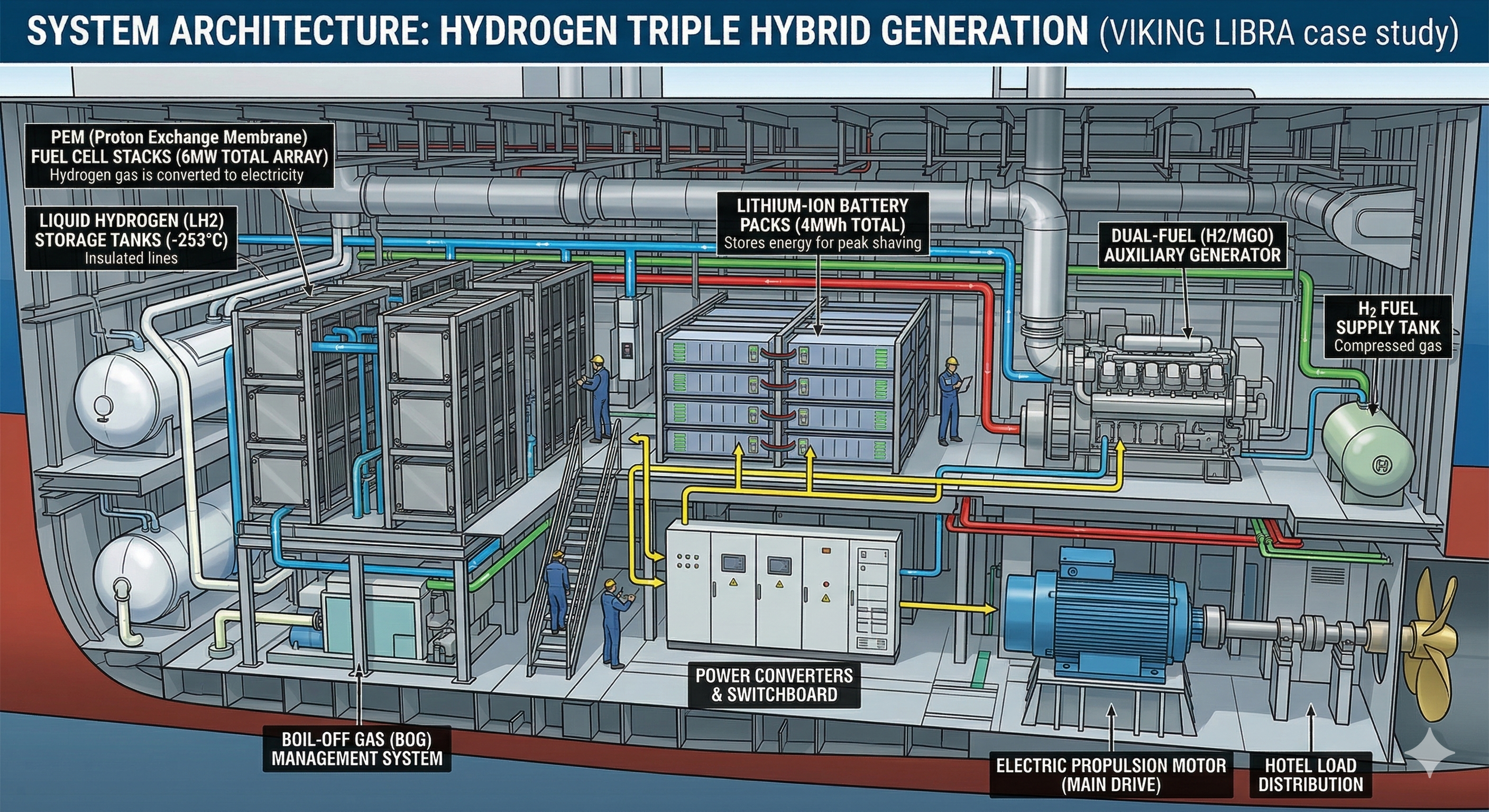
For a hydrogen-powered ship, the onboard generator is no longer a single component — it’s a power plant in its own right, and the gold standard for 2026 is the PEM (Proton Exchange Membrane) Fuel Cell array. Unlike the small kilowatt units of the early 2020s, current builds like the Viking Libra are utilizing modular 200 kW units stacked into 6 MW power plants.
Why PEM is Winning the Shipyard
- Load Following: PEM cells respond almost instantly to power fluctuations, crucial for maneuvering in tight ports.
- Modular Maintenance: Individual units can be serviced or replaced without shutting down the entire power string.
- Zero Noise & Vibration: This is a massive selling point for cruise and research vessels, significantly reducing underwater acoustic pollution.
Storage: The Compressed vs. Liquid (LH2) Debate
The hydrogen-powered ship onboard generator is only as good as the fuel supply feeding it, and the design of the hull is dictated entirely by the hydrogen state. In 2026, we are seeing a clear divergence in shipbuilding strategy — a split well illustrated by the vessels tracked in the hydrogen-powered ships database.
1. Compressed Hydrogen (CH₂)
- Pressure: 350 to 700 bar.
- Best Use: Short-sea shipping, inland waterways, and CTVs (Crew Transfer Vessels).
- The Build Challenge: Requires Type IV composite tanks. These are lightweight but bulky, often necessitating “top-deck” storage to manage potential venting and save internal cargo space.
2. Liquid Hydrogen (LH₂)
- Temperature: −253 °C.
- Best Use: Ocean-crossing bulkers and cruise ships.
- The Build Challenge: Managing “Boil-Off Gas” (BOG). Modern 2026 designs no longer “waste” this gas; it is captured and fed directly into the onboard auxiliary generators to provide “hotel load” power while the ship is at anchor.
The 2026 Hybrid Architecture: The “Triple-Threat”
Total reliance on a single fuel source is a risk few shipowners are willing to take. The most successful blueprints this year utilize a Triple Hybrid System:
- Hydrogen Fuel Cells: Providing the “Base Load” for cruising.
- Lithium-Ion Battery Banks: Acting as a buffer for “Peak Shaving” during sudden power draws (e.g., bow thruster activation).
- Dual-Fuel Backup: A small internal combustion engine capable of running on H₂-diesel blends for emergency redundancy, ensuring the vessel is never “dead in the water.”
Looking Ahead: Onboard Reforming
The most exciting development we are tracking at hydrogenshipbuilding.com is the rise of Onboard Reforming. By carrying hydrogen in a carrier like Green Methanol or Ammonia, shipbuilders can use existing liquid fuel infrastructure and extract the hydrogen “on-the-fly” before it hits the fuel cell. This solves the energy density problem while maintaining a zero-carbon profile.
Technical Insight: For a 50,000 DWT vessel, switching to LH₂ saves nearly 40% in engine room volume compared to early 2020s compressed H₂ designs, allowing for increased TEU or passenger capacity.