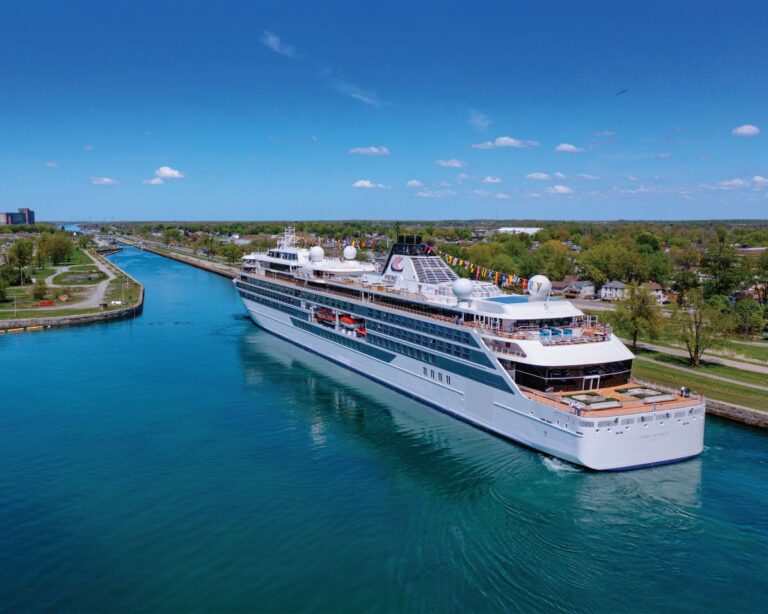
The maritime hydrogen debate has shifted. Through 2020–2024, the industry argued about whether hydrogen was viable at all. In 2026, with the Viking Libra approaching delivery and the H2 Barge No. 2 running commercial cargo on the Rhine, the question has become more specific: liquid or compressed? The answer is not universal — it depends on route length, vessel type, and where you sit on the CAPEX-versus-operating-cost curve.
⚡ TL;DR
- What: A 2026 technical and economic comparison of liquid hydrogen (LH2) and compressed gaseous hydrogen (GH2) as maritime fuels, drawing on current newbuild programmes and the updated IMO regulatory framework.
- Why it matters: Shipowners specifying hydrogen vessels today are locking in a fuel storage architecture for a 25-year asset life. The choice between LH2 and GH2 affects hull design, CAPEX, operating range, bunkering infrastructure dependency, and regulatory exposure.
- Key data: LH2 at −253°C reaches ~71 kg/m³ volumetric density; GH2 at 700 bar requires ~7× the volume of MGO. LH2 cryogenic systems carry a 30–40% CAPEX premium over Type IV cylinder installations.
- Regulatory: IMO CCC 11 has finalised interim hydrogen safety guidelines; formal approval expected at MSC 111, May 2026.
- Watch for: Whether MSC 111 produces a harmonised LH2/GH2 safety code — that single document will unlock class society type approvals for the next generation of vessels.
The Core Problem: Hydrogen’s Volumetric Challenge
Before comparing liquid and compressed storage, it helps to frame why this decision is so consequential for naval architects. Hydrogen has exceptional gravimetric energy density — approximately 120 MJ/kg, roughly three times that of marine diesel. But its volumetric energy density at ambient conditions is extremely low. Every storage solution is a compromise between the energy you can carry and the volume you sacrifice to carry it.
The table below puts the numbers in context:
| Storage Method | Conditions | Density (kg/m³) | Volume vs MGO | Vessel Type Suited |
|---|---|---|---|---|
| Marine Gas Oil (MGO) | Ambient | ~850 | 1× (reference) | All conventional |
| Compressed H₂ (350 bar) | Ambient temp | ~25 | ~15× | Inland / short-sea |
| Compressed H₂ (700 bar) | Ambient temp | ~39 | ~9× | Coastal / CTV |
| Liquid H₂ (LH2) | −253°C | ~71 | ~5× | Deep-sea / cruise |
| Liquid NH₃ (ammonia carrier) | −33°C | ~600 | ~1.6× | Ocean-going tankers |
As a naval architect, these ratios translate directly into hull decisions: tank placement, buoyancy calculation, structural reinforcement, and — critically — what you sacrifice in cargo capacity or passenger space. The 5× volume penalty of LH2 versus MGO is significant, but workable for purpose-designed vessels. The 9–15× penalty of compressed systems is generally only viable for short routes where fuel volumes are small relative to total hull volume.
Compressed Hydrogen (GH2): The Case for Simplicity
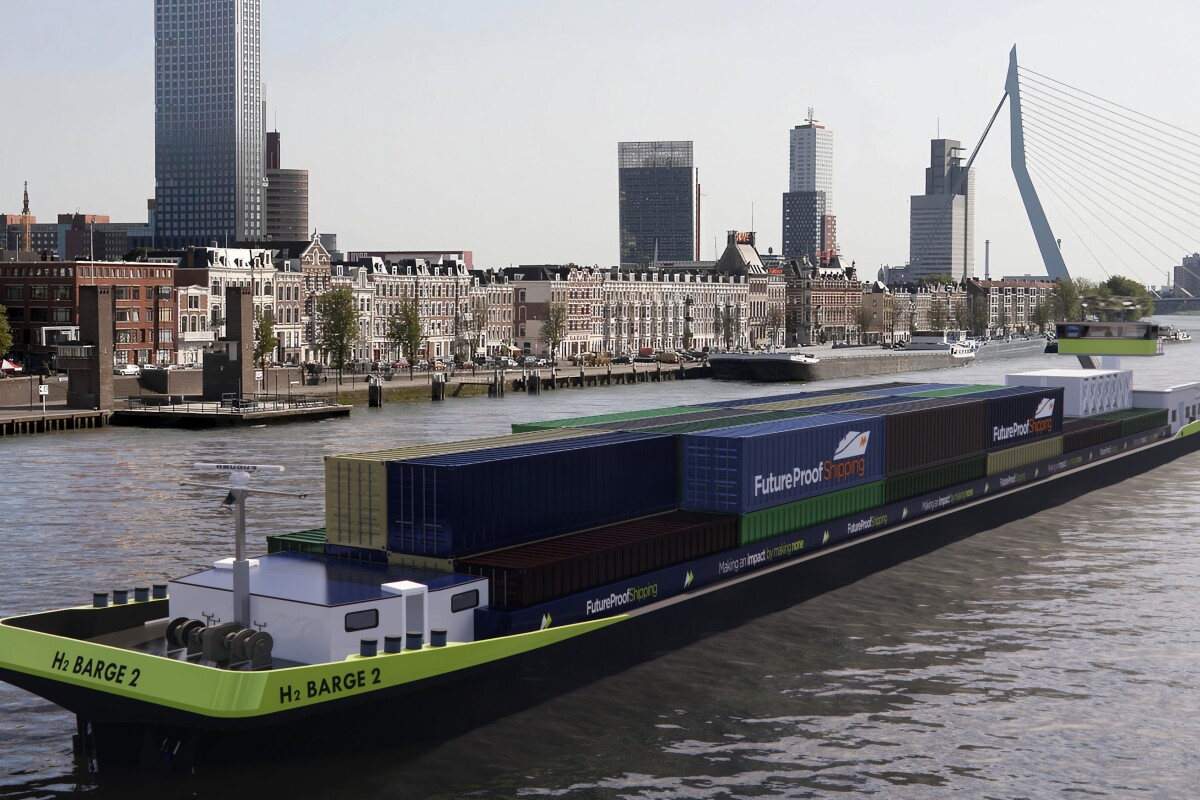
The H2 Barge No. 2, operated by Future Proof Shipping on the Rotterdam–Duisburg route, is the most compelling commercial argument for compressed hydrogen storage. The vessel uses Type IV composite cylinders at 350 bar — well-proven technology borrowed from the heavy-duty trucking sector — and has demonstrated reliable year-round operations on a fixed short route.
Why GH2 works for inland and coastal routes
- No cryogenics: Type IV cylinders operate at ambient temperature. No insulation, no vacuum systems, no boil-off management. The mechanical simplicity reduces maintenance complexity and eliminates the need for specialist cryogenic engineers aboard.
- Mature supply chain: 350 bar hydrogen cylinders are manufactured at scale for road transport. Economies of scale from the trucking sector are directly transferable to maritime, reducing procurement cost.
- Bunkering compatibility: Compressed hydrogen bunkering is operationally straightforward and compatible with existing industrial gas infrastructure at ports. No cryogenic terminals required.
- Lower CAPEX entry point: For a 50–200 km route with predictable port calls, a compressed hydrogen system can be engineered for the specific voyage range without oversizing tanks.
The hard ceiling
The physics are unforgiving beyond a certain range. At 700 bar — the practical upper limit for current Type IV cylinders — compressed hydrogen still requires roughly 9 times the tank volume of equivalent MGO. For a vessel carrying significant cargo over routes longer than ~400 km, the tank volume required begins to eat into cargo capacity to an unacceptable degree.
Naval architect’s note: On the H2 Barge No. 2, the compressed hydrogen tanks are visible on deck — a deliberate design choice that avoids losing internal cargo hold volume. This works on a flat-bottomed river barge where deck height clearance is the constraint, not internal volume. On an ocean-going vessel, deck-mounted cylinders create stability, windage, and structural challenges that fundamentally change the design calculus.
Liquid Hydrogen (LH2): The Deep-Sea Imperative
The Viking Libra — scheduled for delivery at Fincantieri’s Ancona shipyard in late 2026 — represents the state of the art in LH2 maritime design. It is the first large passenger vessel designed from keel up for liquid hydrogen propulsion, using a 6 MW PEM fuel cell installation supplied by Isotta Fraschini Motori.
The LH2 engineering proposition
Liquid hydrogen at −253°C achieves approximately 71 kg/m³ — roughly twice the volumetric density of 700 bar compressed gas, and the only storage state that makes multi-day deep-sea voyages feasible without catastrophic impact on cargo capacity.
The critical enabling technology in 2026 is boil-off gas (BOG) management. Early LH2 systems vented BOG as a loss — a waste of fuel and a safety concern. Modern newbuilds route BOG directly to the fuel cell system for conversion to electricity:
- Daily boil-off rate: Below 0.5% on current-generation vacuum-insulated tanks
- BOG utilisation: Fed into PEM fuel cell arrays for hotel load and HVAC
- Net result: What was a loss becomes a managed fuel stream, improving overall energy efficiency
The CAPEX premium
LH2 systems carry a 30–40% CAPEX premium over comparable compressed hydrogen installations, driven by:
- Vacuum-insulated cryogenic tanks (significantly more complex than Type IV cylinders)
- Cryogenic transfer systems and BOG management equipment
- Additional structural reinforcement for cryogenic temperature cycling
- Specialist commissioning and certification requirements
For a deep-sea vessel, this premium is typically justified by the range capability and cargo capacity retention that LH2 enables. For a short-sea vessel, it is harder to justify against a simpler GH2 system.
Regulatory Framework: Where IMO Stands in 2026
The regulatory picture has clarified materially in the past 12 months.
As of January 1, 2026, a package of new IMO regulations entered force covering container reporting and Ro-Ro fire safety. More significantly for the hydrogen sector, the IMO CCC 11 sub-committee finalised interim safety guidelines for ships using hydrogen as fuel — covering both liquid and compressed storage architectures.
| Milestone | Status | Date |
|---|---|---|
| IMO CCC 10 — interim guidelines draft | Completed | 2024 |
| IMO CCC 11 — guidelines finalised | ✅ Done | September 2025 |
| MSC 111 — formal approval expected | Pending | May 2026 |
| Full IGF Code hydrogen annex | In development | 2027–2028 |
Formal approval at MSC 111 in May 2026 will provide the standardised safety rulebook that class societies need to issue type approvals against a consistent regulatory baseline. Until that point, hydrogen vessel designs have been approved under interim or case-by-case frameworks — workable, but slower and more expensive than a harmonised code.
From a practical standpoint: any vessel being designed today for delivery in 2028 or later should be engineered to the CCC 11 interim guidelines, with flagging authority and class society engaged early on the pathway to full MSC 111 compliance.
The 2026 Decision Matrix
The LH2 vs GH2 choice is not a universal answer — it depends on the specific vessel and route:
| Parameter | GH2 Favoured | LH2 Favoured |
|---|---|---|
| Route length | < 400 km | > 400 km |
| Vessel type | Inland barge, CTV, ferry | Cruise, bulker, RoRo, container feeder |
| Bunkering frequency | Daily or every port call | Every 3–7 days |
| CAPEX sensitivity | High (minimise first cost) | Lower (total lifecycle focus) |
| Cargo capacity priority | Moderate (short routes) | High (long haul) |
| Crew cryogenic expertise | Not required | Required |
| Port infrastructure | Standard industrial gas | Cryogenic terminal needed |
Why This Matters for the Shipbuilding Industry
The vessels entering service in 2026–2028 will define the template for the next generation of hydrogen shipping. The Viking Libra will produce the first real-world dataset on LH2 cruise ship operations — BOG management performance, fuel cell endurance, bunkering time at scale. The H2 Barge No. 2 is doing the same for GH2 inland cargo.
Both datasets matter. The maritime industry needs proof points across the full spectrum of vessel types, not just prestige projects. When MSC 111 delivers a harmonised regulatory framework in May 2026, and when the Viking Libra’s first operational season produces real efficiency numbers, the arguments for and against each storage technology will be grounded in operational evidence rather than engineering theory.
For shipowners specifying vessels today: the storage decision is a 25-year commitment. Engage with classification societies and naval architects early, model both options against your specific route and cargo profile, and track the MSC 111 outcome carefully — it will determine your type approval pathway.
Browse the hydrogen-powered ships database to see how current newbuilds have resolved this choice, and visit the technology overview for a deeper look at fuel cell architectures.
Challenges and Open Questions
- LH2 bunkering network: Outside Rotterdam, Norway, and a handful of Japanese ports, LH2 bunkering infrastructure does not exist. Vessels designed for LH2 today are dependent on infrastructure that is not yet built.
- Type IV cylinder cost trajectory: GH2 economics depend partly on continued cost reduction in composite cylinder manufacturing. If the trucking sector’s hydrogen transition stalls, this learning curve flattens.
- BOG management at small scale: The Viking Libra’s BOG-to-fuel-cell integration works at 6 MW. For smaller vessels with 200–500 kW fuel cell installations, the engineering and cost overhead of a full BOG recovery system may not be justifiable.
- MSC 111 scope: The interim guidelines cover the fundamentals, but the full IGF Code hydrogen annex — expected 2027–2028 — will determine requirements for larger LH2 installations. Designs being finalised now are working with incomplete regulatory certainty.
- Ammonia as the dark horse: For very long ocean routes, liquid ammonia — with its ~1.6× volume penalty versus MGO — may ultimately prove more practical than LH2. Several projects in the ships database are pursuing ammonia-to-hydrogen reforming as an alternative pathway that sidesteps the cryogenic challenge entirely.
Sources
- Viking Libra — hydrogenshipbuilding.com ship profile
- H2 Barge No. 2 — hydrogenshipbuilding.com ship profile
- Future Proof Shipping — H2 Barge commercial operations
- IMO — Regulations in force from 1 January 2026
- DNV — IMO CCC 11 finalises interim guidelines for hydrogen as fuel (September 2025)
- Isotta Fraschini Motori — 6 MW PEM fuel cell module for Viking Libra