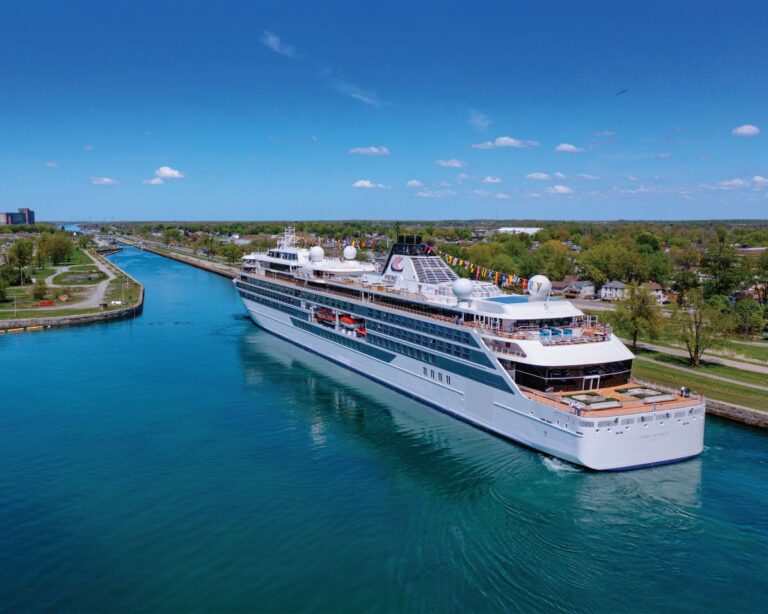
The Viking Libra has been launched at Fincantieri’s Ancona shipyard — crossing the threshold from engineering drawings to a floating hull. For those of us who have been tracking this project since its announcement, the launch marks the moment when the most technically ambitious hydrogen maritime programme of this decade becomes real steel in the water. This post sets aside the press release language and looks at what the Viking Libra actually represents as an engineering object: its powering decisions, fuel system architecture, and the design trade-offs that define it.
⚡ TL;DR
- What: Viking Libra — 238 m LOA ocean cruise ship, launched at Fincantieri Ancona, designed for liquid hydrogen propulsion via a 6.2 MW PowerCell PEM fuel cell system.
- Why it matters: First ocean-going cruise ship to use LH2 as primary fuel. Generates the maritime industry's first dataset on LH2 operations at cruise ship scale — bunkering, boil-off, fuel cell endurance on multi-day deep-sea voyages.
- Key innovation: Swappable ISO-standard LH2 container system (Chart Industries) — treats liquid hydrogen as a modular fuel cassette rather than a fixed shipboard installation.
- Timeline: Launched 2026; delivery and sea trials scheduled for late 2026; commercial service 2027.
- Watch for: Real bunkering time at Rotterdam. The operational tempo of LH2 transfer at cruise ship scale is the unknown that will define whether this model can be replicated fleet-wide.
The Ship in Numbers
Before getting into the engineering decisions, the basic specification:
| Parameter | Viking Libra |
|---|---|
| LOA | 238 m |
| Ship type | Ocean cruise vessel |
| Owner / Operator | Viking Cruises |
| Builder | Fincantieri, Ancona |
| Classification | Lloyd’s Register |
| Flag | Norway |
| Primary fuel | Liquid Hydrogen (LH2) |
| Propulsion type | PEM Fuel Cell – electric drive |
| Installed FC power | 6.2 MW |
| Fuel cell supplier | PowerCell Sweden (MS-225 units) |
| LH2 system | Swappable containers (Chart Industries) |
| Sister vessels | 1 (identical sistership on order) |
| Delivery | Scheduled late 2026 |
At 238 metres, the Viking Libra is not a small vessel. For context, that is longer than two football pitches — a scale that makes the engineering challenge immediately clear. Designing hydrogen propulsion for a 50-passenger river boat is a fundamentally different problem from doing it for an ocean cruise ship carrying hundreds of guests over multi-day itineraries with no opportunity to bunker mid-voyage.
Powering Architecture: The 6.2 MW Fuel Cell System
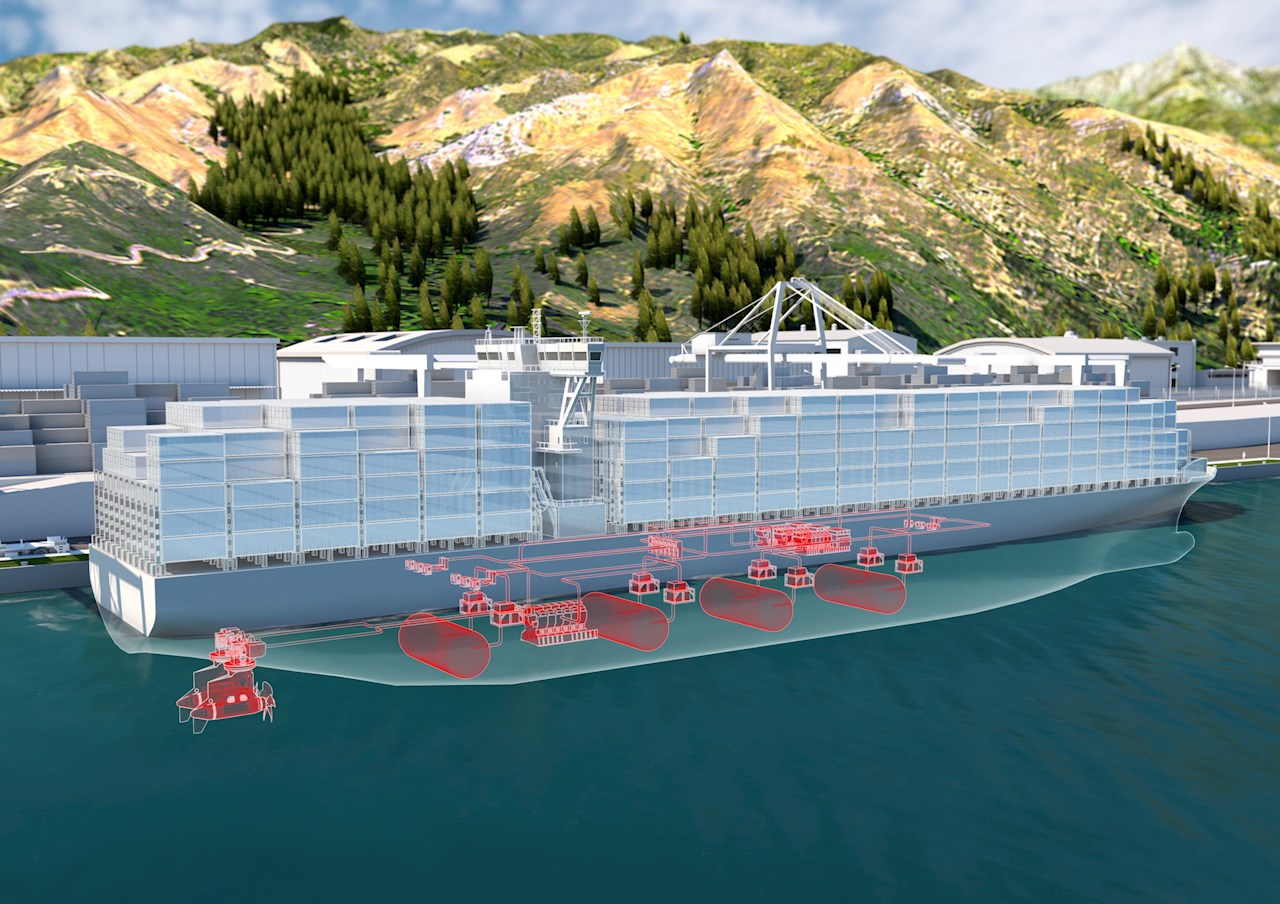
The propulsion heart of the Viking Libra is a 6.2 MW PEM fuel cell installation built on PowerCell Sweden’s Marine System 225 (MS-225) platform — the same system we covered in our recent PowerCell MS-500 analysis. At 225 kW per unit, achieving 6.2 MW requires approximately 27–28 individual MS-225 stacks, organised into parallel arrays with shared hydrogen supply manifolds, cooling circuits, and power conditioning.
Why fuel cells, not hydrogen combustion?
From a naval architect’s perspective, the choice of PEM fuel cells over internal combustion engines running on hydrogen is not self-evident at this scale — both technologies exist. The case for fuel cells on the Viking Libra rests on three factors:
- Hotel load efficiency: A cruise ship’s electrical demand is enormous — HVAC, lighting, galleys, entertainment systems, pumps. A fuel cell produces DC electricity directly; an ICE produces shaft torque that must be converted. For a vessel where electrical load is dominant and propulsion shaft power is secondary, fuel cells are the more efficient path.
- Zero NOₓ and particulate emissions: Cruise ships operating in European waters face increasing port authority pressure on air quality. A fuel cell stack produces only water vapour. An H₂ combustion engine, while significantly cleaner than HFO, still generates NOₓ under high-temperature combustion conditions.
- Vibration and noise: PEM fuel cells have no moving parts in the stack itself. For a passenger vessel, the acoustic and vibration profile of fuel cells is substantially better than any reciprocating machinery — a meaningful quality-of-life factor for guests and crew.
Boil-off gas as a design resource
At cruise ship scale, boil-off gas (BOG) management becomes a first-order design consideration rather than a nuisance. LH2 at −253°C inevitably warms during storage, generating gaseous hydrogen that must be handled. On the Viking Libra, BOG is not vented — it is routed directly to the fuel cell arrays as a priority fuel stream, offsetting drawn-down from the primary LH2 supply.
With modern vacuum-insulated LH2 tanks achieving daily boil-off rates below 0.5%, a vessel with several hundred tonnes of LH2 aboard generates a continuous and manageable BOG flow. For a cruise ship with a large, near-constant hotel electrical load, this flow can be sized to cover a meaningful fraction of auxiliary power demand — turning an unavoidable thermodynamic loss into a productive fuel stream.
The Swappable LH2 Container System: The Real Innovation
The Viking Libra’s most discussed engineering feature is its swappable liquid hydrogen container system, developed in collaboration with Chart Industries. This deserves more careful analysis than it typically receives.
Conventional LH2 storage on a ship is a fixed installation: tanks are built into the hull, insulation is permanent, and the hydrogen supply chain terminates at a shore-side transfer arm connected to the ship. This is how the MF Hydra ferry works and how most LH2 vessel designs are configured.
The Viking Libra uses a different model: ISO-standard cryogenic containers that can be loaded and unloaded as cargo units. Each container holds a defined LH2 quantity; the ship takes on fuel by swapping depleted containers for full ones, in the same operational choreography as a container ship loading boxes.
What this solves — and what it doesn’t
Advantages:
- Bunkering speed: Replacing a container takes minutes, not hours. Conventional LH2 transfer by cryogenic hose is slow due to the insulation requirements, cool-down time, and connection/disconnection procedures. Swappable containers sidestep this bottleneck entirely.
- Supply chain flexibility: A full LH2 container can be filled at a centralised liquefaction facility and transported to any port with container-handling equipment. The ship is not dependent on a purpose-built cryogenic bunkering terminal at every port of call.
- Scalability: The same container standard could serve multiple vessels and applications, building toward a broader LH2 logistics ecosystem rather than bespoke ship-specific infrastructure.
Constraints:
- Container insulation mass: A double-walled, vacuum-insulated cryogenic container is significantly heavier per unit of LH2 than a fixed shipboard tank. The structural overhead of the vacuum jacket is constant regardless of container size; fixed large-volume tanks achieve better insulation efficiency at scale. For a weight-sensitive vessel, this is a real trade-off.
- Interface standardisation: The swappable concept only delivers its full logistics benefit if the container standard is adopted industry-wide. A Viking Cruises-specific container format that no other operator uses does not build the supply chain infrastructure that hydrogen shipping needs.
- Port handling equipment: LH2 containers must be handled with cryogenic-rated lifting gear. Not every container terminal has this; building toward a network of LH2-capable terminals requires investment and coordination.
As a naval architect, I regard the swappable container system as a genuinely interesting engineering approach to the bunkering problem — but its long-term significance depends on standardisation, which is a commercial and political challenge as much as a technical one.
Classification and Regulatory Pathway
The Viking Libra is classified by Lloyd’s Register — the same society that issued the type approval for the PowerCell MS-225 fuel cell system. This is not coincidental. Having the fuel cell supplier’s type approval and the vessel classification with the same society streamlines the technical integration review: LR’s rules for the fuel cell system and their rules for the vessel’s fuel gas systems are developed within a single regulatory framework.
The classification process for an LH2 cruise ship at this scale is, to put it plainly, unprecedented. LR and Fincantieri have been working through a design approval process that has involved:
- Development of risk assessments for LH2 storage adjacent to passenger spaces
- Leak detection system requirements specific to cryogenic hydrogen (different from LNG, for which existing rules are better developed)
- Emergency shutdown procedures for the fuel cell arrays
- Ventilation requirements for machinery spaces handling hydrogen
- BOG management system approval
The IMO CCC 11 interim guidelines for hydrogen as fuel — finalised in September 2025 and pending formal adoption at MSC 111 in May 2026 — provide the regulatory framework within which LR is operating. The Viking Libra will be one of the first vessels delivered under this framework, meaning its classification file will effectively become the reference case for future LH2 cruise ship approvals.
Comparison: Viking Libra vs. Other Hydrogen Vessels in Service
To understand where the Viking Libra sits in the broader fleet picture, it helps to compare it with the hydrogen vessels currently tracked in the hydrogenshipbuilding.com database:
| Vessel | Type | LH2/GH2 | FC Power | LOA | Status |
|---|---|---|---|---|---|
| Viking Libra | Ocean cruise | LH2 | 6.2 MW | 238 m | Launched 2026 |
| MF Hydra | Ferry | LH2 | 0.82 MW | 82.4 m | In service (2021) |
| SeaShuttle | Container feeder | LH2 | ~2 MW | ~130 m | Under construction |
| H2 Barge No. 2 | River cargo | GH2 | 0.4 MW | 110 m | In service |
| Prince Madog | Research | GH2 | 0.32 MW | 57.5 m | In service |
The gap between the MF Hydra (0.82 MW, 82 m, ferry) and the Viking Libra (6.2 MW, 238 m, ocean cruise ship) is stark. There is no intermediate reference point for LH2 operation at cruise ship scale. The Viking Libra is not an incremental step — it is a full order-of-magnitude jump in installed fuel cell power and a near tripling in vessel length.
That gap is both the project’s significance and its risk.
Why This Launch Matters
The Viking Libra’s launch at Fincantieri Ancona is a shipbuilding milestone in the straightforward sense: a keel has become a hull, a concept has become a vessel. But its real significance is operational and commercial.
When the Viking Libra enters service in 2027, it will generate the maritime industry’s first dataset on LH2 operations at ocean cruise ship scale: bunkering time using swappable containers, actual boil-off rates on multi-day voyages, fuel cell array endurance under sustained hotel and propulsion load, and — critically — total operating cost versus a comparable conventionally-fuelled vessel.
That dataset will be worth more to the industry than any modelling study. It will answer the questions that prospective hydrogen cruise ship operators cannot currently answer from first principles: Is swappable LH2 bunkering fast enough for a cruise itinerary? What does fuel cell maintenance actually cost at 6 MW scale? How does LH2 supply chain reliability affect voyage planning?
Viking Cruises has a sistership on order. Whether that sistership leads to a broader programme — and whether other cruise operators follow — will depend almost entirely on what the Viking Libra’s first two years of operation show.
Challenges and Open Questions
- LH2 supply at Viking’s ports of call: Viking’s itineraries cover Northern Europe, the Norwegian fjords, and potentially longer routes. The LH2 supply chain that supports a Rotterdam bunkering call does not yet exist in Tromsø or Reykjavik. The swappable container system helps, but only if containers can be sourced and repositioned reliably.
- Fuel cell array maintenance at sea: 27+ MS-225 units operating continuously on an ocean voyage require maintenance access and spare parts availability far from any shore facility. The maintenance regime for a multi-megawatt PEM array on a cruise ship has not been proven in service.
- Passenger LH2 perception: Cruise passengers are not a captive technical audience. Public perception of liquid hydrogen storage aboard a passenger vessel — whatever the objective safety case — is a commercial variable that Viking Cruises will need to manage carefully in its marketing and safety communications.
- Insurance and underwriting: LH2 vessels at this scale are at the frontier of what marine insurers have underwritten. Premium levels and coverage terms for the Viking Libra will set a market reference that either supports or constrains future LH2 cruise ship programmes.
- MSC 111 alignment: If the May 2026 MSC 111 session introduces requirements that diverge materially from the interim guidelines the Viking Libra was designed to, a mid-design or post-delivery compliance review could be required. This risk is real but manageable given LR’s close involvement throughout.
Sources
- Viking Cruises — Viking Libra programme
- Fincantieri — Viking Libra construction and launch
- PowerCell Sweden — Marine System 225 type approval, Lloyd’s Register
- Chart Industries — LH2 marine container systems
- Lloyd’s Register — hydrogen fuel rules and type approvals
- IMO — CCC 11 interim guidelines for hydrogen as fuel (September 2025)