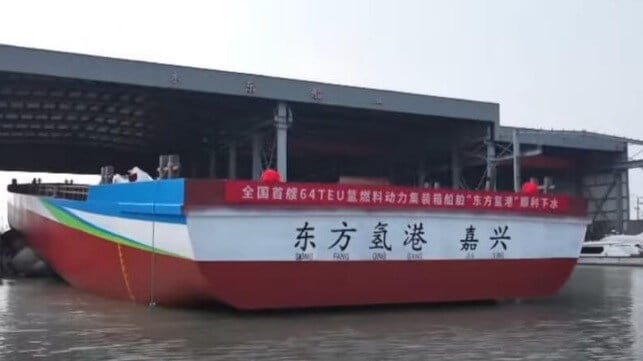
China’s hydrogen push is moving beyond high-profile ocean-going prototypes and into the workhorses of the country’s inland waterway network. In March 2025, the Dong Fang Qing Gang (东方氢港 — “Oriental Hydrogen Port”) completed an 83.7 km trial voyage on the Zhejiang inland waterway system, becoming the first hydrogen fuel cell-powered container ship to finish a long-distance voyage trial in China. For those of us tracking how hydrogen propulsion scales into commercial freight operations, this is a project worth examining closely.
⚡ TL;DR
- What: China's first hydrogen fuel cell inland container ship completed an 83.7 km trial from Zhapu Port (Jiaxing) to Xiasha Port (Hangzhou).
- Why it matters: First long-distance voyage trial for a hydrogen container vessel in China; opens a dedicated green freight corridor in the Yangtze River Delta.
- Key data: 480 kW total fuel cell output, 550 kg onboard H₂, 64 TEU, design range 380 km.
- Timeline: Launched December 2024, trial voyage March 2025.
- Watch for: Commercial entry on the 120 km Zhapu–Xiasha route and whether the hydrogen supply chain can support regular operations.
The Vessel: Specifications and Design
The Dong Fang Qing Gang was built by Zhejiang Hedong Shipbuilding Technology and is operated by Zhejiang Hydrogen Energy Industry Development, a company linked to the Zhapu Economic Development Zone in Jiaxing. The fuel cell systems were supplied by Sino-Synergy Hydrogen Energy Technology (Jiaxing), using their SynWave C240 marine fuel cell modules.
From a naval architect’s perspective, the key challenge in designing an inland river container ship around hydrogen fuel cells is the volume budget. Compressed or liquid hydrogen storage takes up significantly more space per unit energy than conventional bunker fuel, and on a 64-metre river vessel, every cubic metre counts.
| Parameter | Value |
|---|---|
| Length overall | 64.5 m |
| Displacement | ~2,000 t |
| Cargo capacity | 64 TEU (~1,450 t) |
| Propulsion | Hydrogen fuel cell + lithium battery hybrid |
| Fuel cell output | 2 × 240 kW (480 kW total) |
| Hydrogen storage | 550 kg (onboard, largest on any Chinese vessel at time of launch) |
| Design range | 380 km |
| Trial distance | 83.7 km |
| Estimated trial speed | ~5.7 knots (10.5 km/h average) |
The 480 kW combined fuel cell output is modest — roughly equivalent to two medium-sized marine gensets — which reflects the operational profile of inland river freight: relatively low speeds, predictable routes, and no sea-state demands on the hull. The hybrid battery arrangement allows peak-shaving during manoeuvring and port entry, extending fuel cell stack life.
The Trial Voyage
On 17 March 2025, the vessel departed Zhapu Port in Jiaxing and completed the 83.7 km passage to Xiasha Port in Hangzhou over approximately eight hours. The route runs through the Yangtze River Delta waterway system in Zhejiang Province — relatively sheltered, well-charted, and commercially active.
The trial was not a range test. At 83.7 km against a design range of 380 km, the vessel used roughly 22% of its hydrogen capacity, leaving significant margin for analysis and contingency.
From a ship operator’s standpoint, this is sensible trial management: you prove the propulsion system under load conditions without pushing the energy margins in unfamiliar territory. What the trial does confirm is that the fuel cell plant, power management system, and drive train perform together under real transit conditions.
Fuel Cell Architecture
The SynWave C240 modules from Sino-Synergy are PEM (Proton Exchange Membrane) fuel cells, the dominant technology choice for marine hydrogen applications due to their fast dynamic response and relatively compact form factor. Two modules in a 240 kW + 240 kW configuration provide redundancy — an important classification requirement for commercial vessels.
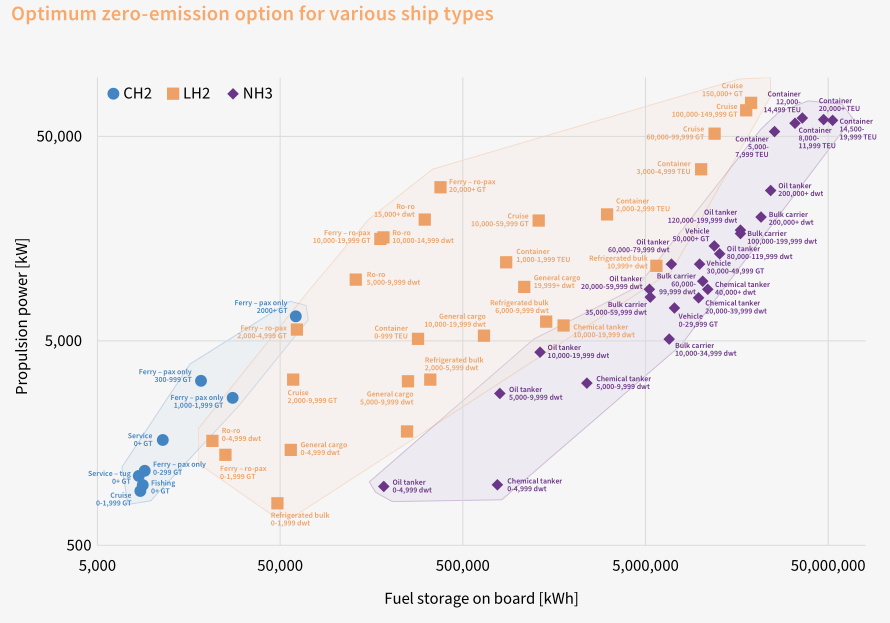
The 550 kg hydrogen storage figure is notable. For context:
| Fuel | Specific energy (MJ/kg) | 550 kg equivalent energy |
|---|---|---|
| Hydrogen (compressed) | 120 MJ/kg | 66,000 MJ |
| HFO | 42.7 MJ/kg | ~620 kg equivalent |
| LNG | 50 MJ/kg | ~1,320 kg equivalent |
On a per-voyage basis, the energy density disadvantage of hydrogen is partially offset by the high efficiency of PEM fuel cells (~50–60% LHV) compared to diesel engines (~40–45% BTE). The net result is that a hydrogen-electric drivetrain requires roughly 2–2.5× the stored fuel mass compared to diesel for the same transport work — a figure that designers must close through tank optimisation or operational frequency of refuelling.
Commercial Route and Environmental Case
The planned commercial service will run the Zhapu–Xiasha route (120 km), serving sea-river intermodal logistics in the Yangtze River Delta. The project documentation cites an estimated annual CO₂ reduction of ~700 tonnes compared to a conventionally-powered equivalent vessel.
For a 64 TEU inland feeder operating on a 120 km route, that figure is plausible. A comparable diesel vessel burning around 8–12 tonnes of fuel per day would emit approximately 25–37 tonnes of CO₂ daily; over 250 operating days, that’s 6,000–9,000 tonnes. The 700-tonne reduction figure likely reflects a partial-year baseline or a lower utilisation scenario — it may understate the full-lifecycle benefit once the route is running at full commercial frequency.
The key variable, as always with green hydrogen shipping, is the carbon intensity of the hydrogen supply itself. The environmental case only holds if the 550 kg of hydrogen is produced from renewable or low-carbon sources. The Zhapu Economic Development Zone has positioned this as part of China’s national hydrogen energy strategy, with the implication of green hydrogen supply — but the well-to-wake emissions trail remains the crucial metric.
Why This Matters
Inland waterways are an often-overlooked frontier for maritime decarbonisation. River and canal freight in the Yangtze River Delta carries enormous volumes of cargo at relatively low speeds — exactly the operating profile where hydrogen fuel cells are competitive: low dynamic power demand, predictable range requirements, and port-adjacent refuelling infrastructure.
For those of us following the hydrogen-powered ships database, the Dong Fang Qing Gang represents a meaningful scaling step. Most hydrogen vessel projects to date involve small passenger ferries or research craft. A 64 TEU container ship with 550 kg of hydrogen storage and a 380 km range operates in a genuinely commercial freight category.
China has been building hydrogen maritime capability systematically: type approval frameworks, fuel cell supplier development, and now operational trial data. The Sino-Synergy SynWave C240 modules used here are a commercially available product — not a one-off research system — which matters for replication and fleet scaling.
Challenges and Open Questions
- Hydrogen supply chain: Who supplies the 550 kg per voyage, at what purity, and at what carbon intensity? Green hydrogen at commercial scale in Zhejiang remains nascent.
- Refuelling infrastructure: Zhapu and Xiasha ports will need dedicated hydrogen bunkering facilities. Port-side hydrogen handling regulations in China are still evolving.
- Stack longevity under commercial duty: PEM stacks degrade over time; inland freight vessels are expected to operate 250+ days per year. What is the replacement cycle and cost for the SynWave C240 modules?
- Cost parity: Hydrogen remains significantly more expensive per unit energy than HFO or LNG for Chinese operators. The commercial case likely depends on subsidy or carbon credit frameworks.
- Classification and survey cycle: Which classification society surveyed the vessel, and under what rules? China Classification Society (CCS) has guidelines for hydrogen fuel cell vessels, but the survey regime for commercial operations is still maturing.
Sources
- Splash247 — China’s first hydrogen-powered inland boxship completes long-distance trial
- Manifold Times — China’s first hydrogen fuel cell-powered inland container ship completes voyage trial
- Maritime Executive — China Launches Hydrogen-Powered Inland Container Vessel
- WorldCargo News — China unveils first hydrogen-powered container ship
- Global Times — China launches hydrogen-powered container ship, capable of sailing 380 kilometers