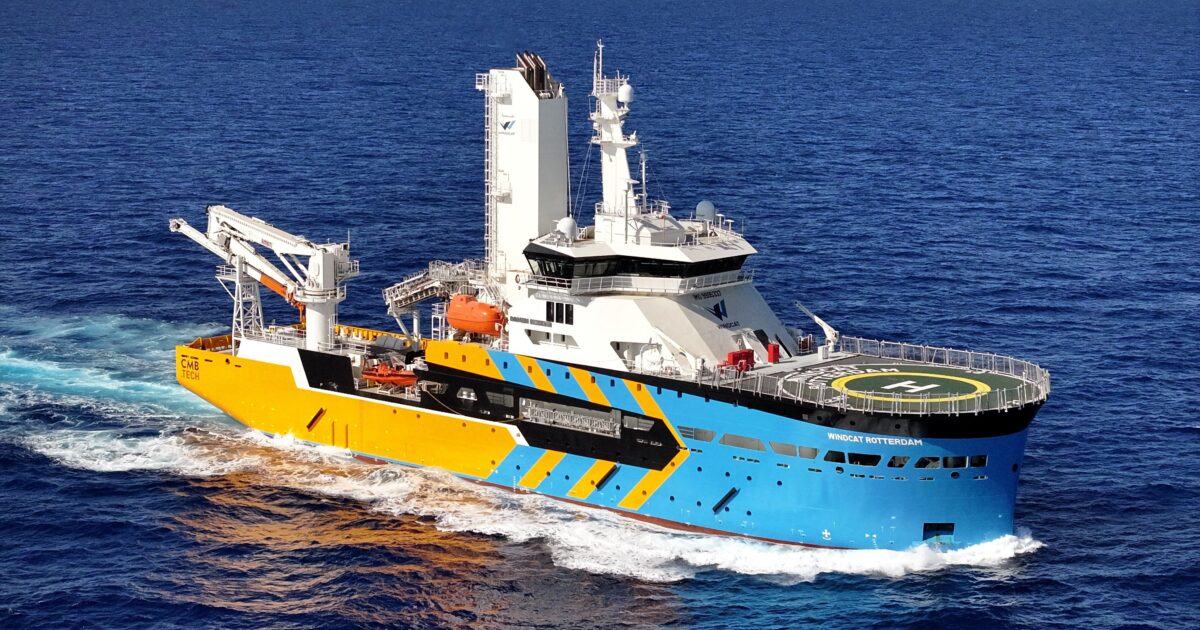
The Windcat Amsterdam arrived in European waters on 25 March 2026 — marking the first time a vessel from Damen’s Elevation Series has operated on this side of the globe. Built at Ha Long Shipyard in Vietnam and delivered in December 2025, the 90-metre CSOV is the second of six vessels ordered by Windcat, a Compagnie Maritime Belge (CMB.TECH) subsidiary. What sets this series apart from conventional offshore wind support tonnage is a pre-installed CMB.TECH hydrogen dual-fuel genset — fitted, but awaiting final regulatory approval before it can burn hydrogen. For those of us tracking how hydrogen propulsion enters commercial offshore operations, this vessel is worth examining closely.
⚡ TL;DR
- What: Windcat Amsterdam, second Damen Elevation Series CSOV, arrived in Europe on 25 March 2026.
- Why it matters: Carries pre-installed CMB.TECH hydrogen dual-fuel genset — the first CSOV class designed from the keel up for hydrogen operation at scale.
- Key data: 89.4 m LOA, 120 personnel, 1,700 kW Corvus battery pack, hydrogen genset pre-installed pending regulatory approval.
- Timeline: Six-vessel series; vessels #4 and #5 due Q2/Q3 2026.
- Watch for: Regulatory approval for hydrogen genset activation, and named offshore wind charter contracts.
The Elevation Series: Design Philosophy
Damen’s Elevation Series (SOV-9020) was conceived specifically for the next generation of offshore wind installation and maintenance work — larger turbines, longer campaigns, higher crew numbers, and tighter sustainability requirements from charterers. The name is deliberate: it refers both to the vessel’s ability to reach elevated turbine access points and to raising the standard of what a CSOV can deliver.
From a naval architect’s perspective, the hull form is noteworthy. Damen opted for an optimised V-shaped hull that prioritises seakeeping and fuel efficiency over raw cargo volume — the right trade-off for a vessel spending weeks on station in the North Sea. The single integrated power network architecture means all generation and storage assets (engines, generators, batteries) share one bus, enabling intelligent energy dispatch across the propulsion and hotel loads.
| Parameter | Value |
|---|---|
| Length overall | 89.4 m |
| Moulded beam | 19.7 m |
| Summer draught | 5.4 m |
| Accommodation | 120 personnel (90 cabins) |
| Weather deck cargo area | 550 m² |
| Warehouse area | 500 m² |
| Max payload | 400 t |
| Design speed | 12.5 knots |
| Endurance | Up to 30 days offshore |
| Classification | DNV |
| Flag | Belgian |
Propulsion and Energy System
The power plant is a hybrid diesel–battery-electric arrangement built around ABC dual-fuel main engines — one 2,390 kW unit and two 1,672 kW units — paired with MAN generators. The Corvus Energy 1,700 kW battery pack handles peak-shaving during dynamic positioning and manoeuvring, and enables zero-emission port operations.
Four Schottel SRP 430 azimuthing thrusters (1,780 kW each) provide the DP capability. The vessel holds a DNV DP class notation appropriate for close-approach work at wind turbine foundations.
The integrated energy network is designed with future expansion in mind: the vessel has dedicated deck connections for shore power, offshore charging, additional battery capacity, or supplementary green fuel generation systems.
This future-proofing is not cosmetic. The offshore wind sector is under increasing pressure from European charterers — particularly oil majors and utilities with net-zero targets — to demonstrate well-to-wake emissions reduction. A CSOV that can credibly upgrade its fuel system mid-life is commercially valuable.
The Hydrogen System: Installed but Not Yet Active
This is the aspect that most interests us at hydrogenshipbuilding.com. CMB.TECH — the clean energy technology arm of the same CMB group that owns Windcat — has supplied a dual-fuel hydrogen genset for the Elevation Series. The system allows the auxiliary generator to run on a hydrogen/diesel blend, with hydrogen contributing to a measurable reduction in NOₓ and CO₂ emissions from the hotel and standby power loads.
The technology is not untested. CMB.TECH has been running dual-fuel hydrogen engines on Windcat’s crew transfer vessel (CTV) fleet for several years, progressively scaling up experience and confidence in the system. The CSOV application represents a significant step up in vessel size and operational complexity.
The catch: the hydrogen genset is pre-installed but not yet operationally active on either delivered vessel, pending final regulatory approvals. This is a familiar pattern in maritime hydrogen deployment — the hardware leads the regulatory framework. Until class and flag state sign off on the operating procedures, the system sits dormant.
Deck Equipment and Turbine Access
Two pieces of equipment stand out from a technical standpoint:
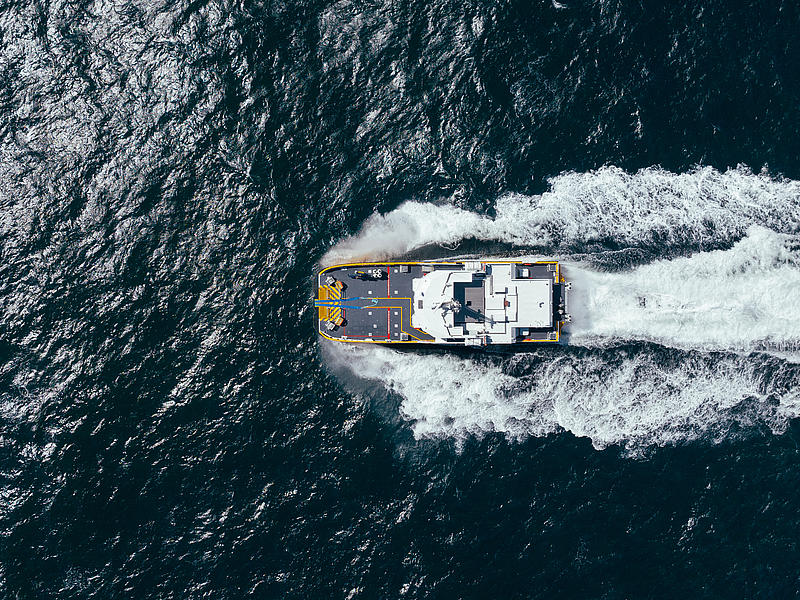
SMST 3D motion-compensated gangway with a vertical range of up to 30 metres above the water surface — the largest vertical range currently available on the market. This is a direct response to the increasing hub heights of next-generation offshore wind turbines (15+ MW class), which require access at heights that earlier-generation gangway systems cannot safely reach in open sea conditions.
SMST 10-tonne 3D motion-compensated crane — described at launch as the world’s first crane of this specification. The combination of 10-tonne SWL and full 3D motion compensation allows heavy component transfers between vessel and turbine in sea states that would previously have required a flat weather window.
Both systems are critical for the economics of offshore wind O&M: every additional hour of gangway access per year translates directly into reduced helicopter lift requirements and faster turbine availability restoration.
The Six-Vessel Programme
The Elevation Series has grown from an initial two-vessel contract into a six-vessel programme, with the final contract signed mid-2024. Anglo-Eastern Ship Management was appointed in July 2025 to manage the full fleet on technical and crewing services.
| Vessel | Delivery | Status |
|---|---|---|
| Windcat Rotterdam | 24 July 2025 | Operational |
| Windcat Amsterdam | 30 December 2025 | In European service from March 2026 |
| Vessel #3 | Early 2026 | Building |
| Vessel #4 | Q2 2026 | Building |
| Vessel #5 | Q3 2026 | Building |
| Vessel #6 | TBD | Ordered |
Beyond the Elevation Series, Windcat has also contracted a Multi-Purpose Autonomous Support Vessel (MP-ASV) under Damen’s Innovation Series, with construction starting in 2026 and delivery expected in 2028.
Why This Matters
The Elevation Series is one of the clearest examples currently in the market of a credible hydrogen integration roadmap for offshore support vessels. Rather than waiting for hydrogen infrastructure to mature before committing to a design, CMB.TECH and Damen have made the hardware investment now — installing the dual-fuel system at build and accepting a temporary operational gap while regulation catches up.
This approach has real commercial logic. A vessel entering a 20–25 year service life in 2025–2026 will face progressively tighter FuelEU Maritime requirements through the 2030s and 2040s. Charterers — particularly European utilities with scope 3 emissions commitments — are already asking for verified emissions data from their service vessel operators. A fleet of six CSOVs with hydrogen gensets activated represents a meaningful emissions reduction story for Windcat’s commercial positioning.
From a shipbuilding perspective, this is also a useful data point on what hydrogen-readiness actually costs at CSOV scale. The system is pre-installed, not retrofitted — meaning the structural, safety, and piping arrangements were engineered in from the start rather than added later. That integration is significantly cheaper and cleaner than a retrofit would be.
For context on how this fits into the broader fleet, see our hydrogen-powered ships database and statistics page.
Challenges and Open Questions
- Regulatory timeline: When will DNV and the Belgian flag state approve the hydrogen genset for active operation? Neither Damen nor Windcat has published a target date.
- Hydrogen bunkering in the North Sea: Where will the Elevation Series vessels bunker hydrogen? North Sea port hydrogen infrastructure for vessels remains very limited in 2026.
- Well-to-wake hydrogen: The emissions benefit depends entirely on whether the hydrogen supplied is green. CMB.TECH’s own green hydrogen production projects are in development, but supply chain specifics for these vessels have not been disclosed.
- Methanol readiness vs. hydrogen: The SOV-9020 spec also lists methanol-ready fuel systems. If green methanol infrastructure develops faster than hydrogen bunkering, operators may face a choice between the two pathways.
- Charter contracts: No named offshore wind project contracts have been publicly announced for Windcat Amsterdam. Commercial utilisation rates will determine whether the programme’s economics support the remaining four vessels.
Sources
- SWZ Maritime — Damen and Windcat launch first Elevation CSOV in Europe
- Damen — Windcat Amsterdam: First Elevation Series CSOV in Europe
- MarineLink — Windcat Amsterdam Debuts as First Elevation CSOV in Europe
- Fuel Cells Works — Hydrogen-Ready: Damen and Windcat Launch Windcat Amsterdam
- Baird Maritime — Vessel Review: Windcat Rotterdam
- Riviera — Windcat turns to Anglo-Eastern to manage hydrogen-powered CSOV