Korean Register (KR) recently published “Safety Considerations for Hydrogen-Fueled Ships” (KR-RND-DECB-INF-014), an 80-page technical guide covering hydrogen system architecture, safety hazard analysis, and the regulatory landscape. It was timed deliberately: the IMO’s 11th CCC session in September 2025 produced the first Interim Guidelines for Ships Using Hydrogen as Fuel, scheduled for submission to MSC 111 in May 2026. The KR document provides the technical background that operators, designers, and class surveyors need to apply those guidelines meaningfully. As a naval architect working on hydrogen vessel projects, I found this one of the more practically useful documents published in this space in recent years — so here is a structured summary of what matters.
⚡ TL;DR
- What: Korean Register's technical guide on hydrogen ship safety — storage, hazards, mitigations, and regulations in one document.
- Why it matters: Bridges the gap between the new IMO Interim Guidelines and the engineering reality of hydrogen fuel systems onboard ships.
- Key data: >66% of hydrogen incidents result in fire or explosion; minimum ignition energy is 0.017 mJ — 16× more sensitive than methane.
- Timeline: IMO Interim Guidelines go to MSC 111 in May 2026 — this guide is the technical companion document.
- Watch for: MSC 111 approval, and how class societies translate the interim guidelines into their own rule frameworks.
Why This Document Exists
The context is straightforward: hydrogen maritime applications are growing, but the regulatory framework is only now catching up. The IMO CCC 11 interim guidelines were developed “within a constrained timeframe and with limited operational experience in the maritime domain,” as the KR document bluntly notes. The result is that several technical and safety-related aspects remain insufficiently addressed — meaning that effective application of the guidelines requires a deeper understanding of hydrogen physics and engineering than the guidelines themselves provide.
KR structured this document as a companion to the IGF Code framework. Where the IGF Code covers LNG-fueled ships, the KR guide draws the comparisons and identifies where hydrogen diverges — and diverge it does, significantly.
The Fleet Landscape: Where We Are Today
Fuel cell propulsion dominates: approximately 86% of hydrogen-fueled ships constructed and operating in the 21st century use PEMFC systems (Fan et al., 2025). The progression is clear from the data:
- Pre-2020: systems typically below 10 kW, only a few kg of compressed H₂ storage
- 2020s: 200-kW-class modules commercially available, multi-module arrays reaching several hundred kW to MW scale
- Emerging: LH₂ storage enabling medium and large vessel applications
The KR document includes full fleet tables. Here is a selection of PEMFC-powered vessels since 2021:
| Year | Vessel | Type | Power output (kW) | H₂ storage | H₂ (kg) |
|---|---|---|---|---|---|
| 2021 | Hydra | Passenger | 400 (2×200) | LH₂ | 4,000 |
| 2021 | Elektra | Push boat | 300 (3×100) | CH₂ | 750 |
| 2023 | Antonie | Cargo barge | 350 | CH₂ | 1,200 |
| 2023 | H₂ Barge 1 | Container barge | 825 (3×275) | CH₂ | 1,000 |
| 2024 | H₂ Barge 2 | Container barge | 1,200 (6×200) | CH₂ | 940 |
| 2024 | Moen | Aquaculture vessel | 145 | CH₂ | 120 |
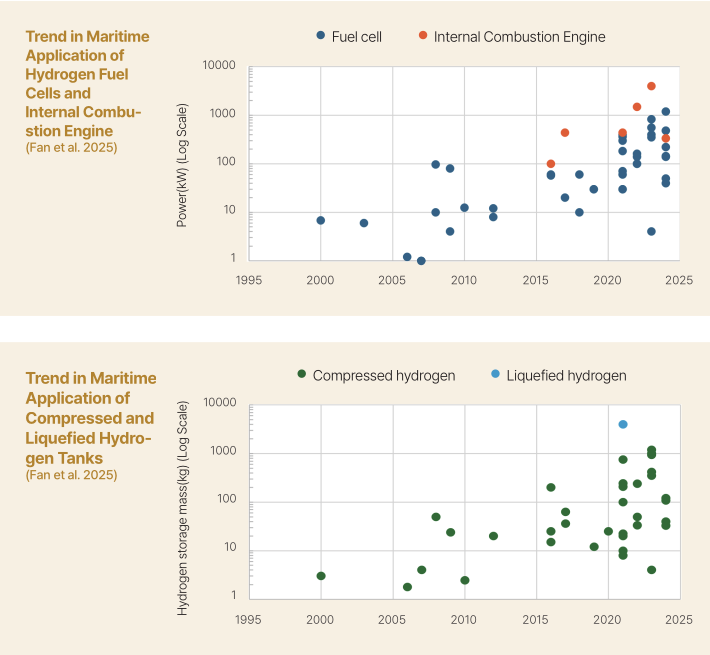
On the H₂-ICE side, the first maritime application was CMB’s Hydroville in 2017 — a 14-metre passenger vessel with 441 kW diesel engines converted for up to 85% hydrogen co-combustion. The technology has since scaled to the Hydrotug 1 tugboat (4 MW, 2023) and is heading toward a 17,500 DWT cargo ship (Onomichi Dockyard / ClassNK, sea trials 2027, commercial service March 2028) using Japan Engine Corporation’s 6UEC35LSGH two-stroke engine at ~3 MW and 30 MPaG hydrogen supply.
Storage: CH₂ vs LH₂ — The Core Design Choice
The IMO Interim Guidelines limit scope to CH₂ and LH₂ only — metal hydrides, LOHCs, and ammonia-based storage are excluded for now, reflecting their lower technological maturity for shipboard use.
| Property | CH₂ (700 bar) | LH₂ (−253°C) |
|---|---|---|
| Volumetric density | ~39 kg/m³ | ~71 kg/m³ |
| Storage temperature | Ambient | −253°C (20K) |
| Tank type | Type I–IV pressure vessels | Vacuum-insulated Type C |
| Fuel system complexity | Simple (pressure reduction only) | High (vaporisers, heat exchangers, compressors) |
| Scalability | Limited by high-pressure vessel geometry | Suited to medium/large vessels |
| BOG management | Not applicable | Required (energy use or GCU combustion) |
CH₂ is the dominant approach today: stored at up to 700 bar in Type I–IV composite pressure vessels arranged in parallel banks. The high operating pressure is both an advantage (no heating or vaporisation needed) and a risk: a high-pressure leak releases a large hydrogen volume in a short time, with high auto-ignition probability. The IMO interim guidelines now require a Tank Connection Enclosure (TCE) to contain and inert the tank connection space.
LH₂ offers roughly twice the volumetric energy density, making it the only credible path for large vessels with significant fuel demand. The fundamental challenge is cryogenic insulation: LH₂ at −253°C requires vacuum-insulated double-wall Type C tanks with multi-layer insulation (MLI). Polyurethane foam — standard for LNG tanks — is unsuitable at these temperatures due to thermal cycling deformation and vacuum incompatibility. MLI thermal conductivity in vacuum is 0.09 mW/mK, versus 21 mW/mK for PUF at atmospheric pressure. Regardless of insulation quality, some boil-off gas (BOG) is inevitable and must be managed — either fed to auxiliary power consumers or burned in a gas combustion unit (GCU).
Nine Hazard Categories Every Designer Must Address
Part 3 of the KR guide analyses the HIAD 2.1 database (954 hydrogen incidents, EU Joint Research Centre). The headline finding: over 66% of hydrogen incidents result in fire or explosion — 38.3% explosions, 28.4% fires. Leaks that do not progress to ignition account for only 21.4% of recorded cases.
The leading causes of those 954 incidents: material/manufacturing defects (23.4%), management failures (21.8%), human factors (14.8%), and system design errors (13.7%). The implication for ship design is clear: technical design alone is insufficient — safety management systems matter equally.
The guide identifies nine discrete hazard categories:
1. Leakage and Dispersion
Hydrogen’s diffusion coefficient in air (0.61 cm²/s) is nearly four times that of methane (0.16 cm²/s). In open areas this is beneficial — leaks disperse rapidly. In enclosed spaces, hydrogen accumulates at ceiling level due to its low density (1.34 kg/m³ vs. 1.82 for methane). Any space containing hydrogen equipment must be treated as a potential flammable-atmosphere zone.
2. Permeation
Hydrogen molecules are extremely small (0.29 nm vs 0.38 nm for methane), enabling permeation through materials that would contain other gases. This is particularly relevant for polymer-lined pressure vessels (Type IV tanks) and elastomeric seals.
3. Fire and Explosion
The lower flammability limit (LFL) of hydrogen is 4% by volume — lower than methane (5.3%). The upper flammability limit (UFL) is 77% — far wider than methane (17%). Combined with a minimum ignition energy of just 0.017 mJ (versus 0.274 mJ for methane), hydrogen has a dramatically wider and more easily ignited explosive range. A static spark from clothing can ignite a hydrogen-air mixture.
4. Deflagration-to-Detonation Transition (DDT)
Hydrogen’s laminar flame speed of 2.70 m/s (vs. 0.37 m/s for methane) and maximum deflagration speed of 975 m/s create a high DDT risk in confined geometries. Once detonation is reached, shock wave velocities of 1,480–2,150 m/s produce structural loads that no conventional ship compartment is designed to withstand.
5. Jet Fire
High-pressure hydrogen releases can produce nearly invisible jet fires — hydrogen flames have almost no visible emission in daylight and very weak infrared emission, making them extremely difficult to detect without dedicated sensors. A hydrogen jet fire at a pipeline flange is not visible to the naked eye under normal lighting conditions.
6. Cryogenic Hazards (LH₂)
LH₂ spills can liquefy or solidify surrounding air components (nitrogen solidifies at 63K, oxygen at 54K). Contact with structural steel or aluminium at −253°C causes cryogenic embrittlement — a rapid loss of ductility and fracture toughness that can cause sudden catastrophic failure. This has direct implications for material selection and for drip tray design under LH₂ piping.
7. Hydrogen Embrittlement
Gaseous hydrogen at high pressure degrades the mechanical properties of many metals over time, particularly steels, through hydrogen-assisted cracking mechanisms. Material selection for CH₂ pressure vessels, piping, and valves must account for this — not all stainless steels are immune.
8. Gas and Fire Detection
Standard catalytic bead detectors and IR-absorption gas sensors are ineffective for hydrogen detection. Dedicated electrochemical or thermal conductivity sensors are required. For fire detection, UV sensors or acoustic detection must supplement conventional IR-based detectors, which cannot reliably detect hydrogen flames.
9. H₂-ICE Combustion Anomalies
For hydrogen internal combustion engines, pre-ignition, backfire, and knock are specific risks arising from hydrogen’s low ignition energy and wide flammability range. Port fuel injection (PFI) systems — used on most current H₂-ICE vessels — are particularly susceptible. Medium-pressure direct injection (MPDI at 10–50 bar) significantly reduces these risks and is considered the near-term commercial standard.
Risk Mitigation: What the Guidelines Require
The KR guide maps nine mitigation strategy categories against the hazards above:
- Minimising leakage — double-wall piping with inert-gas annulus for gaseous H₂ lines in machinery spaces; vacuum-insulated double-wall for LH₂ lines; secondary enclosures (TCE for CH₂, fuel preparation rooms for LH₂)
- Ventilation, inerting, and vacuum — hazardous spaces must be continuously ventilated (minimum 30 air changes/hour) or maintained under inert gas; LH₂ piping annuli maintained under vacuum
- H₂-ICE specific — EGR and SCR for NOₓ control; MPDI or HPDI injection to minimise pre-ignition risk
- Material selection — hydrogen-compatible alloys throughout; austenitic stainless steels generally preferred over carbon steel for high-pressure service
- Hazardous area classification — explosion risk analysis (ERA) required for all hydrogen spaces; larger hazardous zones than equivalent LNG installations due to wider flammability range
- Drip trays — mandatory under all LH₂ piping connections to contain cryogenic spills and prevent contact with ship structure
- Gas and fire detection — dedicated hydrogen sensors; UV or acoustic fire detectors in addition to standard systems
- Fire suppression — dry chemical or water mist systems; CO₂ ineffective for hydrogen fires in open areas
- Obstacle density minimisation — reducing internal obstructions in enclosed hydrogen spaces to prevent DDT propagation by limiting flame acceleration paths
The Regulatory Stack
The guide maps the full set of applicable standards — a useful reference for class submissions:
| Source | Document | Scope |
|---|---|---|
| IMO | MSC.1/Circ.1647 | Interim guidelines for hydrogen as fuel |
| IMO | MSC.565(108) | Alternative design framework |
| IMO | CCC 11 Interim Guidelines | First dedicated H₂ fuel safety framework (→ MSC 111, May 2026) |
| ISO | ISO/TR 15916 | Basic safety considerations for hydrogen systems |
| NFPA | NFPA 2 | Hydrogen technologies code |
| CGA | H-3, H-4, H-5, H-7, G-5 series | Cryogenic storage, bulk supply, piping, venting |
| EIGA | TB 11/20, Doc 211/24, 06/19, 24/18 | European hydrogen safety guidance |
| ASME | B31.12 | Hydrogen piping and pipelines |
The regulatory picture for maritime hydrogen remains incomplete. The IMO Interim Guidelines — if approved at MSC 111 in May 2026 — will be the first official IMO safety framework applicable specifically to hydrogen-fueled ships. Until then, alternative design assessment under MSC.565(108) remains the primary route to class approval.
Why This Matters
For those of us working on hydrogen vessel projects, this KR document fills a genuine gap. The IMO interim guidelines are deliberately concise — they set out requirements without always explaining the physical reasoning. The KR guide provides that reasoning.
The key design insight is this: hydrogen safety cannot be engineered by analogy with LNG. The physics are different enough — wider flammability range, lower ignition energy, invisible flames, permeation, cryogenic embrittlement, DDT risk — that LNG-derived design intuitions will be wrong in several critical areas.
The implication for shipyards and equipment suppliers is that hydrogen ship design requires a step change in safety engineering rigour compared to LNG. Explosion risk analysis (ERA), secondary enclosure design, material qualification, and detection system selection all need specific hydrogen expertise — not adaptation of existing methane/LNG workflows.
We are tracking hydrogen safety framework developments closely at hydrogenshipbuilding.com. For the full vessel database, see our hydrogen-powered ships database and statistics page.
Challenges and Open Questions
- IMO Interim Guidelines approval: MSC 111 (May 2026) will determine whether the guidelines are adopted as-is, amended, or delayed — watch this space
- Class rule integration: how DNV, LR, BV, and others translate interim IMO guidelines into their own rule frameworks will determine what designers actually face in plan approval
- LH₂ large-scale fuel supply: no commercial LH₂ fuel supply system for large vessels has yet been built — the 17,500 DWT Japanese cargo ship (2028) will be the first real test case
- SOFC scaling: solid oxide fuel cells offer efficiencies up to 85% with waste heat recovery and multi-MW potential, but electrode sintering, stack degradation under variable load, and high-temperature sealing remain unresolved engineering challenges
- HPDI two-stroke engines: Japan Engine Corporation’s 6UEC35LSGH at 30 MPaG is at prototype stage — commercial availability for large merchant vessels remains several years away
- Operational safety data: the HIAD 2.1 database draws mostly from land-based industries; maritime-specific incident data is extremely limited and will remain so for years
Sources
- Korean Register — Safety Considerations for Hydrogen-Fueled Ships (KR-RND-DECB-INF-014)
- Fan et al. (2025) — fleet data on hydrogen-fueled ships cited throughout the KR document
- IMO CCC 11/INF.9 (2025) — LH₂-fueled cargo ship principal particulars
- HIAD 2.1 — Hydrogen Incidents and Accidents Database, EU Joint Research Centre