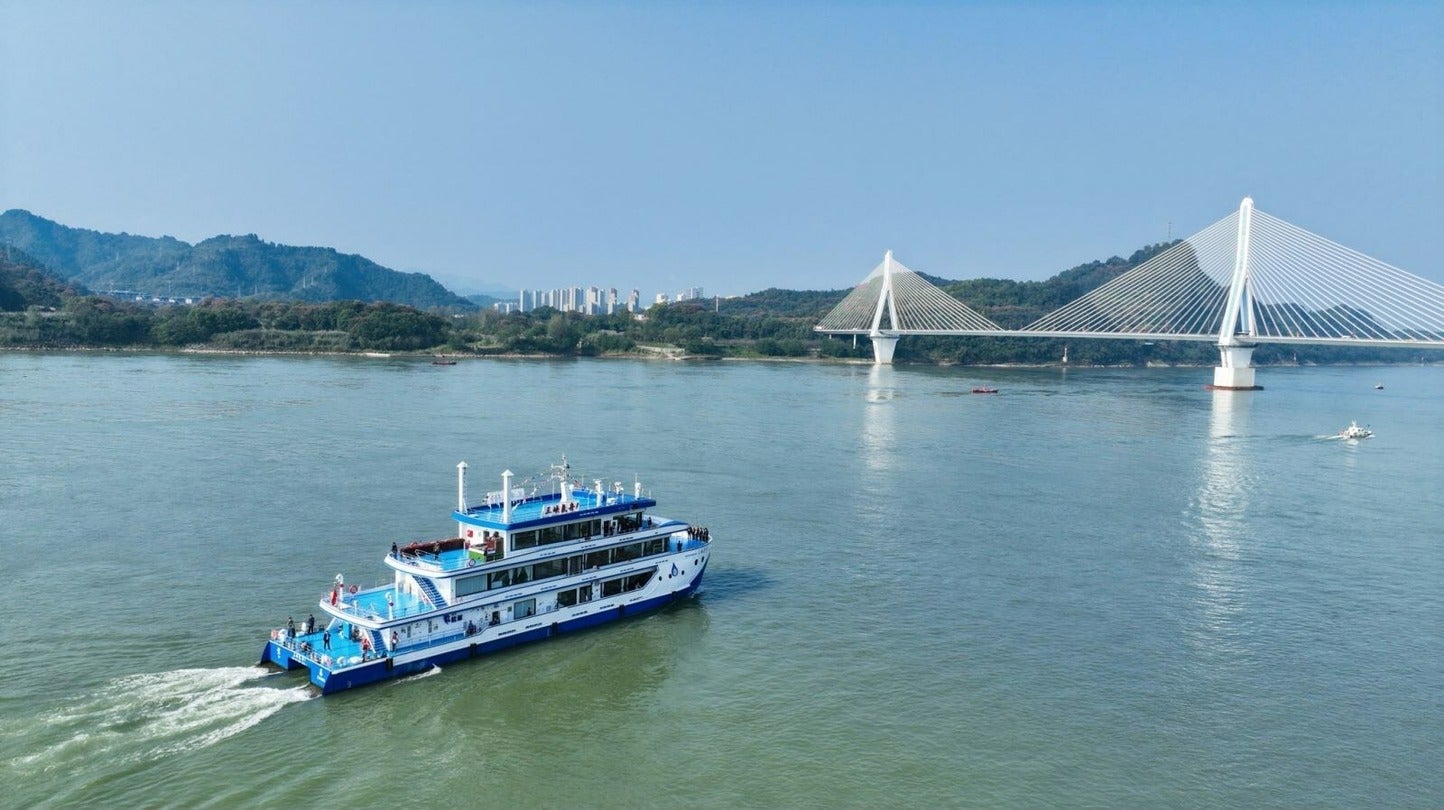
Most hydrogen vessel papers stop at feasibility or sea trial. This one goes further: a peer-reviewed account of the complete lifecycle of the Three Gorges Hydrogen Boat No. 1 — from concept in April 2022 through delivery in November 2023 to six months of revenue operations on the Yangtze River. The paper documents 3,606 km sailed, 2,897 kg of hydrogen consumed, 118 faults logged, and four engineering lessons learned the hard way. For those of us designing hydrogen vessels, this is exactly the kind of operational ground truth the field has been missing.
⚡ TL;DR
- What: Full engineering account of China's first 500 kW PEMFC passenger vessel — design, bunkering, sea trial, and six-month operations data.
- Why it matters: One of the most detailed operational datasets yet published for a hydrogen-powered vessel at this power scale; includes bunkering pressure data, fault breakdowns, and hard-won lessons.
- Key data: 500 kW PEMFC + 1,806 kWh battery hybrid; 240 kg H₂ at 35 MPa; first bunkering took 156 min for 200 kg; later reduced to under 60 min.
- Timeline: Construction May 2022 → Delivery November 2023 → Six months of operations documented through mid-2024.
- Watch for: How CCS formalises these lessons into updated guidelines for high-pressure hydrogen bunkering and FC room space allocation.
The Vessel and Its Design Logic
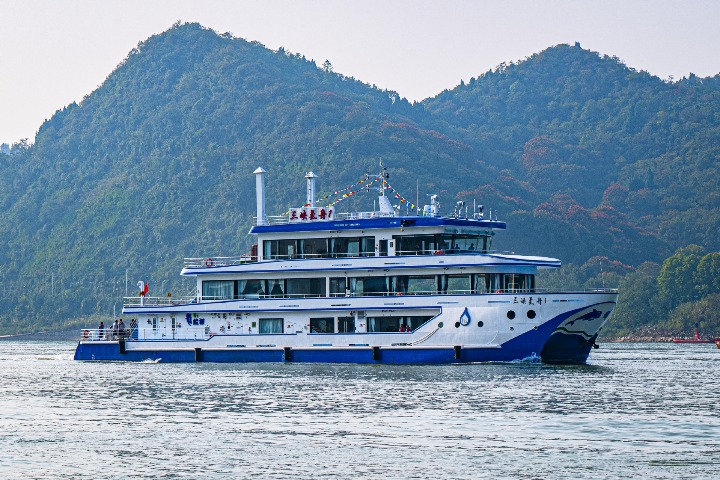
The Sanxia Qingzhou 1 (三峡氢舟1号, “Three Gorges Hydrogen Boat No. 1”) is a catamaran passenger vessel built by Jianglong Shipbuilding for China Yangtze Power Co., Ltd — the state enterprise that operates the Three Gorges Dam. The route runs between the Three Gorges Hydropower Station and the Gezhouba Water Conservancy Complex, a short corridor on the Yangtze in Hubei Province.
| Parameter | Value |
|---|---|
| LOA | 49.9 m |
| Breadth | 10.4 m |
| Draught | 1.85 m |
| Passengers | 80 |
| Max speed | 28 km/h (15.2 knots) |
| Design endurance | 200 km |
| Hull type | Catamaran |
| Classification | CCS (China Classification Society) |
| Delivery | 16 November 2023 |
The propulsion arrangement is twin 500 kW permanent magnet motors driving 360° Z-drive steerable rudder propellers — a compact, manoeuvrable configuration well suited to a river passenger vessel that needs precise berthing control. Each motor operates at 380V, 75 Hz, 1,500 rpm.
From a naval architect’s perspective, the catamaran form is the right choice here. The wide deck area accommodates the hydrogen storage room (7.0×7.4×2.5 m), two fuel cell rooms (6.5×3.3×3.2 m each), and the battery system without compromising passenger space in the way a monohull would require. The challenge — as the paper documents — is that even on a 50-metre catamaran, space for fuel cell room maintenance access is difficult to protect against competing claims from ship structure, ducting, and cabling.
The Hydrogen System: Storage, Supply, and Fuel Cells
The hydrogen fuel storage (HFS) system stores 240 kg of gaseous hydrogen at 35 MPa across 32 Type III cylinders connected in parallel. Each cylinder is an aluminium shell fully wrapped with carbon fibre (408 mm OD, 3,400 mm length), storing approximately 4% of its weight in hydrogen. Temperature monitoring is continuous across all cylinders; the thermally activated pressure relief devices (TPRDs) vent to atmosphere above 110°C.
The hydrogen fuel gas supply (HFGS) system reduces 35 MPa storage pressure to 0.8 MPa for the fuel cells via regulators in the Gas Valve Unit (GVU). The supply lines use double-wall piping throughout the machinery spaces — inner pipe Ø12.7×1.24 mm inside outer pipe Ø50.8×1.65 mm — with mechanical extraction ventilation on the annular space to detect and dilute any leakage before it reaches the fuel cells.
The fuel cell system comprises eight 70 kW PEMFC modules, providing a combined rated output of 500 kW. Each module is housed in a sealed metal enclosure with IP65 protection, with internal recirculation blower, air compressor, intercooler, and humidifier. The modules passed type testing per IEC 62282-3-100 and IEC 62282-3-200. Key parameters:
- Ramp-up from startup to 448 kW: 68 seconds
- Ramp-down from rated power to zero: 62 seconds
- Automatic interlock closure at 1.6% hydrogen concentration in FC room
The slow load-ramping strategy is deliberate. Studies cited in the paper show that rapid load changes degrade PEMFC stack lifetime — the 68 s ramp-up is longer than the 42 s laboratory figure specifically to protect the stacks under real sailing conditions.
The Hybrid Battery System and Energy Management
The lithium-ion battery system comprises two banks of 903 kWh each — 1,806 kWh total — on a DC bus architecture. The battery can provide peak output of 900 kW at 0.5C discharge, giving the hybrid system a combined maximum of 1,400 kW when both FCs and batteries operate simultaneously.
The energy management system (EMS) applies a straightforward load-based dispatch strategy:
| Power mode | Propulsion load | Fuel cells | Batteries |
|---|---|---|---|
| Low power | <110 kW | Off (0 kW) | Discharging |
| Cruising (acceleration) | <500 kW | Following load | Compensating |
| High power | >500 kW | 500 kW rated | Discharging |
| Cruising (deceleration) | <500 kW | Following load | Recharging |
This is sound practice for PEMFC hybrid systems. Keeping the fuel cells at steady-state output during the cruise phase — and using the battery to absorb transient load changes — extends stack life significantly compared to load-following operation. The battery SOC target is 40–90% during navigation, maintained above 60% on arrival to allow shore recharging rather than grid draw during the voyage.
The Zero-Carbon Supply Chain: Hydropower to Hydrogen
What makes this project genuinely notable is not the vessel alone but the integrated zero-carbon supply chain. The bunkering station is located at the Three Gorges Hydropower Station — not at a commercial hydrogen supplier. The hydrogen is produced on-site by PEM electrolysis powered directly by the hydropower plant, consuming 33,000 kWh per day to produce 500 kg of hydrogen per day. The paper describes this as the first implementation of onsite hydrogen production from hydroelectricity specifically for maritime bunkering, globally.
The bunkering process:
- Hydropower electricity → PEM electrolyser (3 MPa, 200 m³/h)
- Compressors step to 20 MPa (compression stage 1) then to 45 MPa (storage stage)
- Shore storage: one 20 MPa tank (21.24 m³) + three 45 MPa tanks (9 m³ each)
- Shore-to-ship transfer via folding mechanical arm at 13 m above water level
- Onboard storage in 32 Type III cylinders at 35 MPa
The well-to-wake emissions from this arrangement are as close to zero as any maritime fuel system currently operating at this scale. The constraint is not the technology — it is the geographic specificity: this supply chain works because the hydropower station and the vessel’s dedicated dock are in direct proximity.
What the Operational Data Shows
After delivery in November 2023, the vessel entered a six-month trial operation period covering 87 operational days. The headline numbers:
| Metric | Value |
|---|---|
| Distance sailed | 3,606 km |
| Hours under way | 323 h |
| Hydrogen consumed | 2,897 kg |
| Electric power used | 41,510 kWh |
| Bunkering events | 20 (total 19 hours) |
| Battery recharging operations | 103 (total 413 hours) |
| Faults/defects logged | 118 (inc. false alarms) |
The fault distribution tells the design community where the real problems are concentrated: 81% of faults originated in the marine hydrogen system — split between the PEMFC modules (48%), hydrogen storage and supply (33%), and fire safety systems (11%). Rudder propellers and electrical power supply together account for the remaining 19%.
The clear implication: for hydrogen vessel projects at this scale, engineering effort should be weighted heavily toward the hydrogen system — not toward the propulsion and power distribution components that designers are already good at.
The sea trial confirmed the vessel achieved its design maximum speed of 28.15 km/h (15.2 knots). Noise levels — 80.8 dB maximum in the propeller room, 38.4 dB minimum in the passenger meeting room — and vibration levels (0.22, 0.42, 0.56 mm/s in X, Y, Z axes) both complied with classification requirements. For a passenger vessel on a scenic river route, the low-noise, low-vibration characteristics of the electric drivetrain are a real operational advantage over a diesel equivalent.
Four Engineering Lessons
The most valuable section of the paper for vessel designers is the lessons learned. The authors are unusually candid.
1. Bunkering pipeline diameter mismatch kills transfer speed
The design target was 14.4 kg/min bunkering speed. In the first bunkering trial, the actual speed achieved was 5.2 kg/min — 36% of target — and the first full bunkering took 156 minutes for 200 kg.
The root cause: the inner diameter of the ship’s bunkering reception pipeline was 5.31 mm, against the shore facility’s 7.93 mm. Combined with a 39-metre pipeline run from dispenser to ship receptacles, the pressure loss was dramatic: 37.26 MPa at the shore cylinder dropped to 35 MPa at the dispenser, 15 MPa at the ship’s receptacle, and only 12.5 MPa inside the onboard cylinders. That pressure cascade left most of the driving pressure lost in friction.
The lesson: bunkering pipeline sizing on the ship side must be co-designed with the shore facility from the outset. The standard vehicle hydrogen refuelling literature that designers often use as a reference is optimised for short pipe runs — it does not translate directly to ship geometries.
2. Sealing gasket tolerance caused cylinder leakage across 20 of 32 cylinders
During pressure sensor installation on the hydrogen cylinder live ports, a sealing gasket with a 12.3 mm inner diameter was used. Nitrogen tightness tests at 43 MPa revealed leakage in 20 of 32 cylinders. The cause: the oversized gasket inner diameter created a gap between the gasket’s inner edge and the bolt’s outer edge, allowing O-ring deformation and eventual seal failure.
Replacing the gaskets with 10.2 mm inner diameter versions eliminated the leakage completely. A tolerance issue with straightforward cause — but 62.5% of the storage system leaking before first bunkering is a serious commissioning failure that careful procurement and incoming inspection should catch.
3. Pressure regulator failure from incorrect venting procedure
During HFGS testing, rapidly venting the low-pressure outlet of the pressure regulator — followed immediately by opening the tank valve to supply 35 MPa hydrogen — caused abnormal depressurisation and mechanical failure of the regulator. The fix: venting operations must be limited to the bunkering pipes, never the low-pressure outlet of the regulator, and the sequence must be controlled.
The generalised lesson is important: hydrogen system commissioning procedures must be developed from first principles, not adapted from LNG or other gas system playbooks. The dynamic response of high-pressure hydrogen regulators to rapid pressure swings differs from natural gas systems in ways that can be destructive.
4. FC room space planning must start at general arrangement stage
The paper identifies three competing claims on fuel cell room volume that designers tend to underestimate: internal ship structure (frames, web frames), hull form taper at the stern, and balance-of-plant equipment (ducting, cable trays, pipe supports). Together, these can consume 20–30% of the theoretical room volume, leaving insufficient clearance for maintenance and survey access.
The recommendation is clear: fuel cell room spatial modelling must be integrated into the general arrangement from the earliest design phase, with access paths to each PEMFC module, the GVU, and the HFGS connections treated as hard constraints rather than post-design overlays.
Why This Matters
The Three Gorges Hydrogen Boat No. 1 is not the largest or the most powerful hydrogen vessel we are tracking at hydrogenshipbuilding.com. But it is one of the most thoroughly documented — and that documentation is what matters most for the next generation of designs.
The 6-month, 3,606-km operational dataset establishes that a 500 kW PEMFC hybrid vessel can operate reliably in commercial passenger service. The fault data — 81% concentrated in the hydrogen system — gives the design community an honest picture of where engineering effort needs to be focused. And the four lessons, particularly on bunkering pipeline sizing and FC room space, are directly actionable in projects currently on the drawing board.
For China specifically, this project demonstrates the technical foundation for a fleet of hydrogen river vessels powered by the country’s enormous hydropower capacity. The Three Gorges Dam generates around 88 TWh per year; diverting a small fraction to hydrogen electrolysis for a fleet of inland vessels creates a credible zero-carbon river transport corridor.
Challenges and Open Questions
- Long-term PEMFC degradation: the paper covers six months of operation; meaningful stack degradation data requires 3–5 years of service, and none yet exists for vessels at this duty cycle
- Bunkering speed: the pipeline mismatch was identified but requires physical modification of the installed system — what was the actual improved performance after the fix?
- Cylinder leakage root cause: the gasket tolerance issue was addressed at commissioning, but the incoming inspection process that allowed 12.3 mm gaskets past quality control is not explained
- Scalability of the supply model: the hydropower electrolysis supply chain is inherently site-specific; replicating it on the broader Yangtze network requires both new electrolysis capacity and bunkering infrastructure at each port
- CCS rule development: the paper references CCS guidelines throughout, but China’s inland waterway hydrogen rules remain less developed than maritime class rules — how the lessons here feed into updated CCS guidance is a key watch point
- Commercial economics: fuel costs, maintenance costs, and lifecycle cost versus diesel are not addressed in the paper
Sources
- Guan, W., Chen, L., Wang, Z., Chen, J., Ye, Q., & Fan, H. (2024). A 500 kW hydrogen fuel cell-powered vessel: From concept to sailing. International Journal of Hydrogen Energy, 89, 1466–1481. https://doi.org/10.1016/j.ijhydene.2024.09.418 (Open access, CC BY 4.0)
- China’s first 500 kW hydrogen fuel-powered ship commences operation — CGTN
- Three Gorges Hydrogen Boat No. 1 — China Three Gorges Corporation
- China’s hydrogen ship in Three Gorges area — Ship Technology