For most of hydrogen shipping’s short history, the conversation has been dominated by PEM fuel cells on small passenger vessels and inland barges. On 30 March 2026, Japan Engine Corporation changed the frame of reference: a 5,610 kW low-speed two-stroke engine running on over 95% hydrogen by heat content — the first of its type to complete full factory testing at the actual power rating of an oceangoing vessel. This is the technology class that propels the bulk of world trade, and it is now demonstrably capable of running on hydrogen.
⚡ TL;DR
- What: Japan Engine Corporation's 6UEC35LSGH achieves >95% hydrogen co-firing at 100% load during full factory testing — world's first for a large low-speed two-stroke marine engine.
- Why it matters: Low-speed two-stroke engines power the majority of oceangoing vessels; this milestone extends hydrogen propulsion into the commercial freight sector in a way fuel cells currently cannot.
- Key data: 5,610 kW at 167 rpm, 350 mm bore, high-pressure direct injection at 30 MPa; LH2 fuel supply system from Kawasaki rated at 781 kg H₂/hour.
- Timeline: Engine delivered to vessel January 2027 → Onomichi Dockyard build → three-year sea demonstration from FY2028.
- Watch for: ClassNK type approval progression and whether MOL/J-ENG announce additional vessel orders off the back of demonstration results.
What Was Actually Tested — and Why It Is Significant
The 6UEC35LSGH is Japan Engine Corporation’s hydrogen-capable derivative of their UEC35LSE-Eco-B2 low-speed two-stroke diesel. The designation tells the story: 6 cylinders, 350 mm bore, long stroke (~1,550 mm, stroke/bore ratio ~4.43), G for gas-capable, H for hydrogen. At its rating point it produces 5,610 kW at 167 rpm — meaningfully more than its diesel equivalent (5,220 kW), because hydrogen’s combustion properties allow a slightly more aggressive heat release.
The milestone reached on 30 March 2026 was the completion of full factory testing with over 95% hydrogen by heat content (approximately 99.9% by volume) at 100% load across all cylinders. This is not a laboratory result with a scaled-down test rig — it is the actual vessel main engine, at full power, on the bench at J-ENG’s Akashi factory.
Two-stroke diesel engines propel the majority of the world’s deepwater fleet. The significance here is not the percentage itself — 95% hydrogen is not particularly novel in small four-stroke engine tests. The significance is the scale, the engine type, and the direct injection approach. This is the propulsion class that actually moves container ships, bulk carriers, and tankers.
What makes the 5.6 MW number commercially meaningful: compare it to the current maximum PEMFC installation in service, H2 Barge 2 at 1.2 MW, or the Three Gorges Hydrogen Boat No. 1 at 500 kW. The 6UEC35LSGH delivers 4.7× the power of the most powerful hydrogen fuel cell vessel currently sailing — from a single engine on a mid-size cargo ship, not a purpose-built technology demonstrator.
The Engine: High-Pressure Direct Injection at 30 MPa
The fundamental engineering challenge with hydrogen in a reciprocating engine is ignition control. Hydrogen has a minimum ignition energy of 0.017 mJ — approximately 16 times lower than methane — and a flammability range of 4–77% by volume. In a port-fuel injection (PFI) configuration, hydrogen in the intake manifold creates serious pre-ignition and backfire risk, limiting power output and reliability.
J-ENG’s solution is high-pressure direct injection (HPDI) at 30 MPa, with diesel pilot ignition. Hydrogen is injected directly into the cylinder near top dead centre — after the pilot diesel has already ignited — eliminating the pre-ignition window entirely. The 30 MPa injection pressure is delivered by Kawasaki’s Marine Hydrogen Fuel System (MHFS), which pressurises the liquid hydrogen via cryogenic pump before gasifying it to delivery temperature (0–50°C).
This approach is mechanically robust and familiar to two-stroke engine engineers: the injection timing and pressure control philosophy are analogous to dual-fuel LNG HPDI systems already in commercial service. The novelty is supplying hydrogen — not methane — at 30 MPa, which requires a completely different fuel system upstream of the injectors.
The Kawasaki LH2 Fuel System
The Kawasaki Marine Hydrogen Fuel System fitted to this vessel and used on the factory test bench is a purpose-designed cryogenic supply system:
| Parameter | Value |
|---|---|
| Onboard LH2 tank capacity | 2 × 70 m³ = 140 m³ total |
| Injection pressure | 30 MPa |
| Maximum supply rate | 781 kg H₂/hour |
| Delivery temperature | 0–50°C (after gasification) |
| Pressurisation method | Cryogenic LH2 pump |
The 781 kg/hour figure is worth pausing on. At full load, the 6UEC35LSGH burns hydrogen at a rate commensurate with its 5.6 MW output. For reference, the MF Hydra — the world’s first LH2 ferry — carries 4,000 kg of total LH2 for its 400 kW fuel cell system. The J-ENG engine at full power would consume that entire LH2 inventory in approximately five hours. This illustrates the fundamental challenge of LH2 for high-power, long-range ocean vessels: the fuel volume demand is large, and bunkering infrastructure must match. A parallel NEDO project, adopted in February 2026, is specifically developing automated LH2 bunkering technology for this application.
The Vessel and Project Timeline
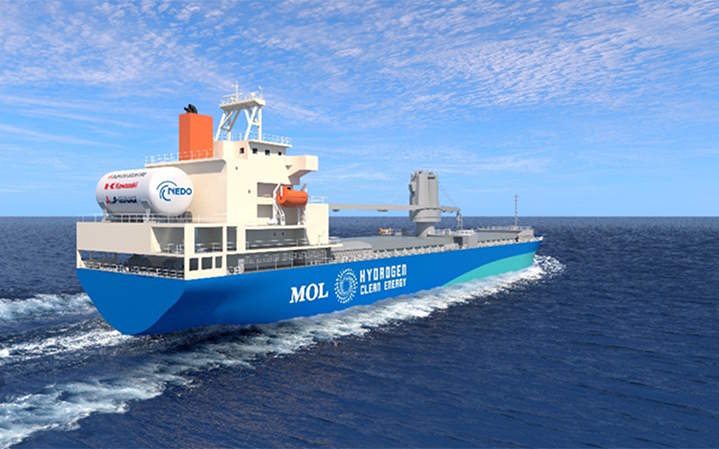
The demonstration vessel is a 17,500 DWT multipurpose ship being built by Onomichi Dockyard for operation by MOL and MOL Drybulk. The 6UEC35LSGH will be the sole main propulsion engine. The project is funded under NEDO’s Green Innovation Fund — the broader Next-Generation Ship Development programme with an allocation of up to ¥40.88 billion (~€240 million).
| Milestone | Date |
|---|---|
| NEDO project adopted | October 2021 |
| ClassNK AiP for parcel layout concept | October 2023 |
| World’s first land-based operation of marine H2 engines (multiple engines) | October 2025 |
| World’s first full factory test of vessel main engine at >95% H2 | 30 March 2026 |
| Engine delivery to Onomichi Dockyard | January 2027 |
| Sea demonstration begins | FY2028 |
| Demonstration period | Three years |
ClassNK has been involved since the Pre-HAZID stage in June 2023, and its role continues through construction and the full three-year demonstration. The AiP granted in October 2023 was itself a world first — the first approval in principle for a vessel with a large low-speed two-stroke hydrogen engine as main propulsion.
How This Compares to the PEMFC Approach
The hydrogen shipping industry has developed along two largely separate tracks. We are tracking both at hydrogenshipbuilding.com:
| Parameter | PEMFC hybrid | H2 two-stroke ICE (6UEC35LSGH) |
|---|---|---|
| Max installed power (current) | 1.2 MW (H2 Barge 2) | 5.6 MW |
| Fuel type | CH2 or LH2 | LH2 (required for high flow rate) |
| NOx emissions | Zero | Yes — SCR required |
| Electrical efficiency | 50–55% | ~40–45% estimated |
| Dynamic load response | Fast (seconds) | Fast |
| Technology readiness | Commercial | Demonstration (2028) |
| Suited to vessel size | Small–medium (<5,000 DWT typical) | Medium–large |
| Propulsion type | Electric | Direct shaft |
The two approaches are not in competition — they serve different vessel segments. PEMFC systems are commercially available today for vessels up to a few thousand DWT with short-range requirements. H2-ICE two-stroke systems address the mid-size and large freight vessel segment, where shaft power requirements of 5–30 MW make fuel cell arrays impractical at current module sizes and costs.
From a naval architect’s perspective, the two-stroke H2 engine also preserves the conventional mechanical drive train: shaft, gearbox (or direct drive), CPP or FPP — a powertrain arrangement that yards and operators already understand. This matters for newbuilding risk assessment and manning, even if the fuel system introduces entirely new competencies.
Why This Matters
The gap between hydrogen shipping’s current reality and its decarbonisation potential has always been the power scale problem. PEM fuel cells, for all their efficiency advantages, cannot yet deliver the shaft power that medium and large cargo vessels need. A 5.6 MW two-stroke engine that runs on 95% hydrogen changes that calculus — not for the fleet today, but for vessels ordered from the late 2020s onward.
The three-year sea demonstration starting FY2028 will generate the operational data that the industry needs: hydrogen consumption rates at real sea states, fuel system reliability over thousands of running hours, NOx emission profiles, and maintenance intervals for HPDI injectors running on hydrogen rather than diesel. If those results hold up, the pathway for hydrogen propulsion on 10,000–80,000 DWT vessels becomes substantially clearer.
For shipowners evaluating hydrogen as a long-term fuel strategy — particularly those with bulk carrier or general cargo fleets — this project is worth watching closely. The technology exists, the class society is engaged, and the demonstration timeline is defined. That is further than most hydrogen propulsion concepts have reached.
Challenges and Open Questions
- NOx: hydrogen combustion produces thermal NOx; the paper trail on SCR sizing and compliance for this engine has not yet been published — at what exhaust temperatures and load profiles does NOx become a practical compliance problem?
- LH2 bunkering infrastructure: 781 kg/hour demand at 30 MPa requires shore facilities that do not yet exist outside of Japan’s domestic hydrogen projects; the parallel NEDO bunkering project is essential but early-stage
- Demonstration vessel scope: three years of operation on a single 17,500 DWT vessel is a limited dataset for making commercial fleet decisions — MOL would likely need two or three further vessels before offering H2-ICE newbuilds as a standard product
- Pilot diesel fraction: the engine retains diesel pilot ignition; the 5% diesel fraction (by energy) still generates CO₂ emissions, so the vessel is not zero-carbon — what is the regulatory treatment of this under FuelEU Maritime and CII?
- HPDI injector durability on hydrogen: hydrogen’s different lubricity and combustion chemistry compared to LNG will affect injector wear rates — long-term data does not yet exist for this specific application
- Cost premium: J-ENG and NEDO have not disclosed the cost premium of the 6UEC35LSGH over its diesel equivalent; commercial viability depends heavily on this figure
Sources
- Japan hits milestone with hydrogen ship engine test — Splash247
- J-ENG / MOL / Kawasaki press release, 30 March 2026 (PDF)
- J-ENG begins full factory testing of large H2-fuelled two-stroke engine — Clean Shipping International
- World’s first onshore operation of marine hydrogen engine — NEDO Green Innovation
- ClassNK AiP for hydrogen vessel parcel layout concept, October 2023 — J-ENG