Kawasaki Heavy Industries has now signed two European liquefied hydrogen corridor commitments within a single month — Hamburg in early May, Amsterdam on 21 May — and the pattern is deliberate. Each agreement places a different partner as terminal operator and demand anchor, while Kawasaki supplies the same core technology layer: the carriers, the liquefiers, and the ship-to-shore interfaces. The Amsterdam corridor, anchored by EcoLog, is the more technically mature of the two: it already has a Front-End Engineering Design contract in place, an owner’s engineer appointed, and an operational target of end of 2030.
⚡ TL;DR
- What: Kawasaki Heavy Industries (KHI) and EcoLog sign a strategic alliance covering the midstream of a liquefied hydrogen supply chain — maritime transport, terminals, and ship-to-shore interfaces — at the World Hydrogen Summit in Rotterdam on 21 May 2026.
- Terminal: EcoLog's Amsterdam LH2 import terminal is the world's first commercial-scale LH2 import facility in FEED — targeting 200,000 t/y LH2 (expandable to 600,000 t/y) and 1.8 Mt/y LCO₂ by end 2030.
- Technical innovation: Cold energy from LH2 regasification is used to liquefy CO₂ on-site — an integrated design that improves whole-system energy efficiency.
- Supply routes: Oman, Saudi Arabia, Spain, and Brazil identified as upstream supply origins.
- Context: KHI signed a separate Hamburg LH2 JDA with Daimler Truck, MB Energy, and HHLA earlier in May — Amsterdam and Hamburg now form twin import anchors for a Kawasaki-technology European network.
What Was Signed and Where
The agreement — described as a strategic alliance rather than a memorandum of understanding — was signed at the World Hydrogen Summit & Exhibition in Rotterdam on 21 May 2026. It covers the midstream segment of liquefied hydrogen supply chains: maritime transportation, import terminals, and the ship-to-shore interface that connects the two.
A strategic alliance in this context means more than a statement of intent. Both parties are committing engineering resources and commercial relationships toward a shared corridor project, with EcoLog as the prospective owner and operator of carriers and terminals, and Kawasaki as the technology and equipment provider. The division of roles mirrors the structure of the Hamburg JDA signed earlier this month, where MB Energy and HHLA hold the terminal and logistics roles while Kawasaki supplies the carrier technology.
What Each Partner Brings
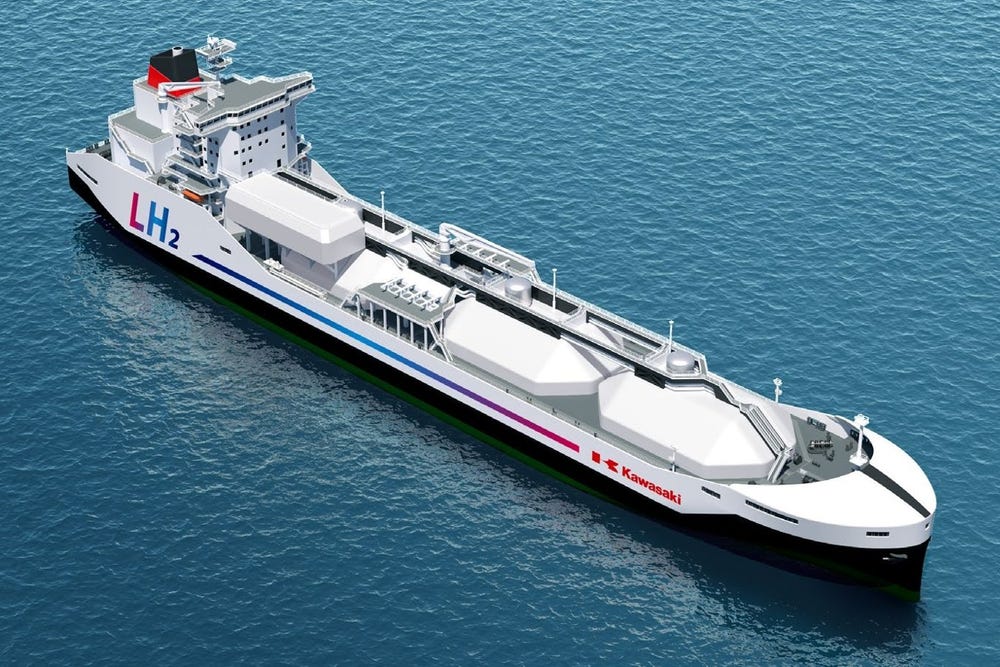
Kawasaki Heavy Industries brings a unique track record. The company built and operated Suiso Frontier — the world’s first liquefied hydrogen carrier, a 1,250 m³ vessel that completed the first international LH2 shipment from Hastings, Australia to Kobe, Japan in 2022. That project, part of the Hydrogen Energy Supply Chain (HESC) consortium, validated cryogenic containment design, boil-off management, and marine loading/unloading procedures at −253°C. Kawasaki is now building a 40,000 m³-class LH2 carrier and has published long-term plans for vessels of up to 160,000 m³ — directly comparable to large LNG carriers.
Beyond ships, Kawasaki manufactures LH2 liquefiers, cryogenic storage tanks, and ship-to-shore loading arms and transfer systems. It is the only company with operational experience across the full LH2 midstream equipment chain.
EcoLog brings experience operating cryogenic cargo vessels in LNG and is transitioning that competence to LH2. The company’s role in this alliance is as terminal developer and carrier operator rather than technology supplier. Its primary project is the Amsterdam LH2 corridor — an import terminal at the Port of Amsterdam that is the most advanced commercial-scale LH2 import project currently in engineering anywhere in the world.
| Partner | Role | Key capability |
|---|---|---|
| Kawasaki Heavy Industries | Technology / equipment | LH2 carriers, liquefiers, cryogenic tanks, ship-to-shore systems |
| EcoLog | Owner / operator | Amsterdam terminal development, LH2 carrier operation, LNG cryogenic expertise |
| KBR | FEED contractor (EcoLog terminal) | Cryogenic engineering design, system specification |
| Mott MacDonald | Owner’s engineer (EcoLog terminal) | Design assurance, construction oversight |
The Amsterdam Terminal: World’s First Commercial-Scale LH2 Import Facility
EcoLog’s Amsterdam project sets the technical and commercial benchmark for every LH2 import terminal that follows.
KBR was appointed to deliver the Front-End Engineering Design (FEED) for the terminal, drawing on the firm’s prior cryogenic work including LH2 systems developed for NASA. The FEED is expected to complete in 2026. Mott MacDonald is acting as owner’s engineer, providing multidisciplinary oversight across planning, design, and construction, with independent design assurance. FEED work began in January 2025.
The terminal’s planned specifications:
| Parameter | Phase 1 (by end 2030) | Phase 2 (expansion) |
|---|---|---|
| LH2 import capacity | 200,000 t/y | 600,000 t/y |
| LCO₂ export capacity | 1.8 Mt/y | 4.25 Mt/y |
The transport connections are unusually comprehensive: two hydrogen pipelines (high- and low-pressure), a dedicated CO₂ pipeline, a truck loading facility, a barge jetty, and rail access. This is not a single-mode terminal for one customer segment — it is being engineered as a distribution hub for hydrogen across Northern European demand sectors: steel, heavy mobility, maritime, and data centres.
The Cold Energy Integration
The most technically interesting feature of the EcoLog Amsterdam design is the dual LH2/LCO₂ integration — a detail that will be immediately legible to any engineer who has worked on LNG regasification.
Liquefied hydrogen arrives at −253°C. When it is regasified for distribution as GH2, the cold energy is normally dissipated to the ambient environment — a thermodynamic loss that adds to the effective cost of the operation. At Amsterdam, that cold energy is directed to a CO₂ liquefaction process instead, converting captured industrial CO₂ into LCO₂ for reuse or permanent geological storage offshore.
The integrated LH2/LCO₂ design is not a marketing concept — it is an engineering choice that improves whole-system energy efficiency and provides a second revenue stream that helps underpin the economics of the LH2 import business.
From a shipbuilding perspective, this integration defines the technical requirements for the ship-to-shore interface. LH2 carriers calling at Amsterdam will need to manage heat ingress and transfer rates that are compatible with the terminal’s cold-energy capture system — a design constraint that Kawasaki, as both carrier builder and equipment supplier, will need to optimise for in the vessel specification.
Kawasaki’s European Network: Amsterdam and Hamburg
The two European LH2 corridors KHI has now committed to in May 2026:
| Corridor | Terminal operator | Demand anchor | Agreement | Status |
|---|---|---|---|---|
| Hamburg | MB Energy + HHLA | Daimler Truck (100 LH2 trucks, series from ~2033) | JDA | Planning phase, COD early 2030s |
| Amsterdam | EcoLog | Industrial H2 demand, NL + Germany | Strategic alliance | FEED underway, COD end 2030 |
Both corridors use Kawasaki carrier technology. Both target commercial operation within the same 2030–2033 window. The supply routes differ: Hamburg is oriented toward Norwegian green hydrogen (Gen2 Energy’s Mosjøen plant is the named upstream partner), while Amsterdam draws on a geographically diversified portfolio — Oman, Saudi Arabia, Spain, and Brazil — a deliberate hedge against single-origin supply risk.
For vessel operators, the geographic spread matters. A Norway-to-Hamburg voyage is roughly 1,500–2,000 nautical miles; an Oman-to-Amsterdam route via the Suez Canal is closer to 7,000–8,000 nautical miles. Those route lengths imply fundamentally different boil-off budgets, carrier utilisation profiles, and fleet size requirements within the same 40,000 m³ vessel class. A carrier optimised for the Norwegian short-sea route will have different insulation specifications and pressure management requirements than one designed for the Arabian Gulf long-haul.
Supply Routes: Four Origins, One European Hub
The upstream supply regions named in the EcoLog–KHI alliance span a wide range of hydrogen production types and shipping distances:
- Oman and Saudi Arabia: Sovereign-backed green and blue hydrogen projects with multi-million-tonne production targets. Long routes (~7,000–9,000 nm) but very large potential volumes and low renewable energy costs.
- Spain: Competitive green hydrogen from Iberian solar and wind, with strong EU Innovation Fund support. Shorter route to Amsterdam (~1,800 nm via Bay of Biscay) and improving rapidly.
- Brazil: Southern hemisphere renewables at high capacity factors. Routes of ~5,500 nm to Northern Europe. Brazilian projects have positioned the country as a long-term green hydrogen exporter with regulatory frameworks developing.
No single route is confirmed as primary. The multi-origin design mirrors the lesson the European energy industry absorbed from single-origin gas dependency — and positions the Amsterdam terminal as a genuine hub rather than a dedicated bilateral pipeline.
Why This Matters
For those of us tracking the hydrogen-powered ships database and the infrastructure that will eventually supply them, the two Kawasaki corridor commitments in May 2026 mark a shift from individual project announcements to the beginning of a European LH2 network architecture.
Two import terminals — both in FEED or committed JDA, both targeting the same commissioning window, both using the same carrier technology — create the minimum conditions for a functioning delivered-LH2 market in Northern Europe. When Amsterdam and Hamburg are both operational, vessel operators will be able to route LH2 cargoes between ports, supply sources will face genuine competition, and a reference price for delivered LH2 will begin to form.
That price signal, and the physical supply chain behind it, is the prerequisite for LH2 as a serious maritime fuel. The statistics page shows that the number of hydrogen-powered vessels in the water is growing — but the jump from coastal and short-sea operations to deep-sea bunkering depends entirely on whether large-volume import infrastructure like Amsterdam and Hamburg comes on stream on schedule.
Challenges and Open Questions
- Vessel specification alignment: EcoLog plans to be a carrier operator. Whether EcoLog’s vessels are sized to the Kawasaki 40,000 m³ design or a different class has not been confirmed. Ship-to-shore compatibility with the Amsterdam terminal must be locked in early in the FEED process.
- Amsterdam CO₂ pipeline infrastructure: The cold-energy integration requires industrial CO₂ sources and offshore storage connections. Rotterdam’s Porthos CCS project provides a nearby precedent, but Amsterdam’s CO₂ transport infrastructure is less advanced.
- Permitting timeline: Post-FEED environmental permitting in the Netherlands (EIA under Wet milieubeheer) for cryogenic infrastructure of this scale has no direct precedent. This is a known long lead item for a 2030 COD.
- RFNBO compliance for non-EU supply: Hydrogen from Oman, Saudi Arabia, and Brazil must meet EU RFNBO certification requirements under FuelEU Maritime and the Delegated Acts. Bilateral recognition frameworks with these supplier countries are not yet fully established.
- Financing: No capital structure or financing details have been disclosed for the EcoLog Amsterdam project. A 200,000 t/y terminal operational by 2030 represents a multi-billion euro commitment that will need to be finalised concurrent with FEED completion.
Sources
- Hydrogen Central: EcoLog and Kawasaki Sign Strategic Alliance in Liquefied Hydrogen Midstream
- KBR: FEED contract for EcoLog Terminal Amsterdam
- Mott MacDonald: Owner’s engineer for EcoLog Terminal Amsterdam
- Hamburg LH2 JDA: Daimler Truck, MB Energy, Kawasaki, HHLA
- Hydrogen-powered ships database
- LH2 technology overview