The bottleneck for shore power at most cruise terminals is not the hydrogen — it is the grid. Upgrading a port’s electrical infrastructure to supply shore power at the 6.6 kV or 11 kV required by medium cruise vessels typically takes three to seven years, and in many locations the grid capacity is simply not available at all. A UK consortium led by start-up ELIRE Maritime has validated an answer to that problem: a 1,200 m² floating platform that generates and stores its own power from hydrogen, connects directly to a berthed ship, and requires nothing from the port grid whatsoever.
⚡ TL;DR
- What: ELIRE Maritime and consortium partners have validated a floating, grid-independent hydrogen power hub under the UK's Clean Maritime Demonstrator Competition Round 6 (CMDC6), funded at £1 million.
- Output: 5 MW continuous clean power via modular 1.3 MW fuel cell units + 45 MWh battery storage, on a three-hexagon floating platform of 1,200 m².
- Hydrogen: 7,500–8,000 kg per week in seven ISO-compatible low-pressure tanks; refuelled twice weekly.
- Emissions: 77% reduction versus onboard diesel generation — approximately 47 tonnes of CO₂ avoided per vessel per week.
- Key claim: Bypasses 3–7 year port grid upgrade timelines; deployable wherever a ship can berth.
The Shore Power Problem the Platform Is Designed to Solve
EU regulations are tightening the screws on ships at berth. FuelEU Maritime and the EU Emissions Trading System both create direct financial incentives to shut down auxiliary engines while in port and connect to shore power instead. The IMO’s MEPC trajectory points the same direction globally. The problem is supply-side: shore power infrastructure at cruise terminals, ferry ports, and bulk terminals is patchy at best, and upgrading it is not fast.
A typical Onshore Power Supply (OPS) installation for a medium cruise vessel — capable of delivering 5–15 MW at 6.6 kV or 11 kV per IEC 80005-1 standards — requires grid reinforcement works, high-voltage switchgear, cable trenching, and in many port environments, coastal zone planning approvals. The lead time is routinely 3–7 years from decision to commissioning. For port authorities that do not yet face the full EU compliance burden, those upgrades are easy to defer. For operators whose vessels call at multiple ports across multiple jurisdictions, grid-connected shore power is unavailable at a significant fraction of their berths.
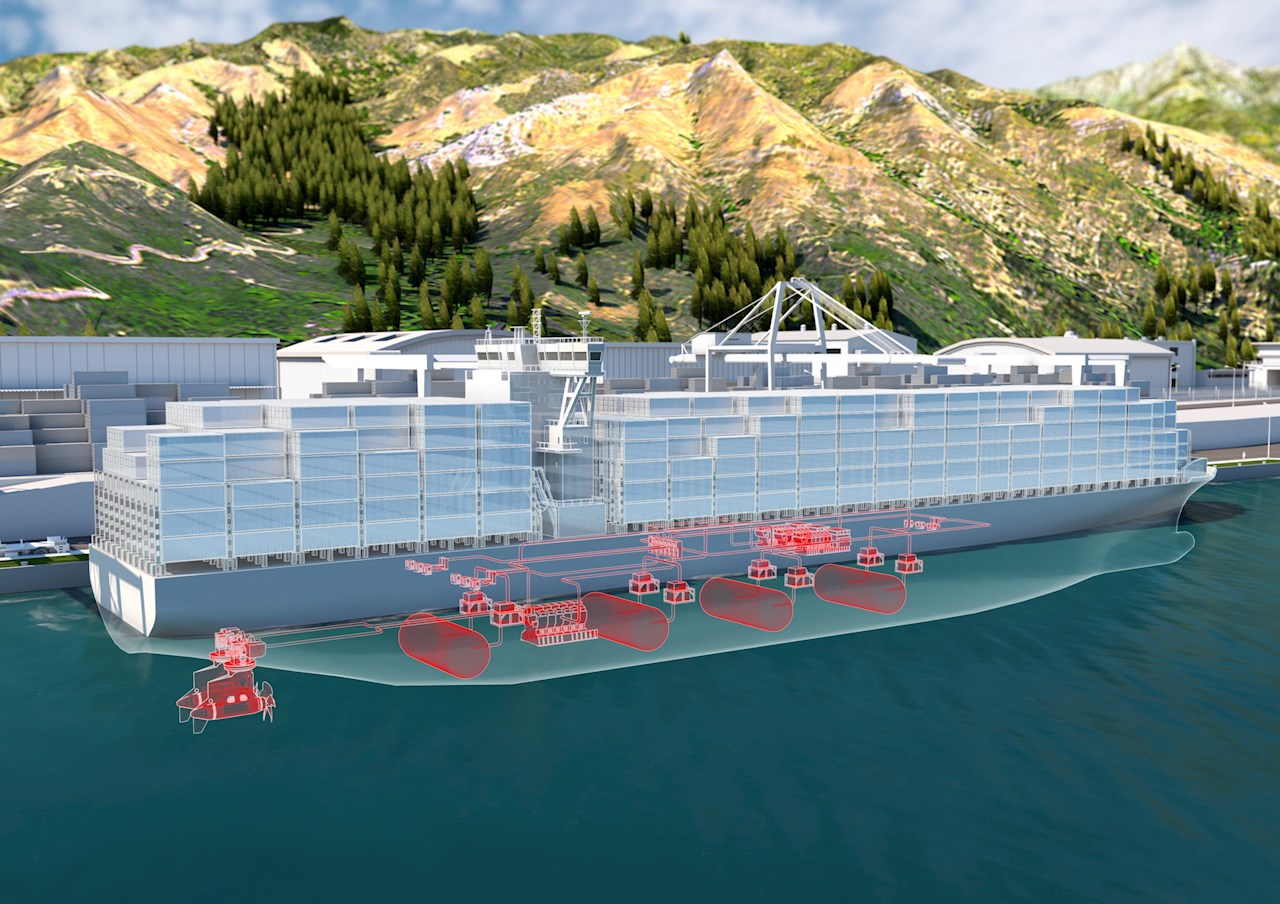
The ELIRE Maritime platform cuts this knot by making the shore power supply self-contained. Hydrogen is delivered to the platform by truck or barge; fuel cells convert it to electricity; a grid-forming inverter and battery buffer manage the AC output; and standard OPS cables connect to the ship. The port grid does not enter the picture.
What Was Validated: The Platform Specification
The CMDC6 feasibility study — funded by UKRI through the UK Department for Transport’s Clean Maritime Demonstrator Competition — was completed by a consortium of six organisations under ELIRE Maritime’s lead:
| Partner | Validation contribution |
|---|---|
| ELIRE Maritime | System integration, concept design, commercial model |
| Ricardo UK | Hydrogen-to-power system validation |
| Rux Energy UK | Fuel cell and hydrogen system testing |
| Schneider Electric | Grid-forming inverter and battery storage systems (50 Hz + 60 Hz) |
| Triton Anchor Europe | Floating platform mooring and anchoring |
| Offshore Renewable Energy Catapult (OREC) | Offshore systems and deployment framework |
| University of Strathclyde | Wave tank testing: stability, structural integrity, motion response |
The physical platform consists of three interconnected hexagonal floating structures with a combined footprint of 1,200 m². The hexagonal geometry is not arbitrary — it allows multiple units to be connected side-by-side or in a cluster configuration, and the geometry distributes structural loads more evenly than a rectangular pontoon under wave loading. Strathclyde’s wave tank testing validated the platform’s motion response and multi-platform interconnectivity across varying sea states, which is a prerequisite for maintaining a stable electrical connection to a berthed vessel.
The power architecture integrates:
- Fuel cell array: Modular 1.3 MW units operating continuously as baseload generation
- Battery energy storage: 45 MWh — approximately 9 hours of full output if fuel cells are offline
- Solar generation: Up to 146 kW onboard PV, reducing hydrogen consumption during daylight
- Grid-forming inverter: Enables island-mode operation with no external grid reference, supporting both 50 Hz (European) and 60 Hz (US/Asian) shore power standards
- Shore power outputs: 6.6 kV and 11 kV — the two standard voltages specified in IEC 80005-1 for large vessels
The combined weekly energy delivery is approximately 91 MWh.
Hydrogen Storage: ISO Tanks, Not Cryogenics
A design choice worth noting from a naval architect’s perspective is the use of low-pressure ISO-compatible hydrogen tanks rather than cryogenic LH2 storage.
Liquefied hydrogen at −253°C would give far higher energy density and reduce the platform’s footprint for a given weekly fuel consumption — but it would also add liquefaction and vaporisation infrastructure, class-approved cryogenic containment, boil-off management systems, and specialised bunkering equipment. For a demonstrator-scale platform targeting port deployment across multiple locations, the complexity and cost of cryogenic hydrogen is prohibitive relative to the operational benefit.
Low-pressure GH2 in ISO tanks is operationally straightforward: the tanks are standard intermodal containers that can be loaded by crane from a truck or barge, swapped out in port with minimal infrastructure, and transported in the same logistics chain used for industrial gas supply. At 7,500–8,000 kg per week across seven tanks, the refuelling cadence of twice weekly is manageable for a port logistics operation without dedicated hydrogen terminal infrastructure.
The tradeoff is energy density: compressed GH2 at typical ISO tank pressures (350–700 bar) carries far less energy per cubic metre than LH2. At 1,200 m², the platform’s footprint is already substantial — a cryogenic alternative at the same energy throughput would likely be smaller. That footprint constraint will become relevant at congested berths.
The Emissions and Economics Case
The validated performance claims:
| Metric | Value |
|---|---|
| Emissions reduction vs. diesel generation | ~77% |
| CO₂ saving per vessel per week | ~47 tonnes |
| CO₂ saving per vessel per year | ~2,444 tonnes |
| Current energy cost (demonstrator) | £0.25–£0.50/kWh |
| Conventional shore power cost | £0.15–£0.25/kWh |
| Global market potential | ~62 TWh/year |
| 10-year CO₂ reduction potential | ~500,000 tonnes |
The current energy cost is above conventional shore power — £0.25–£0.50/kWh versus £0.15–£0.25/kWh — which reflects demonstrator-scale unit economics rather than commercial-scale deployment. At volume, hydrogen fuel cell shore power cost is primarily a function of delivered hydrogen price and fuel cell capex amortisation. As hydrogen supply chains mature and fuel cell costs follow the learning curve that PEM electrolysers have already demonstrated, the gap is expected to narrow.
The more pertinent economic comparison for cruise operators is not against shore power where it already exists, but against auxiliary engine running costs at ports where shore power is unavailable. A medium cruise ship running auxiliary diesel generators for 12–16 hours in port burns significant quantities of fuel oil, incurs EU ETS costs on those emissions, and produces SOx and NOx that attract port environmental levies in an increasing number of jurisdictions. Against that baseline, the ELIRE platform’s current economics look considerably more competitive.
“Ports do not need to wait years for grid upgrades to offer clean power to visiting vessels.” — Luke Jenkinson, CEO, ELIRE Maritime
Scale Constraints: What 5 MW Can and Cannot Power
From a design perspective, the 5 MW continuous output is a real constraint that shapes which vessels this platform can serve.
A medium cruise ship — say, 50,000–80,000 GT, roughly 1,500–2,500 passengers — typically requires 4–8 MW of electrical load at berth for hotel systems: HVAC, lighting, catering, refrigeration, and passenger services. The ELIRE platform’s 5 MW output, supplemented by the 45 MWh battery buffer, sits at the lower end of this range and is adequate for vessels in this class in mild weather conditions.
Large cruise ships — 100,000 GT and above, the mainstream fleet for the major cruise lines — typically require 12–20 MW at berth, with peaks exceeding 20 MW in hot weather or during embarkation with all hotel services running at full load. A single ELIRE platform at 5 MW does not serve these vessels. The modular hexagonal platform design explicitly allows for multi-unit clustering, which could scale the output proportionally — but three or four interconnected platforms covering 3,600–4,800 m² of water surface raises different questions about berth geometry, mooring, and access.
For ferry operators, offshore vessel operators, and naval/coastguard vessels, 5 MW covers a wide range of applications. The cruise market constraint is primarily at the top end of vessel size.
Deployment: Three Continents, No Timeline
ELIRE has stated it is in active discussions to deploy systems on three continents, though no specific ports, operators, or deployment dates have been announced. The CMDC6 study was a funded feasibility study and validation exercise — it produced a validated concept and de-risked the core technology claims, but it does not yet constitute a funded deployment.
The pathway from validated concept to deployed commercial system involves:
- Securing a first deployment partner (port authority or cruise operator)
- Building or commissioning the physical platform
- Obtaining maritime and port safety approvals in the target jurisdiction
- Establishing the hydrogen supply logistics chain at the deployment port
None of these steps are trivial, but none are technically blocked. The technology components — PEM fuel cells, grid-forming inverters, ISO hydrogen tanks, floating pontoons — are all commercially available today. The platform’s novelty is in the integration and the floating configuration, not in any single unproven technology.
Why This Matters
For those of us tracking how clean energy reaches ships at berth, the ELIRE platform addresses a structural gap that large-scale terminal investment cannot solve quickly. The hydrogen-powered ships database tracks an increasing number of vessels that are hydrogen-capable at sea but have no clean power option when they dock at ports with inadequate grid infrastructure.
The floating, deployable format is the key differentiator. A conventional shore power upgrade is a permanent infrastructure commitment by a port authority — capital-intensive, site-specific, and essentially irreversible. A floating hydrogen hub is a floating asset that can be redeployed between berths, between ports, and between continents depending on where demand concentrates. That flexibility is commercially valuable in a market where demand signals are still developing and cruise itinerary patterns shift faster than infrastructure can follow.
The immediate competitive alternative is cold ironing via temporary diesel generators — widely used at under-equipped ports and already drawing regulatory scrutiny. Against that benchmark, the ELIRE platform’s 77% emissions reduction is credible today, before any hydrogen cost reduction is assumed.
The longer-term question is whether the floating format becomes a bridging technology (useful while fixed OPS infrastructure is built out) or a permanent fixture (cheaper and more flexible than fixed infrastructure for certain port types). That answer will depend heavily on where hydrogen supply chains develop and how quickly port grid upgrade programmes actually deliver.
Challenges and Open Questions
- Commercial-scale unit economics: At £0.25–£0.50/kWh, the platform is currently more expensive than shore power where it exists. The commercial case depends on comparison with diesel generation (not shore power) and on hydrogen cost trajectories that are not yet locked in.
- Scale ceiling: 5 MW serves medium vessels. Large cruise ships need 12–20+ MW. Multi-unit clustering is theoretically possible but introduces berth geometry, mooring, and access complexity that has not been validated.
- Hydrogen supply logistics: The platform is only as clean as the hydrogen it receives. ISO tank delivery of compressed GH2 at scale requires a hydrogen trucking logistics chain that does not yet exist at most cruise ports.
- Class and coastal zone approval: A floating powered structure connected to a vessel via high-voltage cables in a busy port environment will require classification society assessment, coastal zone planning approval, and port authority acceptance — all jurisdiction-specific and potentially lengthy.
- Regulatory recognition: OPS under IEC 80005-1 is the global standard shore power framework. Whether a floating hydrogen hub qualifies as OPS for the purposes of EU ETS shore power credits and FuelEU Maritime compliance has not been confirmed.
Sources
- Gasworld: UK-funded group unveils floating hydrogen-powered cruise ship charging concept
- SWZ Maritime: Floating grid-independent hydrogen hub validated
- Ship & Bunker: ELIRE Maritime Consortium Validates Grid-Independent Hydrogen Shore Power Hub
- Maritimt Magasin: Revolutionizing maritime charging
- Schneider Electric: ELIRE Infra secures UK funding for hydrogen power hub feasibility study
- Hydrogen-powered ships database
- Hydrogen technology overview