On 2 June 2026, a Dutch court declared Future Proof Shipping B.V. bankrupt. The Almere-based company had spent nearly a decade building what it believed was the blueprint for emission-free inland container transport — and in engineering terms, it largely succeeded. The market never followed. Two lessons from the wreck deserve to travel further than the bankruptcy filing.
⚡ TL;DR
- Who: Future Proof Shipping (FPS), Dutch inland shipping pioneer, bankrupt June 2, 2026.
- What: Operated H2 Barge 1 (world's first hydrogen inland container ship, 2023) and H2 Barge 2 (2024) on Rotterdam–Belgium routes.
- Why it failed: Hydrogen at ~€20/kg made transport costs approximately twice conventional rates. No shipper base willing to pay the premium on a structural basis.
- Lesson 1: Never build a hydrogen-only vessel without a conventional-fuel fallback. When hydrogen economics don't work, the vessel earns nothing.
- Lesson 2: The market is not ready. Sustainability interest from cargo owners does not convert to signed contracts at 2× the cost.
The Story in Brief
Future Proof Shipping was founded on a straightforward thesis: inland waterway transport was one of the easiest segments of shipping to decarbonise with hydrogen, because route lengths are short, ports are accessible, and cargo is predictable. The company retrofitted its first vessel — a conventional diesel inland container ship — to run on hydrogen fuel cells, and in May 2023 launched what it described as the world’s first zero-emission hydrogen-powered inland container ship.
The H2 Barge 1 (formerly FPS Maas) operated between the Port of Rotterdam and BCTN’s terminal in Meerhout, Belgium, carrying containers primarily for Nike. It was a genuine technical achievement, backed by a credible roster of partners: Air Liquide for hydrogen supply, BCTN for terminal operations, Rabobank for financing, and Holland Shipyards Group for the retrofit work. In 2024, King Willem-Alexander visited Holland Shipyards Group — hydrogen inland shipping had reached the top of the national agenda.
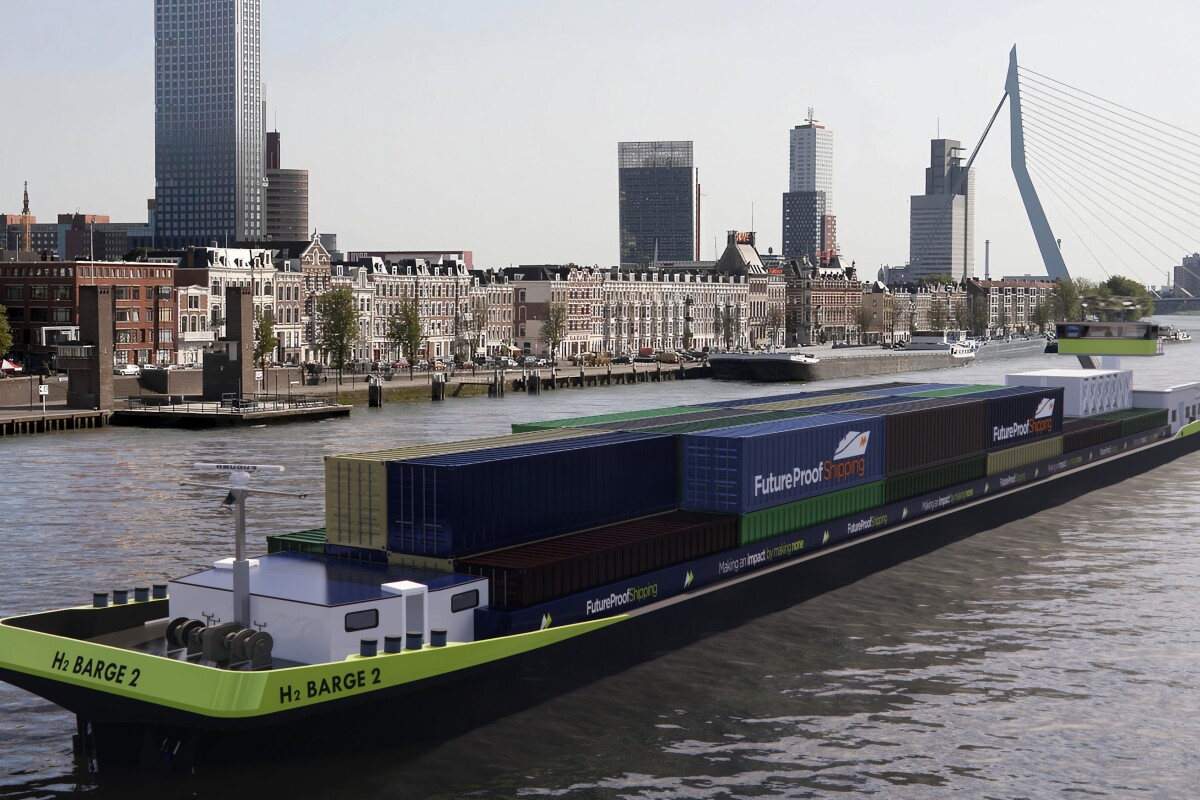
A second vessel, H2 Barge 2, followed in 2024. It was fitted with six PEM fuel cell modules providing 1.2 MW total capacity, along with hydrogen storage tanks, battery packs, and a full electric drivetrain.
By November 2025, FPS managing director Sara Ravazza was publicly calling for government operating subsidies, arguing that without subsidy support, hydrogen shipping was simply not financially viable. Seven months later, the company was in bankruptcy.
The Numbers That Didn’t Work
The core problem was hydrogen cost. At the time of FPS’s operations, green hydrogen in the Netherlands was available at approximately €20 per kilogram. The economic threshold for hydrogen shipping to be competitive with diesel-powered inland barges is estimated at around €4–5 per kilogram — a factor of four to five below current market prices.
The gap translated directly into transport rates. FPS’s shipping costs were approximately double those of conventional diesel competition. Cargo owners — even those with stated sustainability commitments — were not willing to absorb that premium on a structural basis. According to CFO Hans Bosman in the post-bankruptcy Schuttevaer interview, interest was never the problem: “Despite significant attention, new customers failed to materialise.” The interest was real. The contracts were not.
The decision to build the H2 Barge 2 without secured customer contracts proved to be the company’s undoing. Bosman’s reflection was blunt: “Had we only kept the first ship, the world would look different.” With a single vessel, the demonstration project was fundable as an innovation asset. Two vessels required commercial throughput that the market was not yet providing.
Lesson 1: Never Build Hydrogen-Only Without a Conventional Fallback
FPS’s vessels were purpose-converted to run on hydrogen. When hydrogen became too expensive to operate commercially, the vessels could not generate revenue. There was no diesel mode, no LNG backup, no bridge fuel. The ships sat at a cost — capital servicing, berth fees, crew — with no income path unless green hydrogen became affordable.
This is a design decision, not just a financial one. The most resilient hydrogen vessel projects operating today have maintained conventional fuel capability alongside their hydrogen systems. Norway’s MF Hydra, the world’s first liquid hydrogen ferry, operates with a diesel backup system that allows it to continue service when hydrogen supply is interrupted or unavailable. The same logic applies to virtually every dual-fuel vessel currently under development: dual-fuel is not a hedge against commitment to hydrogen, it is risk management for a market that is not yet mature.
The argument for hydrogen-only vessels is efficiency and purity — no diesel tanks, simpler classification, cleaner messaging to customers. The counterargument, validated by the FPS failure, is that hydrogen-only vessels carry an all-or-nothing exposure to hydrogen economics. If the fuel price doesn’t come down on schedule, or if supply infrastructure is disrupted, the vessel is stranded.
The practical implication for vessel designers and operators: specify dual-fuel capability at the design stage, even if the intention is to run on hydrogen. The cost of retaining conventional fuel capability at build time is a fraction of the cost of a stranded asset.
Lesson 2: The Market Is Not Ready — and Interest Is Not Demand
The FPS story is not unique. Norwegian maritime fuel cell manufacturer TECO 2030 filed for bankruptcy in December 2024, having been unable to raise the capital needed to bring its factory to production scale. CEO Tore Enger was direct about the cause: “Investment had come to a halt across Norway and Europe in green projects. Potential investors do not trust that the requirements for emission reductions will come.”
Both companies were technically sound. Both had credible teams and genuine industry support. Both failed for the same underlying reason: there is not yet enough paying demand for green transport to sustain a commercial business at current hydrogen costs.
The distinction between interest and demand matters precisely here. FPS attracted Nike as an anchor customer, royal visits, conference invitations, and extensive press coverage. None of that translated into a second, third, and fourth shipper willing to sign contracts at twice the market rate. Sustainability managers express genuine interest in zero-emission transport. Procurement managers sign contracts at market-competitive rates. The gap between those two conversations is where hydrogen shipping businesses go to die.
This is not a permanent condition. When hydrogen prices fall — through electrolyser scale-up, grid tariff reform, and dedicated green power procurement — the economics will shift. The FuelEU Maritime GHG intensity targets, escalating from −2% today to −80% by 2050, will eventually create regulatory pressure that converts interest into contractual necessity. But “eventually” and “today” are not the same investment horizon, and businesses that required commercial viability in 2024–2026 could not wait for 2030–2035 market conditions.
What the Sector Should Take From This
FPS’s bankruptcy is a data point, not a verdict on hydrogen shipping. The company ran hydrogen-powered commercial vessels for three years, accumulated genuine operational knowledge, and demonstrated that the technology works. That knowledge base — lessons on fuel cell management, hydrogen logistics, hull integration, regulatory certification — does not disappear with the bankruptcy.
What the failure demonstrates is that the demonstration phase and the commercial phase of hydrogen shipping require different business models. Demonstration projects can be sustained by grant funding, innovation subsidies, and anchor customers willing to pay a premium for first-mover positioning. Commercial operations require either a fuel cost that competes with diesel, or a regulatory floor that forces all competitors to pay the same green premium.
Neither of those conditions exists for inland shipping in the Netherlands in 2026. The hydrogen price threshold of €4–5/kg is roughly where European green hydrogen production costs are projected to arrive in the early 2030s — not today.
The vessel operators and shipowners tracking this site who are planning hydrogen-capable newbuildings or retrofits should draw three concrete conclusions from the FPS failure:
- Retain conventional fuel capability until hydrogen supply chains are mature and hydrogen prices are competitive. Dual-fuel is not compromise; it is survival.
- Do not scale ahead of committed offtake. A second vessel requires a second customer. Do not build on projections.
- Lobby for the regulatory floor. FPS needed carbon pricing or a minimum green fuel obligation at inland terminals to make its economics work. Without policy that internalises the carbon cost of diesel, green transport cannot compete on price. The EU Ports Strategy and FuelEU Maritime are moving in the right direction — but the absence of a minimum supply obligation for Sustainable Maritime Fuels means the commercial conditions for the next FPS do not yet exist.
The pioneering work was real. The timing was not.
Sources
- Schuttevaer: Future Proof Shipping gaat ten onder (June 5, 2026)
- FaillissementsDossier: Faillissement Future Proof Shipping B.V. (F.13/26/169)
- Binnenvaartkrant: Pionier in waterstofvaart Future Proof Shipping failliet
- Schuttevaer: Kiloprijs waterstof moet rond vier of vijf euro liggen (April 2026)
- Schuttevaer: FPS pleit voor subsidie om te blijven varen op waterstof (November 2025)
- Maritime Executive: TECO 2030 files for bankruptcy (December 2024)
- Ship & Bunker: TECO 2030 Goes Bust
- Offshore Energy: FPS retrofitted vessel cleared to sail on hydrogen