Klaipėda Port has inaugurated Lithuania’s first green hydrogen production and refuelling facility — a PEM electrolyser capable of producing around 127 tonnes of hydrogen per year, backed by €12 million in investment and half-funded by the EU. A hydrogen-powered waste collection vessel is close to completion and will become the country’s first green hydrogen-powered ship. Commercial hydrogen supply to external customers begins in autumn 2026. For the Baltic Sea region, this is a meaningful first step from aspiration to operational infrastructure.
⚡ TL;DR
- What: Lithuania's first green hydrogen production and refuelling station at Klaipėda Port — PEM electrolyser, ~127 t/year capacity.
- Key data: €12M total investment; €6M from NextGenerationEU; first hydrogen produced April 2026; commercial supply from autumn 2026.
- Maritime first: A hydrogen-powered port service vessel (waste collection) is near completion — Lithuania's first hydrogen-powered ship.
- Partners: LTG Group (rail), BEGA stevedoring, Volvo Lietuva (road); construction by Inžinerinis projektavimas, MT Group, Gevalda.
- Watch for: Commercial bunkering launch (autumn 2026) and the waste collection vessel entering service.
What Was Built
The facility at Klaipėda — Lithuania’s only seaport and the country’s main cargo gateway on the Baltic — is built around a polymer electrolyte membrane (PEM) electrolyser that produces green hydrogen from grid electricity. At full capacity the plant will generate approximately 127 tonnes of green hydrogen per year, equivalent to roughly 350 kg per day.
The development timeline ran from project launch in 2023 through construction start in summer 2025, main equipment delivery in October 2025, and first hydrogen production in April 2026. The official inauguration in June 2026 marks the transition from commissioning to early operations. Commercial hydrogen supply to external customers is scheduled for autumn 2026.
The total investment is approximately €12 million, of which €6 million came from the European Union’s NextGenerationEU recovery and resilience facility via Lithuania’s Economic Recovery and Resilience Plan. The EU co-funding reflects the facility’s role as demonstration infrastructure rather than a purely commercial project — the economics of on-site electrolytic hydrogen production at this scale do not yet stand on their own.
| Parameter | Detail |
|---|---|
| Electrolyser technology | PEM (polymer electrolyte membrane) |
| Annual production capacity | ~127 tonnes H₂/year |
| Daily production equivalent | ~350 kg/day |
| Total investment | €12 million |
| EU funding | €6 million (NextGenerationEU) |
| First hydrogen produced | April 2026 |
| Commercial supply start | Autumn 2026 |
| Port authority own use | ~25% of production |
The Waste Collection Vessel: Lithuania’s First Hydrogen Ship
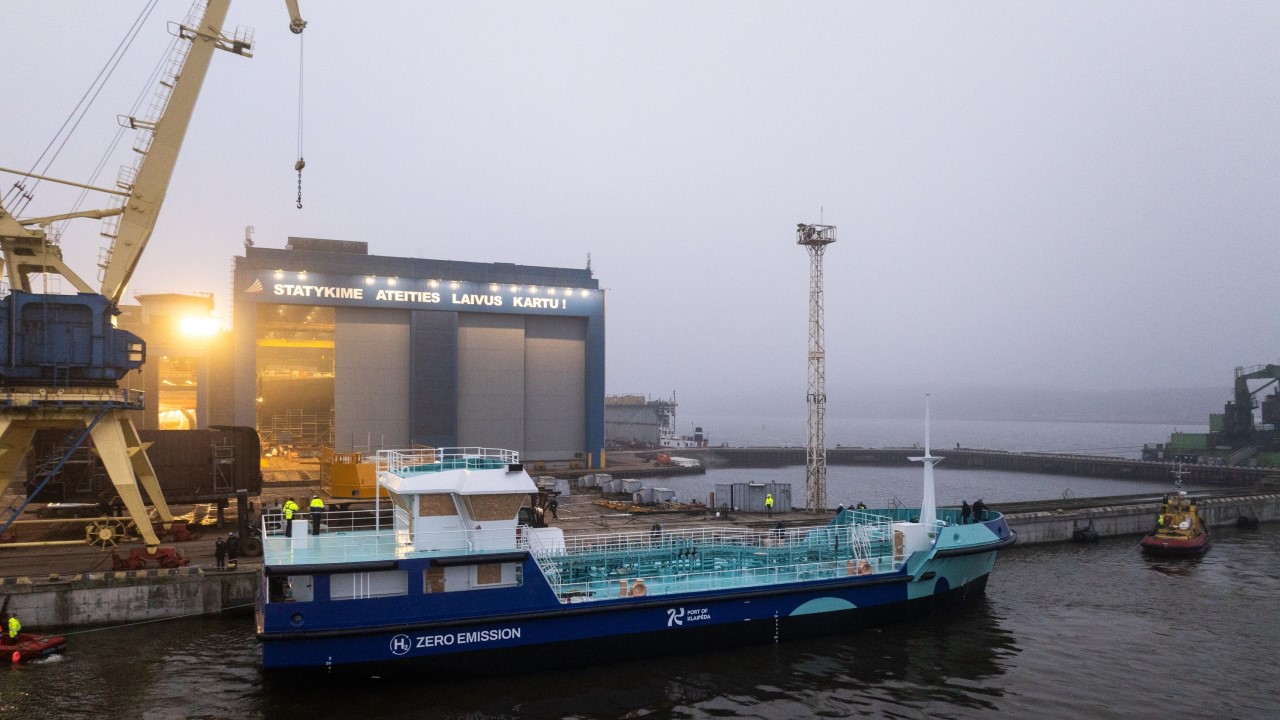
The most directly maritime element of the project is a hydrogen-powered waste collection vessel currently near completion, which will become the country’s first green hydrogen-powered ship. It will operate within Klaipėda Port collecting waste from vessels calling at the port — including stormwater, sewage, sludge, and garbage — replacing a conventional diesel-powered service vessel.
The vessel’s propulsion system combines two electric motors fed by a 2,000 kWh battery pack and hydrogen fuel cell systems. The design logic is straightforward from a naval architect’s perspective: a port service vessel with short, predictable operational cycles is an ideal first platform for hydrogen fuel cell integration. Range anxiety is minimal, turnaround times are controlled, and the refuelling point is co-located with the production facility. It is the same logic that made harbour tugs and passenger ferries on fixed routes the first commercial applications of hydrogen propulsion elsewhere in Europe.
The production scale — 350 kg/day at full output — is sized appropriately for this initial application. A waste collection vessel of the type described would likely consume on the order of 20–50 kg of hydrogen per operational day. The remaining production is available for the port authority’s own fleet, the partner organisations’ vehicles, and from autumn 2026, commercial customers.
A Multi-Sector Demand Base
Klaipėda Port Authority has structured the project with a deliberate multi-sector demand base rather than relying on maritime consumption alone. At 127 t/year, the facility cannot sustain meaningful commercial ship bunkering by itself — but it can demonstrate hydrogen production economics, build operational competence, and supply a portfolio of initial users across transport modes.
The confirmed partner organisations represent three sectors:
| Partner | Sector | Role |
|---|---|---|
| LTG Group | Rail | Hydrogen for rail operations |
| BEGA (Klaipėda Stevedoring) | Port logistics | Hydrogen for port equipment |
| Volvo Lietuva | Road transport | Hydrogen for heavy-duty trucks |
| Klaipėda Port Authority | Maritime/fleet | Waste collection vessel + Toyota Mirai fleet |
A Toyota Mirai hydrogen fuel cell car has already joined the port authority’s vehicle fleet, providing a small but immediate demand point while the larger consumers come online. This multi-sector approach is sensible: it diversifies early offtake risk and builds the case for a larger second-phase facility based on demonstrated demand across modes.
Scale and Context
127 tonnes per year is a modest production volume by the standards of the projects hydrogenshipbuilding.com normally tracks. The EcoLog Amsterdam terminal we covered recently targets 200,000 tonnes of LH2 per year in Phase 1 — roughly 1,600 times the Klaipėda output. The ELIRE Maritime floating hydrogen hub concept validated under UK CMDC6 funding was designed to dispense 7,500–8,000 kg per week — about twice Klaipėda’s daily output.
But the comparison is not really fair, because Klaipėda is solving a different problem. The Amsterdam and Hamburg terminals are import-and-distribution infrastructure designed for the 2030s. Klaipėda is building local production and operational competence in 2026. The two types of infrastructure are complementary: ports that operate hydrogen equipment today will be better positioned to handle large-scale hydrogen imports when supply chains mature.
From a port operations perspective, the key question is not whether 127 t/year is enough to bunker commercial vessels — it is not — but whether the operational knowledge gained here translates into the capability to manage hydrogen safely at larger volumes. That knowledge does not come from planning documents; it comes from running the equipment.
Klaipėda Port already has relevant precedent here. Lithuania’s Independence FSRU (floating storage and regasification unit), moored at Klaipėda, made Lithuania the first Baltic state with LNG import capacity when it entered service in 2014. The port demonstrated then that it could manage cryogenic energy infrastructure ahead of broader regional adoption. The hydrogen facility follows that pattern.
What Comes Next
The autumn 2026 commercial supply launch is the near-term milestone to watch. At that point, Klaipėda shifts from demonstration project to operating hydrogen supplier, and the economics of the facility become visible in practice.
Beyond that, the scaling question is unavoidable. The EU Ports Strategy adopted in March 2026 designates ports as multi-fuel energy hubs and anticipates growing hydrogen infrastructure across EU port networks. For Klaipėda to develop into a serious bunkering hub for Baltic shipping, it would need a production facility an order of magnitude larger, or access to imported hydrogen from a Northern European production corridor.
The current facility does not yet enable that. But it establishes the operational baseline — safety management, refuelling procedures, maintenance protocols, regulatory classification — on which a larger facility can be built.
Why This Matters
For the hydrogen-powered ships database we maintain, the Klaipėda waste collection vessel represents a category that is underrepresented: port service vessels. Most hydrogen ship projects target ferries, cruise ships, or offshore support — higher-profile applications with larger fuel consumption. But port service vessels (tugs, waste collectors, pilot boats, line boats) are in many ways the ideal entry point for hydrogen propulsion: they operate within a port’s controlled environment, return to base daily, and are often publicly owned, making them less sensitive to the fuel cost premium.
Lithuania becomes the second Baltic state after Norway to operate a hydrogen-powered vessel in a port context. The hydrogen-powered ships database tracks several port service applications already operating in Northern Europe; the Klaipėda vessel will join that list when it enters service.
Challenges and Open Questions
- Production economics: At €12M for 127 t/year capacity, the capital cost is approximately €94,000 per tonne of annual capacity — high by comparison with planned large-scale projects, reflecting the small-scale electrolysis penalty. Without subsidy, the hydrogen produced here cannot compete with diesel on cost.
- Scaling path: 127 t/year supports the port service vessel and fleet vehicles, but commercial ship bunkering requires at minimum 10× this volume. The business case for a Phase 2 expansion will depend on demonstrated demand from the autumn 2026 commercial launch.
- Grid carbon intensity: Lithuania’s electricity grid is partially decarbonised but still mixed. The carbon intensity of electrolytic hydrogen is directly linked to the grid mix at time of production; the facility’s green credentials depend on renewable power procurement or time-of-use matching.
- Regional competition: Estonia and Latvia are also developing Baltic hydrogen strategies. Klaipėda has a first-mover advantage, but the Baltic hydrogen hub question is not settled.
Sources
- Container News: Klaipėda Port opens Lithuania’s first green hydrogen station (June 2026)
- H2 Tech: Port of Klaipėda green hydrogen project enters testing phase (February 2026)
- Fuel Cells Works: Klaipėda Port opens Lithuania’s first green hydrogen station (June 2026)
- Ship & Bunker: Lithuania opens first green hydrogen refuelling facility at Klaipėda Port
- Manifold Times: Klaipėda Port launches Lithuania’s first green hydrogen production refuelling facility
- Port of Klaipėda: Green Port hydrogen project page