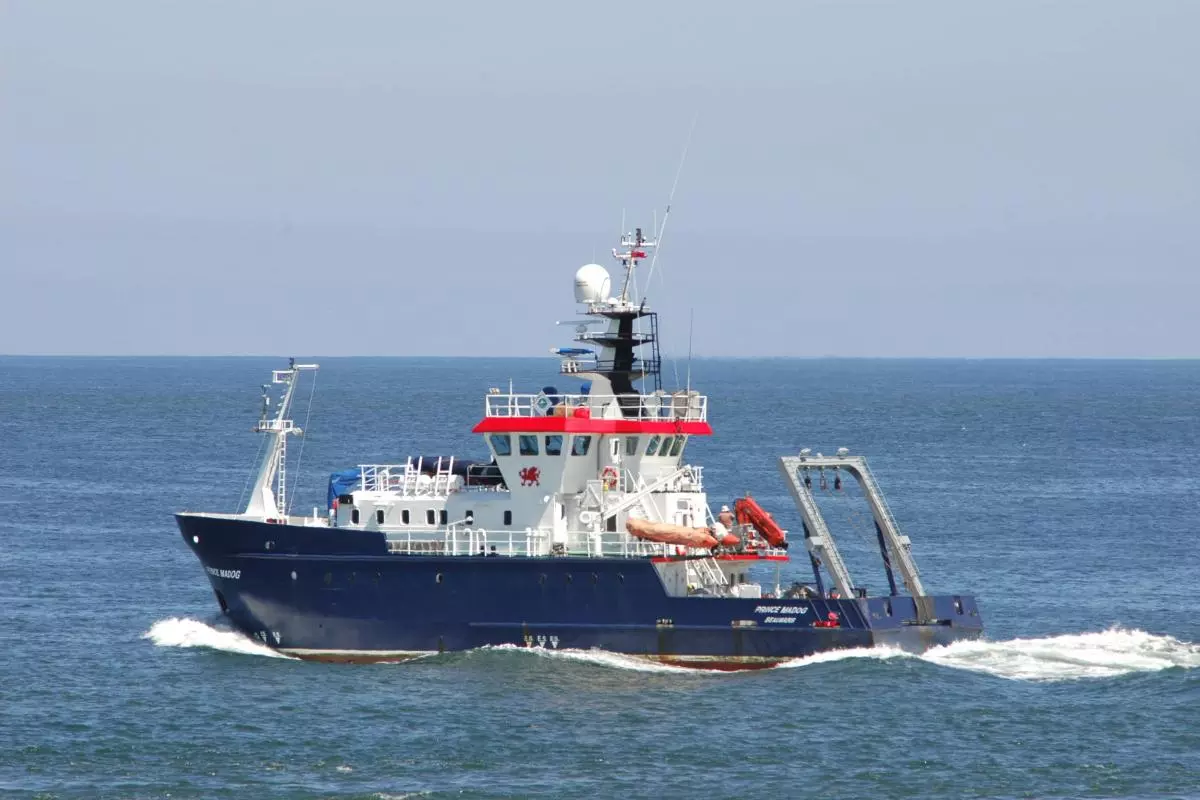
Lloyd’s Register has granted class certification to the hydrogen fuel cell retrofit of RV Prince Madog, a 34.9-metre UK research vessel operated by Bangor University’s School of Ocean Sciences. Awarded at Seaworks 2026 in Southampton under LR’s ShipRight Risk Based Certification framework, this is the first sea-going, manned hydrogen retrofit to reach this regulatory milestone. The £5.5 million TransShip II project — funded through the UK Government’s Clean Maritime Demonstration Competition — is significant not only as a technical demonstration but as a proof that an established certification pathway now exists for hydrogen retrofits that fall outside traditional class rules.
⚡ TL;DR
- What: LR ShipRight Risk Based Certification granted to the hydrogen fuel cell retrofit of RV Prince Madog — first sea-going, manned hydrogen retrofit to achieve class certification.
- Vessel: 34.9m research vessel, 390 GT, built 2001, operated by Bangor University; owner O.S. Energy.
- Propulsion: Hydrogen-electric hybrid alongside existing diesel; up to 60% emissions reduction in hybrid mode, zero-emission at low speeds.
- Funding: £5.5M via UK CMDC Round 3 (Innovate UK / Department for Transport); three years of development.
- Why it matters: ShipRight RBC establishes a replicable certification route for hydrogen retrofits outside traditional regulatory frameworks — the first time this pathway has been used for a manned, sea-going vessel.
The Vessel and the Project
RV Prince Madog has operated as Bangor University’s oceanographic research vessel since 2001. At 34.9 metres length overall and approximately 390 gross tonnes, she is a mid-sized coastal research vessel with a crew of eight and nine scientific berths, designed for survey and oceanographic work in UK coastal and shelf waters. Her design speed is 10.5 knots with an endurance of ten days.
The TransShip II consortium, led by O.S. Energy, was awarded £5.5 million under Round 3 of the UK Government’s Clean Maritime Demonstration Competition (CMDC3), administered by Innovate UK on behalf of the Department for Transport. The retrofit project began in April 2023 and involved three years of development work before reaching the LR certification milestone in June 2026.
The original consortium was broad, including H2Tec (a Logan Energy subsidiary), Solis Marine Engineering, Newcastle Marine Services, Chartwell Marine, Cedar Marine, Stone Marine Propulsion, and the Universities of Exeter and Newcastle-upon-Tyne. At the certification stage, the hydrogen system integration work is credited to Ecomar Propulsion, a UK-based hydrogen and clean energy systems specialist.
| Parameter | Detail |
|---|---|
| Vessel | RV Prince Madog |
| Flag | UK |
| Operator | Bangor University (School of Ocean Sciences) |
| Owner / Lead | O.S. Energy |
| LOA | 34.9 m |
| GT | ~390 |
| Built | 2001, Visser |
| Project name | TransShip II |
| Total investment | £5.5 million |
| Funding source | UK CMDC Round 3 (Innovate UK / DfT) |
| Certification | LR ShipRight Risk Based Certification (RBC) |
| Certified at | Seaworks 2026, Southampton |
What Was Retrofitted
The retrofit integrates a gaseous hydrogen storage system and hydrogen fuel cell array with the Prince Madog’s existing diesel propulsion — producing a hydrogen-electric hybrid arrangement rather than a hydrogen-only vessel. This design choice is worth noting: the vessel retains its diesel capability, with the fuel cell system supplementing power at lower loads and enabling zero-emission operation at slow speeds or short distances, and up to 60% emissions reduction in normal hybrid operation.
From a naval architect’s perspective, this is the sensible approach for a retrofit on an existing vessel. The diesel main engine provides range, redundancy, and power for demanding operational conditions; the hydrogen system handles the emissions-sensitive portion of the duty cycle — port manoeuvring, slow-speed survey work, and coastal transits. The propulsion design was developed by O.S. Energy’s in-house naval architecture and R&D team, with Ecomar Propulsion managing the hydrogen system through integration and certification.
The fuel cell system is connected to the vessel’s electrical bus alongside a battery pack, forming a hybrid architecture that manages energy dispatch between the three sources: diesel generator, fuel cell, and battery. Specific fuel cell power ratings and hydrogen storage volumes have not been disclosed in publicly available project documentation.
The ShipRight RBC Pathway — Why It Matters
The certification framework is as significant as the vessel itself. LR’s ShipRight Risk Based Certification (RBC) is designed to provide an assurance route for technologies that fall outside the scope of traditional prescriptive class rules. When the rules were written, hydrogen fuel cells were not contemplated as marine propulsion. The ShipRight RBC framework allows a project team to demonstrate that its specific design achieves an equivalent — or better — level of safety through a documented risk-based process, without waiting for formal rule amendments.
For hydrogen retrofit projects, this matters because:
- The International Maritime Organization’s relevant codes (IGF Code, interim guidelines for fuel cells) were written primarily for new builds and do not address retrofit integration comprehensively
- Lloyd’s Register’s own class rules have evolved, but the regulatory framework for hydrogen on existing manned vessels remains immature
- ShipRight RBC provides a project-specific route to certification, generating documentation that future projects can reference
The LR certification on Prince Madog is the first time this pathway has been formally applied to a sea-going, manned hydrogen retrofit. Mark Nijhoff of Lloyd’s Register stated that “projects like Prince Madog demonstrate hydrogen technologies can be implemented safely and pragmatically,” while Oliver Cornforth of O.S. Energy described the certification as establishing “a pathway for the adoption of hydrogen propulsion on workboats and larger commercial vessels.”
LR has separately published LR-GN-061, the maritime industry’s first dedicated guidance notes for onboard hydrogen generation, which addresses a related regulatory gap — the lack of clear technical requirements for vessels generating hydrogen from other fuels aboard. Together, these steps are building the regulatory infrastructure that hydrogen shipping needs.
| Regulatory element | Status |
|---|---|
| IMO IGF Code (hydrogen) | Interim guidelines; new builds only |
| LR Rules for hydrogen fuel cells | Evolving; gap for retrofit integration |
| ShipRight RBC (project-specific) | First manned retrofit certified — Prince Madog |
| LR-GN-061 (onboard H2 generation) | Published 2026 — industry first |
The Holyhead Hydrogen Hub Connection
When operational, the Prince Madog will be bunkered with hydrogen from the Holyhead Hydrogen Hub at Parc Cybi on Anglesey, North Wales — a land-based hydrogen production facility under development. This is a meaningful detail: the project is not simply demonstrating hydrogen propulsion in isolation, but establishing a shore-to-ship hydrogen supply chain in a specific UK regional context.
Parc Cybi benefits from Anglesey’s position as a candidate site for offshore wind development and its established energy infrastructure. For O.S. Energy and Bangor University, having a committed hydrogen supply source in proximity to the vessel’s home port resolves one of the central questions facing any hydrogen vessel project: where does the fuel actually come from?
This mirrors the logic we have seen in other hydrogen port projects. The ELIRE Maritime floating hydrogen hub — also CMDC-funded — addresses exactly this problem by positioning supply infrastructure at the point of demand. The Holyhead-Klaipėda-ELIRE cluster of projects collectively illustrates that the near-term hydrogen maritime ecosystem is being built around specific, regional supply chains rather than a unified bunkering network.
Hybrid Design: The Right Call for Research Vessels
The hybrid hydrogen-diesel architecture deserves analysis on its merits, not just as a transitional compromise. Research vessels have inherently variable power demand profiles: high-speed transits between survey areas, slow-speed station keeping during scientific operations, and occasional peak demands from scientific winches, dynamic positioning, and deck machinery.
This profile is well-suited to hybrid operation. The fuel cell produces clean, consistent power at its rated efficiency point — ideal for the sustained low-power scientific operating mode. The diesel covers peak demands and provides range on transits where hydrogen consumption would otherwise be prohibitive. The battery buffers load transients that neither source handles efficiently.
The outcome is more genuinely useful than a hydrogen-only design would be for this vessel type. We saw in the collapse of Future Proof Shipping that hydrogen-only vessels carry all-or-nothing fuel risk: when hydrogen is unavailable or unaffordable, the vessel earns nothing. The Prince Madog retrofit avoids that exposure by design.
From a naval architecture perspective, the hybrid arrangement also means the conversion does not require structural modification to accommodate hydrogen storage for the vessel’s full endurance — only the portion of the fuel cycle the fuel cell system is intended to serve. That significantly reduces the retrofit complexity and cost compared to a full hydrogen replacement of the diesel system.
Why This Matters for the Wider Fleet
The UK workboat and coastal research vessel fleet runs to hundreds of vessels in the 20–80 metre range. Most are diesel-powered, most operate on short, predictable routes, and most are controlled by public institutions, universities, or port authorities — owners who are often more receptive to sustainability investment than commercial operators facing tight freight margins.
The ShipRight RBC certification on Prince Madog means there is now a documented, approved pathway for hydrogen fuel cell retrofit on a manned, sea-going vessel of this type. The next project team that approaches Lloyd’s Register with a similar proposal — a port pilot boat, a hydrographic survey vessel, a harbour patrol craft — has a precedent to work from.
The hydrogen-powered ships database shows that fuel cell propulsion in the marine sector has so far concentrated in ferries, offshore support vessels, and port service craft. The research vessel category is underrepresented. Prince Madog will change that, and the certification framework it has established should accelerate conversions in the broader workboat segment — particularly as FuelEU Maritime’s GHG intensity trajectory tightens through the 2030s.
Challenges and Open Questions
- Specific fuel cell and storage specs have not been publicly disclosed, limiting the ability to model what duty cycles the system can serve and at what cost. Transparency on these parameters would help the wider industry learn from the project.
- Holyhead Hydrogen Hub progress: the vessel’s operational hydrogen supply depends on Parc Cybi delivering fuel reliably. If the shore-side facility is delayed, the vessel’s hybrid capability becomes a demonstration rather than a commercial reality.
- Cost of retrofitted hydrogen: At research vessel scale, on-site electrolysis hydrogen in Wales will not be cheap in 2026. The operational economics of the fuel cell system will depend heavily on what the university pays per kilogram — and whether CMDC funding covers operating costs as well as capital.
- Replication at commercial scale: The ShipRight RBC pathway works for individual project certification. A scalable workboat retrofit programme needs more standardised LR rules, not just project-by-project risk assessments. The Prince Madog certification is a precedent, not yet a standard.
Sources
- Ship & Bunker: UK hydrogen vessel retrofit wins LR certification
- Marine Link: LR certifies R/V Prince Madog hydrogen fuel cell retrofit
- All About Shipping: Prince Madog hydrogen fuel cell retrofit wins LR certification
- India Shipping News: Prince Madog hydrogen fuel cell retrofit wins LR certification
- Bangor University: Prince Madog to be powered by hydrogen in £5.5M TransShip II project
- Lloyd’s Register: LR-GN-061 guidance notes for onboard hydrogen generation
- Fuel Cells Works: Prince Madog hydrogen fuel cell retrofit wins LR certification