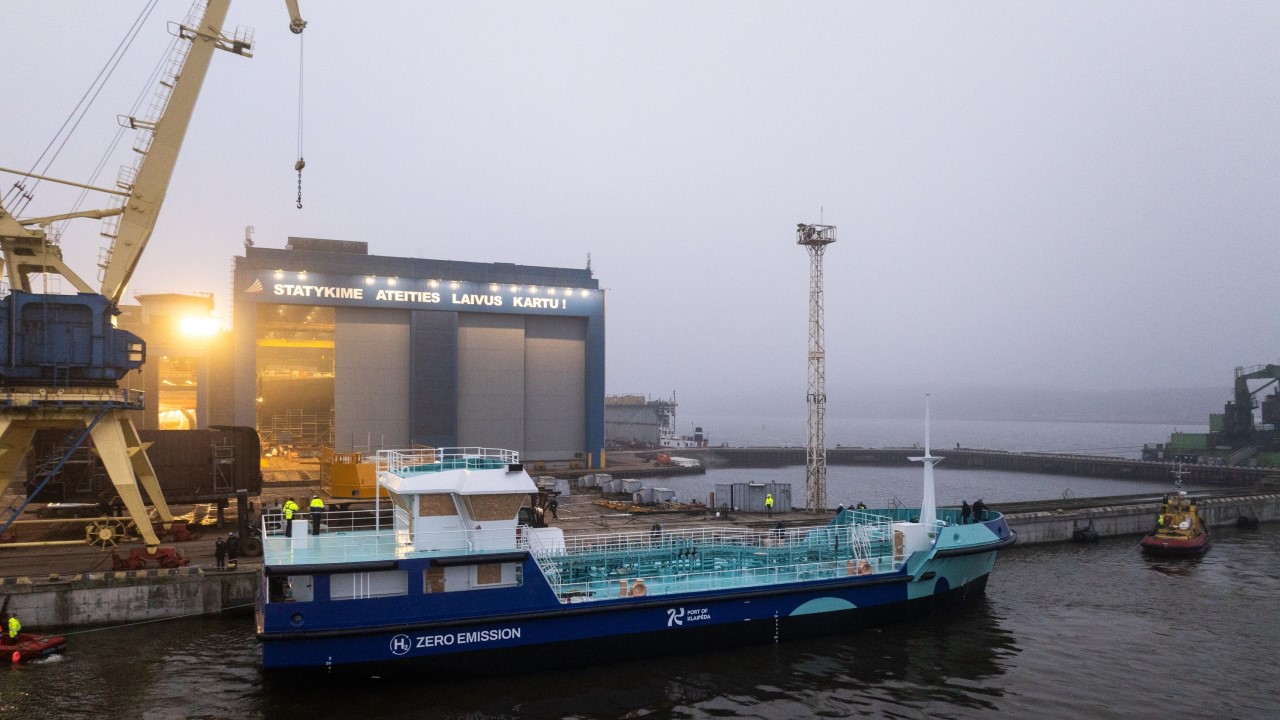
Rasa — Lithuania’s first hydrogen-powered vessel — has entered service at Klaipėda Port. Christened on 18 June 2026, the 42-metre waste collection tanker runs on two Genevos hydrogen fuel cells and a 2 MWh battery, with no diesel or LNG on board. It collects bilge water, sludge, sewage, and garbage from vessels calling at the port, operating 24/7 on green hydrogen produced on-site at Klaipėda’s newly inaugurated PEM electrolyser. Rasa is the world’s first commercial tanker of any kind to run exclusively on green hydrogen and battery power without a fossil-fuel fallback.
⚡ TL;DR
- Vessel: MV Rasa — 42 m waste collection tanker, 400 m³ liquid waste capacity, crew of 3.
- Propulsion: 2× Genevos HPM-40 fuel cells (80 kW total) + 2 MWh EST-Floattech battery + Danfoss Editron electric drive.
- Builder: Baltic Workboats (Nasva, Estonia) / hull by Western Baltija Shipbuilding (Klaipėda).
- Fuel: 100% compressed green hydrogen, no pilot fuel, no diesel fallback.
- In service: Christened 18 June 2026; hydrogen supplied by Klaipėda Port's on-site PEM electrolyser.
The Vessel
Rasa is a purpose-built waste collection tanker operated by Klaipėda State Seaport Authority. At 42 metres length overall and 10 metres beam, she is a medium-sized port service vessel — comparable in footprint to a small harbour tug or pilot boat, but optimised for waste handling rather than towage.
Her primary function is collecting liquid waste from ships at berth in Klaipėda: bilge water, sewage, sludge, and stormwater are taken aboard and transported to onshore treatment facilities. The vessel can hold up to 400 m³ of liquid waste per trip, operating 24/7 on a cycle that keeps her working continuously within the port boundary.
The vessel was designed by Western Baltic Engineering and built as a collaborative project between Baltic Workboats (BLRT Grupp, Nasva shipyard, Saaremaa island, Estonia) and Western Baltija Shipbuilding (Klaipėda), which constructed the hull. Baltic Workboats handled the electric propulsion integration, power management, automation, battery packs, control systems, and interior outfitting.
| Parameter | Detail |
|---|---|
| Vessel name | Rasa |
| Type | Waste collection tanker |
| Owner / operator | Klaipėda State Seaport Authority |
| Builder | Baltic Workboats (BLRT Grupp), Nasva, Estonia |
| Hull | Western Baltija Shipbuilding, Klaipėda |
| LOA | 42 m |
| Beam | 10 m |
| Crew | 3 |
| Cargo capacity | 400 m³ liquid waste and sludge |
| Max speed | 8 knots |
| Christened | 18 June 2026 |
The Propulsion System
Rasa is a battery-dominant, fuel cell-extended vessel. The distinction matters for understanding how she is actually operated.
The primary energy reservoir is a 2,000 kWh battery system supplied by Dutch company EST-Floattech — a large pack that can sustain approximately eight hours of port operations on battery power alone. Two Genevos HPM-40 hydrogen fuel cell modules, each rated at 40 kW continuous output, function as range extenders: they run continuously to replenish the battery and extend operational endurance by approximately 40% relative to battery-only operation at 8 knots. Together the fuel cells contribute 80 kW of steady-state power.
The electric propulsion package is supplied by Danfoss Editron, whose drives and motors convert the combined battery/fuel cell output into shaft power. Total zero-emission operational duration exceeds 10 hours continuously under normal port duty cycles.
This architecture is the right choice for a waste collection vessel. Port service craft have predictable duty cycles, operate within a bounded area, and return to base frequently — making battery-dominant operation feasible in a way it would not be for a vessel making open-sea passages. The fuel cells top up the battery during operation rather than providing direct propulsion power; the battery absorbs load transients without stressing the fuel cells; and the result is a simple, well-integrated system with high reliability.
It is also worth noting the absence of a diesel backup. Most hydrogen demonstration vessels at this stage retain a fossil-fuel fallback for operational risk management — the rationale being that if hydrogen supply is disrupted, the vessel must still be able to work. Rasa has no such fallback. That decision is made possible by the fact that Rasa’s hydrogen supply comes from the same facility she is moored at: Klaipėda Port’s on-site PEM electrolyser. Supply disruption risk is a port operations problem, not a bunkering logistics problem.
The Hydrogen Supply Chain
Rasa does not rely on a hydrogen supply chain in the conventional sense. Her fuel is produced on-site at Klaipėda Port’s Green Port hydrogen facility — the same PEM electrolyser we covered in our Klaipėda hydrogen station post earlier this month.
That facility produces approximately 127 tonnes of green hydrogen per year (roughly 350 kg/day at full output) from grid electricity. A waste collection vessel of Rasa’s size, operating on the fuel cell range-extender model described above, would consume on the order of 20–50 kg of hydrogen per operational day — well within what the on-site plant can supply while retaining capacity for road transport customers (LTG rail group, Volvo Lietuva trucks) and port fleet vehicles (a Toyota Mirai is already in service).
This co-location of supply and demand is the cleanest possible hydrogen logistics arrangement. It eliminates transport costs, eliminates the need for a dedicated bunkering vessel or high-pressure transfer infrastructure beyond what is needed at one fixed point, and simplifies the overall system to: electrolyser → compressor → bunker station → vessel.
Baltic Workboats and the BLRT Grupp Context
The builder, Baltic Workboats, is an Estonian shipyard on Saaremaa island that specialises in aluminium and steel workboats for pilot, patrol, fire-fighting, and survey applications. It is part of BLRT Grupp, a Baltic industrial conglomerate with shipbuilding and ship repair operations across Estonia, Latvia, and Lithuania — which is why the hull construction was handled by the group’s Lithuanian yard, Western Baltija Shipbuilding, while the systems integration work was done in Estonia.
For Baltic Workboats, Rasa is a first on two counts: the first vessel built at their Nasva facility, and the first vessel in their portfolio to use hydrogen as an onboard energy source. Peeter Raamat, R&D Head at Baltic Workboats, stated: “Baltic Workboats is pleased to have found a company that shares our values in advancing new technology in the maritime industry” — a reference to the relationship with Genevos, the French fuel cell supplier.
Genevos is a French marine fuel cell company whose HPM series modules are designed specifically for marine environments: vibration tolerance, salt-spray resistance, and compact packaging for retrofit and newbuild integration. Genevos’ selection as the fuel cell supplier for Rasa was announced in mid-2024, when the keel-laying ceremony took place. The HPM-40 module — two of which are installed on Rasa — is rated at 40 kW continuous with a compact form factor suited to port service vessel machinery spaces.
Why Port Service Vessels Lead the Way
Rasa joins a growing category of hydrogen vessels that are making the technology’s case through operational reality rather than demonstration tonnage. In the hydrogen-powered ships database, port service vessels — tugs, pilot boats, waste collectors, patrol craft — are increasingly prominent alongside the higher-profile ferry and offshore applications.
The case for port service vessels as the leading edge of hydrogen propulsion is structural:
- Fixed home port: they do not need a distributed bunkering network; one refuelling point suffices
- Predictable duty cycles: battery and fuel cell sizing can be optimised rather than over-engineered for worst-case scenarios
- Public ownership: port authorities are typically more receptive to sustainability investment than commercial operators working against freight margin pressure
- Regulatory access: port authorities often control the planning permissions, quay allocations, and utility connections needed to build on-site hydrogen production
These same factors apply to the Hydrotug at Antwerp, the waste collector at Amsterdam, and the pilot boats appearing in Scandinavian port programmes. Klaipėda’s Rasa fits the same template — and its distinction is that it is the first in this category to carry no fossil fuel at all, relying entirely on on-site green hydrogen.
What’s Changed Since Our Earlier Coverage
When we wrote about the Klaipėda hydrogen station opening eight days ago, Rasa was described as near completion. She has now been christened and entered service. Two updates are worth noting:
- The vessel’s name was confirmed as Rasa — a Lithuanian given name, also meaning “dew” in Lithuanian. It is a fitting choice for a vessel whose emissions are literally water.
- The entry in our ships database has been updated from
orderedtooperational, with full specifications added.
The commercial hydrogen bunkering service for external customers at Klaipėda remains on track for autumn 2026.
Sources
- Ship Energy: Port of Klaipėda’s hydrogen-fuelled waste collection vessel up and running
- Ship & Bunker: Klaipėda’s hydrogen-fuelled waste collection ship begins operations
- Workboat365: Baltic Workboats delivers electric waste tanker RASA
- Offshore Energy: Genevos to provide hydrogen fuel cell system for Lithuania’s first hydrogen-electric ship
- Fuel Cells Works: The world’s first green hydrogen-powered tanker Rasa was christened in the Port of Klaipėda
- H2Today: A hydrogen waste-collection vessel in Lithuania