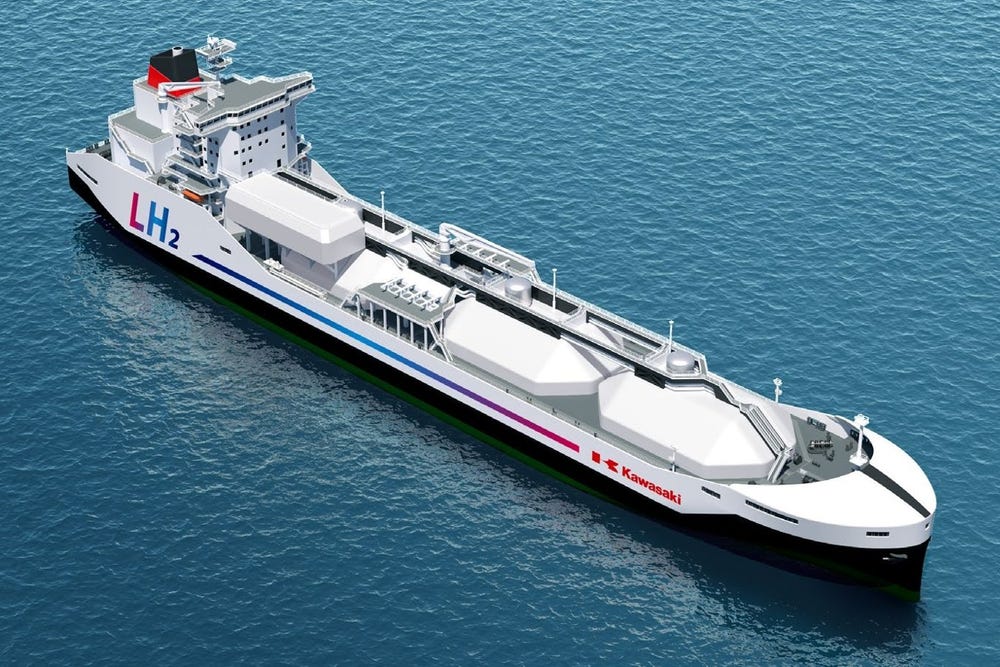
A swappable liquid hydrogen tank has cleared a major land-based test campaign in Italy — not aboard a ship, but on a purpose-built test rig in Staranzano, Gorizia. The tank itself is a fairly conventional vacuum-insulated cryogenic vessel. What’s genuinely interesting is that it’s built into a standard 40ft ISO container footprint, which sidesteps the bunkering-infrastructure problem that has stalled more than one LH2 newbuild.
⚡ TL;DR
- What: The EU-funded sHYpS (Sustainable Hydrogen Powered Ships) consortium has completed a land-based test campaign for its swappable liquid hydrogen storage container at a dedicated test site in Staranzano, Italy.
- Why it matters: The tank is built as a C-type, ISO 40ft-format container — swappable at any port with standard container-handling equipment, not dependent on bespoke shore-side LH2 bunkering infrastructure.
- Key data: Target platform is a 6 MW PEM fuel cell powertrain on a Viking Ocean Cruises newbuild, aiming to cut ~50% of emissions on a 14-day fjord cruise; Ricardo has already built a 393 kW multi-stack fuel cell module for the reduced-power demonstrator phase.
- Timeline: Project launched 2022 (~€14.3M budget); Tank Connection Space installed at Staranzano March 2026; land-based test campaign cleared August 2026; shakedown cruise testing targeted for later in 2026; a scaled-up demonstrator is planned for 2027.
- Watch for: Whether the containerised swap model gets adopted beyond this one Viking newbuild — the consortium is explicitly targeting adaptation to 5,000–8,000 DWT cargo and container vessels.
What Actually Got Tested
Land-based testing before shipboard installation is standard practice for any novel cryogenic fuel system — class societies won’t sign off on a fuel gas system that hasn’t been proven in a controlled environment first, and for LH2 at −253°C the consequences of a design flaw are not something you want to discover at sea. sHYpS’s test site at Staranzano has been building up to this campaign in stages: the Tank Connection Space (TCS) — the interface module handling the piping, instrumentation, and safety systems between the cryogenic tank and the ship’s fuel gas system — was delivered and installed on its dedicated foundation in March 2026, followed by installation of the auxiliary systems needed to run monitoring, control, and safety validation around it.
The public reporting on the campaign itself is light on hard numbers — no disclosed hold times, boil-off rates, or pressure-cycle counts from the coverage available. What is clear is that the campaign is being run by CENERGY, under Task 6.4 of the project, specifically to validate performance and safety of the storage system under operational conditions before anything goes near a shipyard. That’s the right order of operations, and it’s the same sequence Lloyd’s Register and other class societies have pushed for on every LH2 newbuild we’ve tracked on this site — land-based proving before Approval in Principle, before construction.
The Tank: Unremarkable Cryogenics in a Very Useful Box
Strip away the “swappable” framing and the core technology is what you’d expect: a vacuum-insulated, C-type pressure vessel holding liquid hydrogen at cryogenic temperature, built by Chart Industries (through its VRV containment business) to fit inside a standard ISO 40ft container envelope — roughly 2.4 m in diameter and 12 m long. C-type tanks are the established choice for LH2 and LNG at this scale specifically because the cylindrical, fully-supported geometry handles internal pressure and sloshing loads without the fatigue and support-structure complications that come with prismatic (Type B) tanks — the same logic that put C-type tanks on most small-to-mid-scale LNG-fuelled newbuilds over the last decade.
| Element | Detail |
|---|---|
| Container format | ISO 40ft, C-type cryogenic pressure vessel |
| Approx. dimensions | ~2.4 m diameter × 12 m length |
| Tank design/manufacture | Chart Industries (VRV) |
| Fuel gas handling & ship integration | NAVALPROGETTI |
| Fuel cell / energy management design | Ricardo |
| Test site | Staranzano, Gorizia, Italy (CENERGY) |
| Target platform | Viking Ocean Cruises newbuild |
| Target powertrain | 6 MW PEM fuel cell |
| Demonstrator fuel cell built to date | 393 kW multi-stack module (Ricardo) |
What isn’t unremarkable is the packaging decision. By keeping the tank inside a standard container footprint that fits existing reach stackers, gantry cranes, and container chassis, sHYpS is deliberately trading some volumetric efficiency for something ports already know how to handle. A fixed, ship-integrated cryogenic tank — the approach behind most LH2 newbuild concepts we cover, including the large-scale vacuum-insulated tanks Lloyd’s Register has been granting Approval in Principle for elsewhere in Asia — gets you better stowage factor and a simpler gas system, but it also means the vessel can’t bunker anywhere that lacks dedicated shore-side LH2 infrastructure. That infrastructure barely exists today. A swappable container can, in principle, be filled at a centralised liquefaction and filling hub and trucked or barged to any port capable of handling a standard container — which is every port that already handles containers.
The real bet in sHYpS isn’t whether a C-type ISO tank can hold LH2 safely — that’s a solved problem at smaller scale. It’s whether decoupling the fuel supply chain from the vessel’s own tank, and letting existing container logistics do the heavy lifting, gets hydrogen-fuelled ships built faster than waiting for ports to build bespoke bunkering infrastructure first.
Why This Matters
For owners weighing an LH2 newbuild today, shore-side bunkering infrastructure — or the total lack of it — is usually the limiting factor, not the ship. A containerised, swappable tank turns that into a logistics problem rather than a civil-engineering one: fill containers at a small number of centralised sites, move them by existing intermodal transport, and swap them in port with equipment that’s already there. That’s a meaningfully lower barrier to a first LH2 newbuild than committing to a fixed tank and a shore-side bunkering station that doesn’t exist yet at your home port.
It’s also notable that the consortium isn’t stopping at one Viking cruise ship. Objective SO7 in the project scope explicitly targets adapting the same swappable-container approach to 5,000–8,000 DWT cargo and container vessels — a segment where a bolt-on, non-permanent fuel system is arguably even more attractive, since it doesn’t force a full newbuild redesign around a fixed cryogenic tank. If the Staranzano test campaign holds up through shipboard integration, this is a template that could move a lot faster into short-sea cargo than a purpose-built LH2 tanker ever will.
Challenges and Open Questions
- Public reporting on the August 2026 test campaign doesn’t disclose specific pressure, boil-off, or cycle-test results — worth watching for a technical paper or class society summary once sHYpS publishes fuller results.
- Volumetric efficiency is the trade-off: a swappable container carries meaningfully less usable energy per unit of stowed volume than a purpose-built, ship-integrated tank, since it has to preserve a standard container envelope and reserve space for its own connection hardware.
- The reduced-power demonstrator (Ricardo’s 393 kW module) is a fraction of the 6 MW target powertrain — scaling the energy management and gas handling system up by more than 15× is still ahead of the project, not behind it.
- Swap logistics only work if there’s actually a network of ports and filling hubs willing to handle LH2 containers — right now that network is effectively the sHYpS project itself.
- The shakedown cruise, when it happens, will be the first real test of whether class society sign-off, ship integration, and operational handling all come together outside a controlled test site.
Sources
- sHYpS Project overview
- Liquid hydrogen swappable storage solution for ships in the making — Offshore Energy
- sHYpS Project Reaches New Milestone — NavalProgetti
- sHYpS Project: Key Milestone Achieved for LH2 On-Land Testing Phase — NavalProgetti
- Swappable Liquid Hydrogen Tank for Ships Clears Major Testing Milestone in Italy — Fuel Cells Works