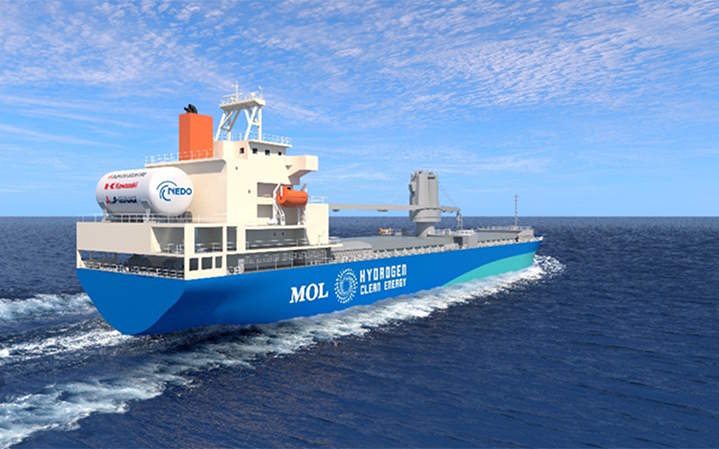
Japan’s Ministry of Land, Infrastructure, Transport and Tourism (MLIT) and Ministry of the Environment have jointly opened a new application round for the country’s Zero Emission Ship Construction Promotion Project — a ¥15.1 billion (roughly $95 million) programme running through January 2031. It’s being described as the second round of Japan’s zero-emission vessel push, and the shift in what it actually pays for is the real story: the first generation of this subsidy built the factories, and this one buys the ships.
⚡ TL;DR
- What: A ¥15.1bn ($95M) five-year subsidy pool, jointly run by MLIT and Japan's Ministry of the Environment, covering equipment costs on new zero-emission vessels.
- Subsidy rates: Up to 50% of eligible equipment costs for hydrogen, ammonia, and pure battery-electric vessels; up to 33% for methanol-fuelled and hybrid vessels.
- Eligible hardware: Engines, fuel tanks, fuel supply systems, propulsion batteries, and shore charging/power equipment — new-build only, no retrofits.
- Trade-route split: Internationally-trading vessels are restricted to hydrogen or ammonia propulsion to qualify; domestic vessels can also use methanol, battery, or hybrid systems.
- Bonus track: A separate green-steel subsidy pays ¥60,000/tonne (up to 50% of cost, rising to two-thirds for GX-committed firms) for lower-carbon hull steel.
- Budget shape: ¥1.2bn in year one, scaling up through 2031; this round's applications reportedly close December 3, 2026.
What’s Actually New Here
Japan has been funding zero-emission shipbuilding since at least fiscal 2024, through the same MLIT/Ministry of Environment partnership and the same executing body, the Japan Ship Technology Research Association (日本船舶技術研究協会). But the earlier rounds — a ¥9.4bn call in FY2024, a further round in FY2026 — were aimed squarely at the supply side: subsidising the production facilities that manufacture hydrogen and ammonia engines, fuel tanks, and outfitting equipment, at up to 1/3 for large firms and 1/2 for SMEs. That’s a bet on domestic industrial capacity — get Japanese yards and engine builders tooled up to build this hardware before competitors do.
This new ¥15.1bn round pays out differently. Instead of subsidising the manufacturer’s tooling, it subsidises the shipowner’s equipment bill on an actual newbuild — engines, tanks, fuel supply systems, batteries, shore power gear — at the same 50%/33% split, now keyed to fuel type rather than company size. It’s a demand-side lever: rather than just building the factories, Japan is now paying to make sure someone orders what comes out of them.
| Facility-subsidy rounds (FY2024–26) | This round (from Aug 2026) | |
|---|---|---|
| Subsidises | Manufacturing/production facilities | Equipment fitted to an actual newbuild |
| Rate basis | Company size (1/3 large, 1/2 SME) | Fuel type (50% H2/NH3/battery, 33% methanol/hybrid) |
| Who benefits directly | Engine and equipment manufacturers | Shipowners and operators placing orders |
| Aim | Build domestic supply capacity | Create demand to absorb that capacity |
Where the Money Goes
The fuel-type tiering is the clearest signal of Japan’s priorities. Hydrogen, ammonia, and pure battery-electric propulsion get the full 50% rate; methanol and hybrid systems get 33%. That’s consistent with how the ministries frame the higher capital risk of hydrogen and ammonia hardware — cryogenic or high-pressure tanks, dedicated fuel-supply systems, NOx abatement for ammonia combustion — versus methanol, which already runs on more conventional liquid-fuel infrastructure and mature engine platforms.
The international/domestic split matters too. Vessels trading internationally only qualify if they run on hydrogen or ammonia — Japan is explicitly not subsidising methanol or battery-electric newbuilds for its deep-sea fleet under this scheme, reserving that support for domestic and coastal tonnage where battery range and methanol bunkering infrastructure are less of a constraint. It’s a narrower bet than it first looks: the headline pool covers four fuel types, but only two of them qualify for Japan’s oceangoing fleet.
A less-discussed add-on: the programme also subsidises green steel used in hull construction, at ¥60,000 per tonne, covering up to 50% of cost — rising to two-thirds for shipyards that have formally signed on to Japan’s Green Transformation (GX) initiative. It’s a reminder that “zero-emission vessel” spending in Japan isn’t only about the powertrain; embodied emissions in the steel itself are now part of the same funding envelope.
Why It Matters
The timing lines up with the IMO’s Net-Zero Framework, which is set to apply a carbon levy to ships above 5,000 GT from 2028 — the kind of regulatory deadline that turns a subsidy from nice-to-have into a hedge against future compliance costs. Japan is a major shipbuilding nation with its own fleet-renewal interest, and a programme that pays half the equipment bill on a hydrogen or ammonia newbuild materially changes the CAPEX case for domestic owners like NYK, MOL, and K Line weighing alternative-fuel orders now versus waiting.
It’s also a different mechanism from what Europe is doing on the same problem. The EU’s proposed SMAP allocation (see our breakdown of how that mechanism actually pays out) reimburses part of the operating fuel-price gap between hydrogen and fossil bunkers, year in arrears. Japan’s scheme instead buys down the capital cost of the vessel itself, paid at the point of construction. Different lever, same underlying problem: hydrogen and ammonia newbuilds cost more to build and, for now, cost more to run.
Challenges and Open Questions
A few things this subsidy doesn’t solve. It doesn’t touch operating costs — the price gap between green hydrogen or ammonia and conventional bunker fuel remains, and a subsidised vessel still has to find affordable, available fuel once it’s in service. It doesn’t fund bunkering infrastructure directly, only the shipboard fuel-supply equipment; ports still need to build out hydrogen and ammonia bunkering capability for these vessels to actually operate on the fuel they were subsidised to burn. And it’s new-build only — the existing fleet gets none of this.
There’s also a disclosure gap worth flagging honestly: Ship & Bunker’s original article was not accessible to us directly, so the figures above are cross-checked against Japan’s own MLIT and Ministry of the Environment press releases plus independent trade coverage, rather than quoted from the source piece itself. The application-window dates in particular (a December 3, 2026 close reported by secondary sources) should be confirmed against the official portal before anyone relies on them for a filing deadline.
Sources
- Ship & Bunker: “Japan Opens Second Round of Zero-Emission Vessel Programme” (original source; not directly accessible at time of writing)
- MLIT: ゼロエミッション船等の建造促進事業(令和7年度補正予算)公募開始
- Ministry of the Environment: 令和7年度(補正予算)「ゼロエミッション船等の建造促進事業」の公募開始
- Fuel Cells Works: “Japan Allocates ¥15.1B to Zero-Emission Ship Projects”
- gasworld: “Japan puts hydrogen, ammonia, and methanol ships in line for subsidies”