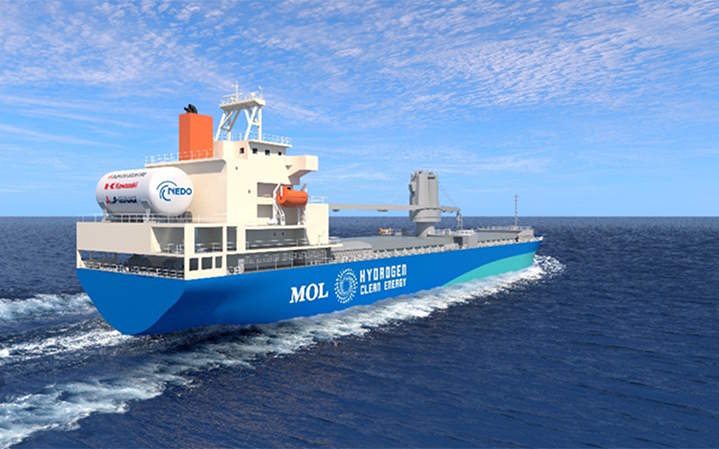
Six months ago, Japan Engine Corporation ran a 5.6 MW low-speed two-stroke engine on over 95% hydrogen at full load — a genuine first for the engine class that actually moves world trade. We covered the factory test in depth at the time. What’s worth checking now, with J-ENG having just exhibited at SMM 2026 in Hamburg, is not the milestone itself but the shape of the programme around it.
⚡ TL;DR
- What: No new hydrogen engine milestone since the March 2026 factory test — the 6UEC35LSGH is still in verification testing ahead of its January 2027 shipment to Onomichi Dockyard.
- Why it matters: J-ENG used SMM 2026 (1–4 September, Hamburg) to position the hydrogen engine as one line in a three-fuel roadmap — hydrogen, ammonia, and methanol — not a standalone bet.
- Key data: J-ENG's ammonia engine (7UEC50LSJA-HPSCR) completed FAT/TAT in August 2025; a methanol variant (UEC50LSJM) targets FY2027; an ammonia series model (UEC60LSJA) targets FY2028 — bracketing the hydrogen engine's own January 2027 shipment date.
- Adjacent progress: Kawasaki signed a contract for a 40,000 m³ LH2 carrier in January 2026 and qualified an LH2 ship-shore coupler in December 2025 — the bunkering-side infrastructure this project will eventually depend on.
- Watch for: The January 2027 engine shipment as the next real checkpoint, and whether NOx/injector-durability/cost-premium data — all still undisclosed — surfaces before then.
What’s Actually New Since March
Not much on the engine itself, and that is worth saying plainly rather than padding out a milestone that hasn’t happened yet. J-ENG’s own SMM 2026 materials describe the 6UEC35LSGH as having been “successfully commissioned in March 2026” and now undergoing verification testing — consistent with, not beyond, what we reported in March. There is no public update on NOx aftertreatment sizing, HPDI injector wear data, or the cost premium over the diesel-equivalent UEC35LSE — the same open questions we flagged six months ago remain open.
What has changed is context, not substance. J-ENG exhibited at SMM 2026 (Japan Pavilion, Hall B7, Booth 450) and used the platform to lay out where the hydrogen engine sits inside a broader multi-fuel product roadmap — a useful reframing for anyone evaluating this project as a hydrogen-specific bet versus a hedged technology strategy.
J-ENG’s Multi-Fuel Roadmap
| Fuel | Engine | Status | Target |
|---|---|---|---|
| Hydrogen | 6UEC35LSGH | Factory-tested >95% H2, verification ongoing | Shipment January 2027 |
| Ammonia | 7UEC50LSJA-HPSCR | FAT/TAT completed | August 2025 (complete) |
| Ammonia (series) | UEC60LSJA | In development | FY2028 |
| Methanol | UEC50LSJM | In development | FY2027 |
Read as a set, this is not a company betting its two-stroke future on hydrogen alone. J-ENG’s ammonia engine is already through factory and type-approval testing — a full engineering cycle ahead of the hydrogen variant — and a methanol engine is queued in between. From a naval architect’s perspective, that sequencing makes sense: ammonia and methanol both run through combustion chemistry and fuel-handling problems that are less severe than hydrogen’s near-zero ignition energy and wide flammability range, so it is a rational engineering path to work through the easier fuels first while the hydrogen programme runs its longer demonstration timeline in parallel. J-ENG is positioning itself as a “First Mover” across all three pathways rather than picking a winner before 2030.
The Infrastructure Question Is Moving, Just Not at J-ENG
The original coverage flagged LH2 bunkering infrastructure as the binding constraint: the 6UEC35LSGH’s 781 kg H2/hour demand at 30 MPa needs shore facilities that mostly don’t exist yet. That constraint hasn’t been resolved, but the surrounding Kawasaki ecosystem has kept moving on the supply side:
- January 2026 — Kawasaki signed a contract to build a 40,000 m³ liquefied hydrogen carrier, smaller than the 160,000 m³ vessel we covered in May, but adding to the same company’s growing LH2 shipping capacity.
- December 2025 — Kawasaki’s LH2 ship-shore coupler received technology qualification, a specific piece of the transfer chain (getting cryogenic hydrogen from shore tank to ship tank without excessive boil-off) that any future bunkering point for the Onomichi Dockyard vessel would need.
- February 2026 — Kawasaki’s proposal for automated LH2 bunkering technology was adopted as a separate NEDO Green Innovation Fund theme — already noted in our March coverage, and still the project most directly relevant to whether the 6UEC35LSGH can actually be fuelled at scale once it’s in service.
None of this is engine news. It’s supply-chain news from the same corporate group developing the engine’s fuel system, and it matters because a 5.6 MW engine that runs on hydrogen is only as useful as the infrastructure that can deliver hydrogen to it at 781 kg/hour. The carrier and coupler work shows Kawasaki treating LH2 logistics as a parallel, not sequential, problem — building shipping and transfer capability alongside the engine rather than waiting for the engine to prove itself first.
Why This Matters
The absence of new engine-specific milestones since March is not a red flag — three-year sea demonstrations and January 2027 engine shipments don’t compress. What SMM 2026 clarified is how J-ENG is managing risk across its decarbonisation product line: hydrogen is the highest-risk, longest-timeline fuel in the roadmap, bracketed by ammonia and methanol variants that de-risk the underlying engine platform and give the company revenue and operational data before the hydrogen variant needs to prove itself commercially. For shipowners evaluating any of these three pathways, that sequencing is itself useful information — it signals which fuel J-ENG expects to be commercially ready first, and it isn’t hydrogen.
Challenges and Open Questions
- Still no published NOx, injector-durability, or cost-premium data — the same gaps flagged in March remain unfilled six months later; SMM 2026 didn’t add technical disclosure on any of them.
- January 2027 engine shipment is the next real checkpoint — until the engine physically ships to Onomichi Dockyard, “verification testing” is difficult to independently assess from outside the programme.
- Bunkering infrastructure is advancing at the corporate-group level, not yet at the project level — Kawasaki’s carrier and coupler progress doesn’t confirm a bunkering solution exists for this specific vessel’s home port when the three-year demonstration begins in FY2028.
- No additional vessel orders announced — a single 17,500 DWT demonstration vessel remains the entire commercial commitment for this engine class; MOL has given no indication of a second hydrogen-ICE newbuild pending demonstration results.
Sources
- World’s First Hydrogen-Fueled Operation of a Main Engine in Factory for a Large Commercial Vessel — Mitsui O.S.K. Lines (27 March 2026)
- Japan Engine (J-ENG) to Exhibit at SMM 2026 — MarketScreener
- Development of Liquefied Hydrogen Bunkering Automation Technology — Kawasaki Heavy Industries (20 February 2026)
- Kawasaki Hydrogen Road — global.kawasaki.com
- Our original coverage: Japan’s 5.6 MW Hydrogen Two-Stroke Engine Achieves 95% H2 Operation in Factory Test