On 25 September 2026, the 4,500 GT coastal tanker Kikou Maru sailed roughly 33 km across Osaka Bay in about two hours — nothing remarkable by distance, except that the whole voyage ran on a hydrogen-fuelled engine. Not a bench test, not a factory trial: an actual ship, actually underway, actually burning hydrogen. The Nippon Foundation is calling it the world’s first demonstration voyage of its kind, and on the specifics — a vessel sailing under power from a hydrogen-only marine engine, rather than running the engine on a test stand — that claim holds up.
⚡ TL;DR
- What: Kikou Maru, a 104.93 m / 4,500 GT coastal tanker, completed a demonstration voyage in Osaka Bay running on a Yanmar Power Solutions pilot-ignition hydrogen four-stroke engine.
- Why it matters: This is a ship actually sailing on hydrogen engine power, not a shoreside test rig — the milestone is operational, not just technical.
- Key data: ~33 km, ~2 hours, ~500 kW engine output, roughly 1.2 tonnes of CO2 avoided versus conventional fuel for the voyage.
- Timeline: Voyage on 25 September 2026, under the Nippon Foundation's Zero Emission Ship Project (launched January 2022, targeting carbon-neutral Japanese coastal shipping by 2050).
- Watch for: Whether this four-stroke, premixed-combustion approach scales beyond coastal tankers, versus Japan's parallel two-stroke, direct-injection programme aimed at oceangoing vessels.
What Actually Happened
Kikou Maru is owned and operated by Uyeno Transtech, built by Fukuoka Shipbuilding at its Nagasaki yard and delivered in 2025 as a conventional coastal tanker before being modified for this demonstration. The hydrogen engine and associated fuel-handling equipment were developed by Yanmar Power Solutions under the Marine Hydrogen 4-Stroke Engine/Hydrogen Engine Compatible Large Domestic Tanker Development Consortium, with the whole programme sitting under the Nippon Foundation’s Zero Emission Ship Project, launched in January 2022 with the explicit goal of carbon-neutral Japanese coastal shipping by 2050.
| Detail | |
|---|---|
| Vessel | Kikou Maru, 104.93 m, 4,500 GT coastal tanker |
| Owner/Operator | Uyeno Transtech |
| Builder | Fukuoka Shipbuilding (Nagasaki), delivered 2025 |
| Engine | Yanmar Power Solutions four-stroke, high-speed, pilot-ignition hydrogen engine |
| Engine output | ~500 kW |
| Voyage | 25 September 2026, Osaka Bay, ~33 km, ~2 hours |
| CO2 avoided | ~1.2 tonnes vs. conventional fuel |
Nippon Foundation Executive Director Mitsuyuki Unno framed it plainly: “It is a first step toward achieving carbon neutrality by 2050, and will accelerate decarbonization in Japan’s coastal shipping industry going forward.” Uyeno Transtech’s CEO Takashi Ueno said the company “gained valuable experience from the hydrogen demonstration and would continue to explore new energy sources” — notably modest language for a world-first, which tracks: this is a single short demonstration voyage, not a commercial service.
The Combustion Architecture: Premixed, Not Direct-Injected
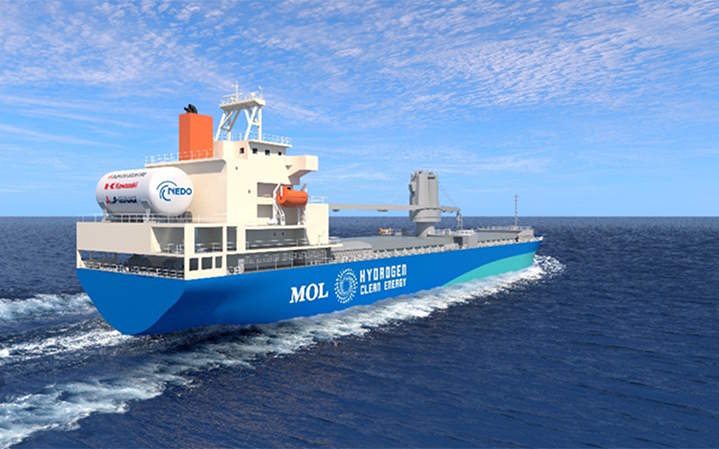
This is where it gets interesting for anyone who’s been following Japan’s other big hydrogen-engine programme. We covered J-ENG’s 6UEC35LSGH back in March — a 5,610 kW low-speed two-stroke engine that hit >95% hydrogen co-firing in factory testing, destined for a 17,500 DWT MOL multipurpose vessel under the same NEDO Green Innovation Fund umbrella. Both engines use diesel pilot ignition. That’s where the similarity ends.
| Yanmar (Kikou Maru) | J-ENG (6UEC35LSGH) | |
|---|---|---|
| Engine type | Four-stroke, high-speed | Two-stroke, low-speed |
| Combustion | Premixed hydrogen-air charge, diesel pilot ignition | High-pressure direct injection (30 MPa) near TDC, diesel pilot |
| Output | ~500 kW | 5,610 kW |
| Target vessel class | Coastal tankers | Oceangoing bulkers/multipurpose vessels |
| Status (as of Oct 2026) | Shipboard demonstration voyage completed | Factory-tested; shipboard trial planned 2028 |
Yanmar’s engine premixes hydrogen and air in the intake, then uses a small diesel pilot charge to ignite it — architecturally closer to a conventional dual-fuel genset running in gas mode. J-ENG’s engine instead injects hydrogen directly into the cylinder after the pilot diesel has already ignited, specifically to eliminate the pre-ignition window that premixed hydrogen combustion is prone to at higher loads. That’s not a coincidence of two companies solving the same problem differently — it’s the right engineering answer twice over, because a high-speed four-stroke coastal engine and a low-speed two-stroke main engine have different knock tolerances, different duty cycles, and entirely different reasons to exist. Direct injection buys J-ENG the combustion stability to push past 95% hydrogen at full load on a 5.6 MW engine; Yanmar doesn’t need that complexity to get a 500 kW coastal engine through a two-hour harbor-adjacent demonstration.
Why a Tanker, and Why Osaka Bay
Coastal tankers are a sensible first target for hydrogen engines for the same reason they’re a good target for most alternative fuels: short, repeatable routes with predictable refuelling points, rather than the open-ended range requirements of deep-sea trade. Japan’s coastal fleet is also disproportionately old and due for renewal, which makes it a more tractable retrofit-and-replace target than persuading a tanker owner to redesign a VLCC. None of that is unique to hydrogen — it’s the same logic that’s made ferries, harbour craft, and short-sea vessels the proving ground for most of the hydrogen fleet we track.
Why This Matters
The distinction between “engine passed a factory test” and “ship sailed on this engine” matters more than it sounds. A factory test tells you the combustion process works under controlled load. A demonstration voyage tells you the fuel system, the safety systems, the crew procedures, and the engine all worked together, underway, outside a test cell — which is the actual bar for commercial deployment. Japan now has proof points at both ends of that bar simultaneously: Yanmar’s engine has been to sea; J-ENG’s engine has been through the harder combustion problem at a much larger scale but hasn’t sailed yet. Between the two, Japan is covering the coastal and oceangoing cases with genuinely different engineering, backed by the same government funding apparatus (NEDO’s Green Innovation Fund) and the same classification society (ClassNK) doing the safety sign-off on both.
Challenges and Open Questions
- Diesel pilot fuel means this isn’t zero-carbon, even on hydrogen power — the same caveat we flagged for J-ENG’s engine. Neither Splash247 nor Riviera’s coverage specifies the exact pilot diesel fraction for Kikou Maru’s trial, so the real CO2 reduction percentage (as opposed to the absolute 1.2-tonne figure for this specific voyage) isn’t yet publicly quantified.
- No published hydrogen substitution ratio. Unlike J-ENG’s clearly stated >95% co-firing figure, available reporting on Kikou Maru’s trial doesn’t give an exact hydrogen fuel ratio — only that it’s described as a record for this engine class.
- One short voyage is not a commercial service. 33 km and two hours establishes feasibility, not economics — bunkering infrastructure, refuelling turnaround, and route economics for a hydrogen-fuelled coastal tanker fleet are all still open questions.
- Scalability beyond 500 kW is unproven for this premixed architecture. Whether Yanmar’s approach can grow to power larger coastal vessels without hitting the pre-ignition limits that pushed J-ENG toward direct injection in the first place is the natural next question.
Sources
- Japan claims world-first hydrogen tanker voyage — Splash247
- Tanker completes first hydrogen-fuelled carbon-neutral voyage in demonstration — Riviera Maritime Media
- World’s 1st Successful ‘Zero-Carbon’ Voyage — The Nippon Foundation