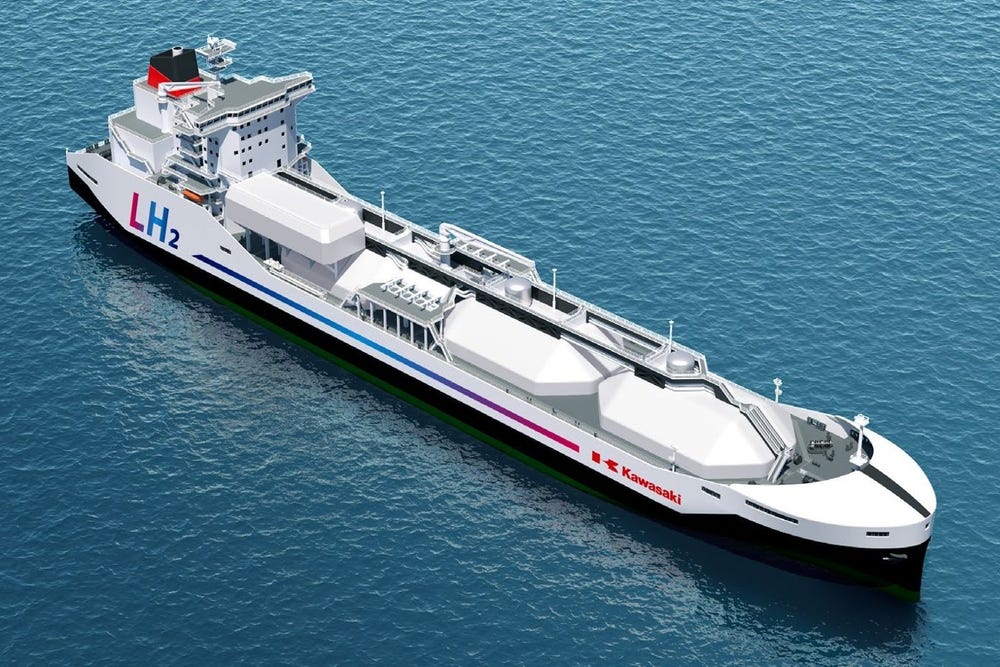
No vessel, no fuel cell, no megawatt figure in this one — just a six-inch pipe with a coupling on the end. But that pipe is exactly what has been missing from every liquid hydrogen shipping story we’ve covered: a commercial-specification, class-qualified hydrogen loading arm that can actually move LH2 from a carrier’s tanks to shore. Kawasaki Heavy Industries and TB Global Technologies (TBG) have just finished building one.
⚡ TL;DR
- What: Kawasaki Heavy Industries and TBG (a Tokyo Boeki Holdings subsidiary) have completed development of a commercial-specification six-inch liquid hydrogen ship-to-shore loading arm, announced 14 October 2026.
- Key data: Flange-type coupling requiring no insertion, a new seal-gas system cutting helium consumption, and a simplified emergency-release clamp. ClassNK qualified both the 6-inch and a companion 16-inch coupler design in December 2025 after liquid-hydrogen testing at JAXA's Noshiro Rocket Testing Center.
- Where it's going: Three of these arms are destined for the Kawasaki LH2 Terminal in Ogishima, Kawasaki City — built to serve carriers in the 40,000 m3 class, the same size as Kawasaki's own LH2 carrier design.
- Timeline: Traces back to a 2019 pilot arm, a 2022 world-first pilot LH2 transfer at the Hytouch Kobe demonstration terminal, and commercial-version development starting August 2023 — seven years from prototype to commercial spec.
- Watch for: Whether this is the piece that finally lets LH2 import terminals scale past single-cargo demonstration runs into repeatable commercial throughput.
What a Commercial Hydrogen Loading Arm Actually Takes to Build
A hydrogen loading arm sounds like plumbing, and at one level it is — but a cryogenic loading arm for −253°C liquid hydrogen is a genuinely hard engineering problem, and it’s one that’s been the quiet bottleneck behind every LH2 shipping announcement we’ve tracked, from Kawasaki’s 160,000 m3 carrier design to the Hamburg LH2 import gateway. You can build the carrier and the storage tank; without a loading arm that can connect, transfer, and disconnect reliably at commercial cadence, neither one does anything.
The new arm is a six-inch, flange-type ship-to-shore coupling — meaning it clamps onto a mating flange rather than inserting into a receiving socket, which Kawasaki and TBG say makes it lighter and more compact than the insertion-type couplings used on earlier prototypes. It also carries a new seal-gas system that reduces the helium needed to maintain joint pressure, and a simplified clamp mechanism for the emergency release device — the component that has to disconnect the arm cleanly if a ship surges beyond its mooring tolerance, without venting cryogenic hydrogen into the terminal.
From Prototype to Commercial Spec: Seven Years
This isn’t a one-off engineering sprint. It’s the latest step in a programme that’s been running since Japan’s Cabinet Office SIP initiative first funded a pilot loading arm:
| Milestone | Date | What happened |
|---|---|---|
| Pilot loading arm developed | 2019 | 11.5 m arm, double-wall vacuum insulation, under Japan’s SIP programme |
| First pilot LH2 transfer | 2022 | World-first pilot-scale LH2 transfer at the Hytouch Kobe demonstration terminal |
| Commercial-version development begins | August 2023 | Kawasaki and TBG start work on the commercial six-inch design |
| Liquid hydrogen testing | Aug 2025 – Jul 2026 | Real LH2 transfer tests at JAXA’s Noshiro Rocket Testing Center |
| ClassNK technology qualification | December 2025 | Both 6-inch and 16-inch Ship Shore Couplers qualified by ClassNK (Nippon Kaiji Kyokai) |
| Commercial completion announced | 14 October 2026 | Kawasaki and TBG announce the six-inch commercial arm is complete |
The fact that this ran through an actual rocket-testing facility is not incidental — JAXA’s Noshiro center is one of the few sites in Japan equipped to handle real liquid hydrogen at the volumes needed to test full-scale transfer equipment, rather than relying on inert-gas or scaled-down surrogates. Testing with the real fluid, at the real flow rates, is exactly what a shipowner’s insurer and class society want to see before a coupling goes anywhere near a commercial cargo operation.
Why the Coupling Design Is the Hard Part
As a naval architect, the detail worth dwelling on here isn’t the headline “world’s first” — it’s the specific list of what changed between the pilot and commercial versions: flange coupling instead of insertion, a new seal-gas system, and a simplified emergency-release clamp. Each of those addresses a real failure mode in cryogenic transfer equipment. An insertion-type coupling has to maintain a seal along its full insertion length while cycling between ambient and cryogenic temperature hundreds of times over its service life — thermal cycling is exactly where cryogenic seals fail. A flange coupling confines the sealing interface to a single, inspectable joint face, which is a more forgiving design to qualify, maintain, and replace in service.
The emergency-release system matters just as much. A loading arm connected to a berthed LH2 carrier has to be able to disconnect in seconds if the vessel surges past its mooring limits — without that capability, you either accept the risk of a ruptured line or you accept much tighter (and more expensive) mooring and weather restrictions on every cargo operation. Simplifying that clamp mechanism without weakening its reliability is the unglamorous engineering work that determines whether a terminal can actually operate in real port conditions rather than only on calm demonstration days.
Where This Plugs In
Three of these commercial loading arms are planned for the Kawasaki LH2 Terminal in the Ogishima area of Kawasaki City, Kanagawa Prefecture — part of the Liquefied Hydrogen Supply Chain Commercialization Demonstration Project led by Japan Suiso Energy under NEDO’s Green Innovation Fund. The arms are sized for carriers in the 40,000 m3 class, which happens to match Kawasaki’s own LH2 carrier design on order for 2030 — suggesting the terminal and the newbuild carrier are being developed as a matched pair rather than independent projects. That’s the right way to build LH2 infrastructure: a loading arm with no compatible ship to serve is a very expensive piece of plumbing, and a carrier with no terminal that can unload it is a stranded asset.
Why This Matters
Every LH2 shipping project we track — carriers, terminals, bunkering studies like Fraunhofer’s recent LH2 bunker fuel cost analysis — ultimately depends on equipment exactly like this working reliably at commercial scale. It’s not a story that generates headlines the way a new carrier order does, but it’s arguably more load-bearing: the entire LH2 supply chain thesis collapses if ship-to-shore transfer can’t move from single-demonstration-cargo events to repeatable, class-qualified, all-weather operations. A six-inch arm won’t move the volumes a future 160,000 m3 carrier will need — that’s going to require the 16-inch coupler ClassNK qualified alongside it — but qualifying the smaller size first, on a real terminal, with a real carrier class behind it, is how this kind of infrastructure actually gets built.
Challenges and Open Questions
- The ISO 24132 reference comes from a single outlet (jp.ibtimes.com) covering what appears to be a Japanese-language press release. We couldn’t independently confirm the standard number against Kawasaki’s or TBG’s own release text or the ISO catalogue, so we’re flagging it as reported rather than verified.
- No flow rate, operating pressure, or transfer capacity figures are public yet for the commercial six-inch arm — these are the numbers that would let us actually compare it against the loading arms used at LNG terminals of similar scale.
- The 16-inch coupler, qualified alongside the 6-inch version in December 2025, hasn’t had its own “commercial completion” announcement — worth watching, since that’s the size that would actually support carriers at the 160,000 m3 end of Kawasaki’s roadmap.
- No date yet for when the three Ogishima arms go into service, or for the first commercial (non-demonstration) cargo through the Kawasaki LH2 Terminal.
Sources
- Kawasaki Heavy, TBG Complete Six-Inch Commercial Liquid Hydrogen Loading Arm — jp.ibtimes.com
- ClassNK Certifies Liquefied Hydrogen Coupler — World Ports Sustainability Program
- Ship Shore Coupler for Liquefied Hydrogen Transport Obtains Technology Qualification from ClassNK — H2-Tech
- World’s First Loading Arm for Ship-to-Shore Transfer of Liquid Hydrogen — JAXA (2019 pilot programme background)