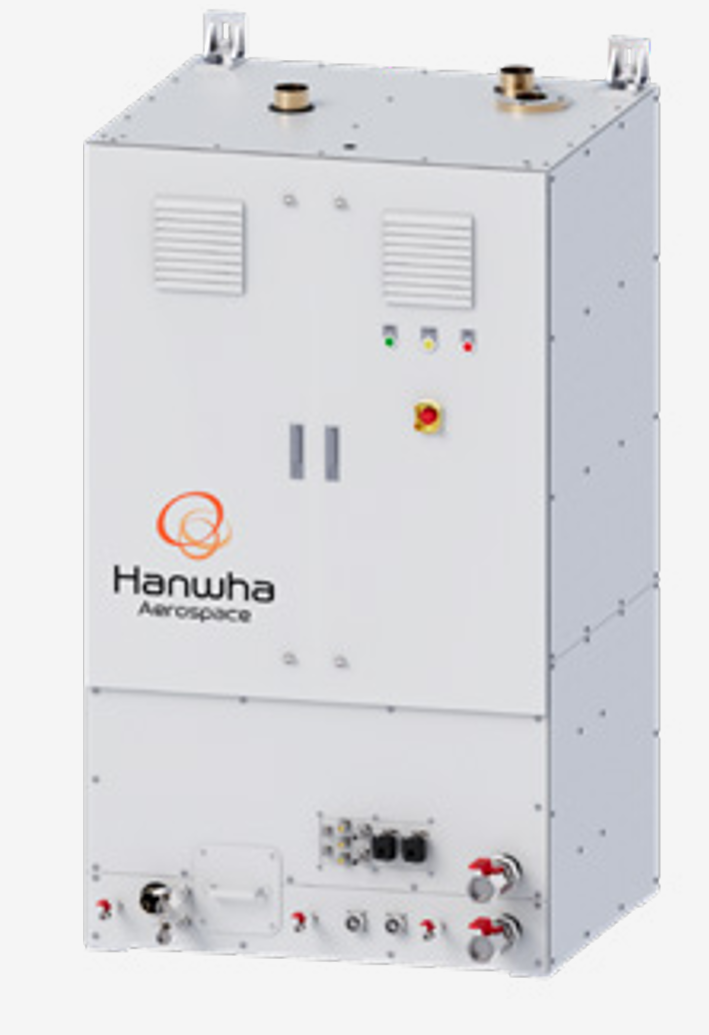
An approval in principle tells you a concept is sound. A type approval tells you the actual hardware has been tested, qualified, and can be bolted to a ship. Hanwha Aerospace has just crossed that second, much harder line: the Korean Register (KR) has granted full type approval to its 200 kW marine hydrogen fuel cell system — the certification that turns a promising design study into installable equipment.
⚡ TL;DR
- What: Hanwha Aerospace's 200 kW marine hydrogen fuel cell system received full type approval from the Korean Register, reported 10 November 2026.
- Why it matters: Type approval is a product-level certification — it qualifies the specific hardware for shipboard installation, a materially higher bar than the approval-in-principle (AiP) stage most marine fuel cells sit at today.
- Key data: Rated output 200 kW, energy efficiency above 50%, tested under simulated marine conditions including vibration and vessel inclination; KR also audited Hanwha's manufacturing process and quality management system.
- Timeline: KR approval in principle (2024) → DNV approval in principle for the same 200 kW system (March 2025) → KR type approval (November 2026).
- Watch for: Whether DNV follows with its own type approval on the same system, and which vessel or newbuilding programme becomes the first to actually install it.
Approval in Principle vs. Type Approval: Why the Distinction Matters
As a naval architect, the gap between these two certification stages is the gap between “we like this idea” and “you may install this.” An approval in principle (AiP) is a classification society’s assessment that a technology concept is feasible and doesn’t obviously conflict with class rules — useful for de-risking a design at an early stage, but it says nothing about a specific, built unit. A type approval is different in kind: the classification society tests the actual production hardware against defined performance and safety criteria, and audits the manufacturer’s production and quality processes, so that any unit built to that type can be installed on a vessel without a fresh one-off review each time.
Hanwha Aerospace’s 200 kW system has now cleared both stages with two different societies — KR AiP in 2024, DNV AiP in March 2025 — and has just cleared full type approval with KR. That’s the step that actually matters commercially: a shipowner or yard specifying this fuel cell no longer needs to treat it as an unproven concept requiring bespoke sign-off.
What Got Tested
| Parameter | Detail |
|---|---|
| Rated output | 200 kW |
| Energy efficiency | Above 50% |
| Fuel cell type | PEMFC (polymer electrolyte membrane) |
| Target application | Long-distance vessels needing sustained high power output |
| Marine qualification tests | Vibration, vessel inclination (simulated marine conditions) |
| Additional KR review | Manufacturing process and quality management system audit |
| Certification path | KR AiP (2024) → DNV AiP (Mar 2025) → KR type approval (Nov 2026) |
Fifty-percent-plus efficiency is a genuinely strong number for a PEM stack at this power rating — PEM systems in this class typically land in the 45–55% range depending on load point, so Hanwha’s figure sits at the favourable end rather than representing a step-change. The more interesting number is the testing regime itself: vibration and inclination testing is precisely the stuff an AiP doesn’t require, because AiP is a paper exercise against a design, not a qualification of physical hardware under sea-state loading.
Part of a Much Bigger Hanwha Hydrogen Push
This fuel cell doesn’t exist in isolation. Hanwha Aerospace has been developing it jointly with sister company Hanwha Ocean (the group’s shipbuilding arm) since at least 2024, and the system sits inside a wider Hanwha Group strategy to own multiple pieces of the alternative-fuel propulsion stack simultaneously:
- Hanwha Ocean / Amogy: Hanwha Ocean has a contract to buy Amogy’s ammonia-to-power system, which itself incorporates Hanwha Aerospace’s fuel cell technology — fuel cells doing the electricity generation, ammonia doing the energy storage and transport.
- Hanwha Group / HMM / KR MoU (November 2025): The three parties signed an agreement to develop an integrated propulsion system combining fuel cells and ammonia gas turbines, reportedly targeted at 2,000 TEU-class feeder containerships — a concrete vessel segment rather than a generic R&D exercise.
- Government-backed R&D: Hanwha Aerospace was selected as lead organisation for a state-funded programme developing fuel cell power packs above 200 kW, suggesting this certified unit is a building block rather than the ceiling of its ambition.
For a conglomerate that already builds the ships (Hanwha Ocean), this is a vertically integrated bet: control the yard, control the propulsion technology, and partner for the fuel supply chain (Amogy’s ammonia cracking) rather than relying on third-party equipment makers for the parts that matter most to a newbuild’s commercial case.
Why This Matters
Marine fuel cell certification has been crowded with AiPs for several years now — EODev, Vinssen, and others have all announced AiP or early type-approval milestones we’ve tracked, and it’s become easy to read “approval” headlines as more settled than they are. A full type approval from KR is a meaningfully different claim: it means a shipowner working with KR as class society could specify this exact unit on a newbuilding today without an open-ended design review. Combined with the HMM/KR MoU naming a specific vessel segment (2,000 TEU feeders), this reads less like a standalone fuel cell story and more like Hanwha assembling the regulatory and commercial pieces for an actual orderable propulsion package.
For hydrogenshipbuilding.com’s tracked fleet, this doesn’t add a vessel yet — no ship has been named as the first installation — but it does lower the regulatory barrier for whichever owner moves first with a KR-classed newbuild.
Challenges and Open Questions
- No vessel, owner, or shipyard has been named as the first installation for the newly type-approved system. Type approval qualifies the hardware; it doesn’t commit anyone to buying it.
- This report comes from a single outlet (TheElec) published the same day we’re writing this. We found strong independent corroboration for the certification path (KR AiP 2024, DNV AiP March 2025 — both corroborated across multiple outlets including Hanwha’s own press release), but no second source yet for the specific KR type-approval milestone itself — worth treating as reported-but-fresh rather than fully cross-verified.
- DNV’s own type approval, separately reported as “in process” with a target of securing it “by next year” (an unconfirmed date from a secondary source), hasn’t been confirmed as complete — so KR is currently the only society to have taken this system past AiP.
- No public pricing or production capacity figures for the fuel cell have been disclosed.
Sources
- Hanwha Aerospace secures type approval for marine hydrogen fuel cell — TheElec
- Hanwha Aerospace’s Hydrogen Fuel Cell System Receives DNV Approval in Principle — Hanwha Group (official press release, March 2025)
- Hanwha Group, HMM, and KR sign MOU to develop next-generation carbon-free ship propulsion systems — Hellenic Shipping News
- A marine fuel cell developed by Hanwha Aerospace — The Korea Herald