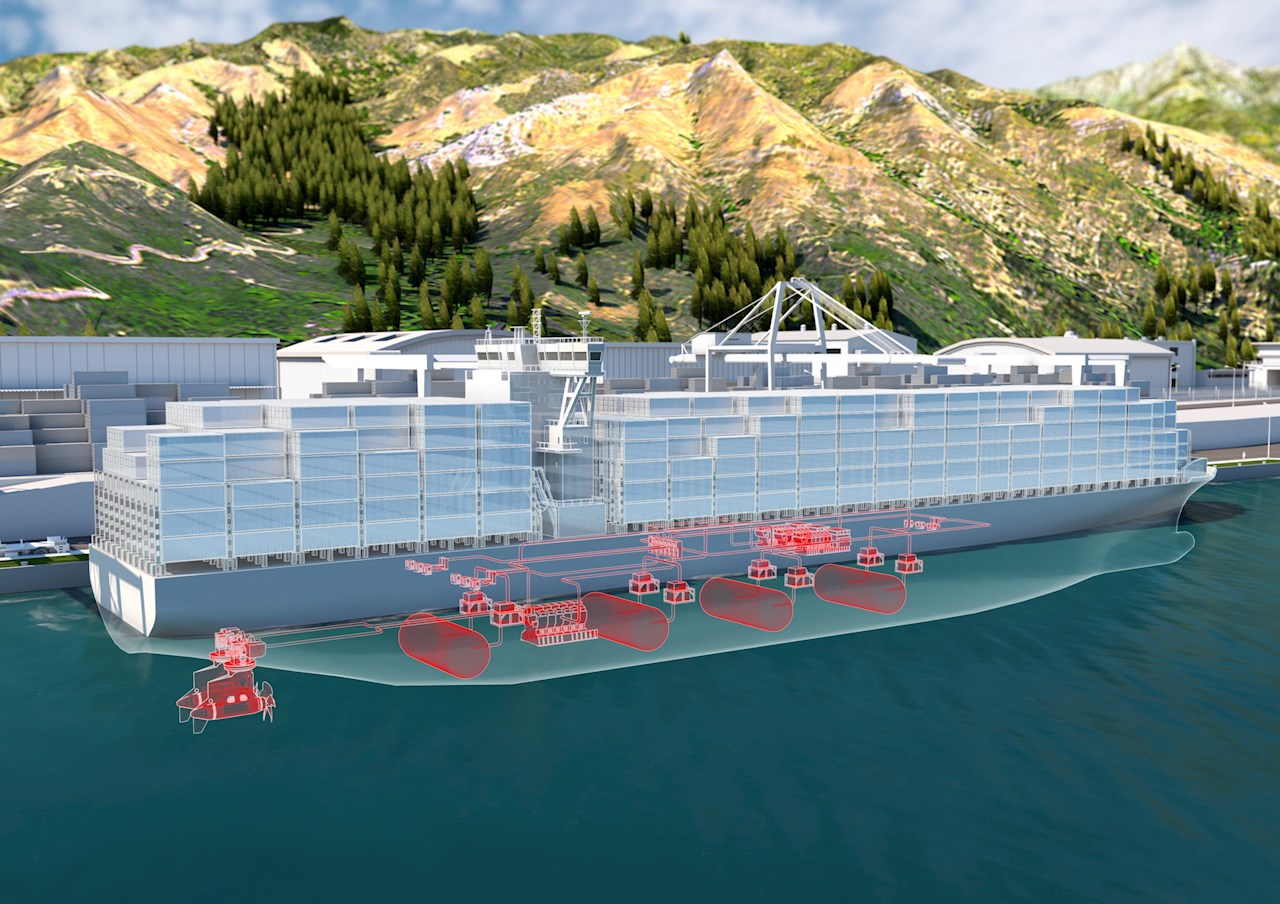
PowerCell Group’s latest newsletter is mostly a highlight reel — an AI data center order, a hydrogen aviation conference slot, a trade-show appearance. But buried in the “Summer Orders” roundup is a small, specific order that says more about where marine fuel cells are actually headed than any of the bigger headlines: a SEK 21 million (~€1.8M) deal with Germany’s Aerospace Center (DLR) to build a methanol-to-hydrogen test bed for cruise ships.
⚡ TL;DR
- What: PowerCell secured a SEK 21 million order from DLR (Deutsches Zentrum für Luft- und Raumfahrt) for an integrated Fuel-to-Power system at DLR's maritime test facility in Kiel, Germany.
- Scope: Two Marine System 225 fuel cell systems, two methanol reformers (supplied by partner MReformer), hydrogen buffer storage, gas mixing and integrated system control — built on PowerCell's M2Power platform.
- Timeline: Delivery in Q4 2026, commissioning in the first half of 2027.
- Project: Part of Germany's "zero4cruise" initiative, aimed squarely at cruise-ship decarbonisation.
- Context: Announced days before PowerCell shows the same MS 225 and its larger M2Power 250 platform at SMM Hamburg (1–4 September 2026).
Why reform methanol instead of just storing hydrogen
The order is easy to skim past — it’s a research contract with a government agency, not a ship sale. But the technology choice it funds is the interesting part.
Storing and bunkering hydrogen at the scale a cruise ship needs remains the industry’s hardest unsolved logistics problem: cryogenic liquid hydrogen needs -253°C tanks and almost no port has bunkering infrastructure for it. Methanol doesn’t have that problem — it’s liquid at ambient temperature and pressure, ships and tanks built for it already exist, and IMO newbuild rules already accommodate it as a marine fuel.
The catch is that PEM fuel cells — the type PowerCell builds — want pure hydrogen, not methanol. The system DLR ordered solves that by putting the reformer in the fuel path: methanol goes into the tank, a reformer strips hydrogen out of it just before the fuel cell stack, and the ship never has to solve hydrogen bunkering at all. It’s the same logic PowerCell’s Chief Analytics & Sustainability Officer Victor Åkerlund laid out in a Marine Insight piece published alongside this newsletter: PEM cells “can operate on hydrogen directly or integrate reformer technologies to convert methanol,” letting an operator hedge on which fuel infrastructure actually shows up at their home ports.
What DLR’s Kiel facility actually buys is realism. Rather than bench-testing the reformer-plus-fuel-cell stack at steady output, DLR will use it to reproduce real vessel operational profiles — from steady-state cruising to the dynamic load swings of a cruise ship shifting between propulsion, hotel load and port operations. That’s the data PowerCell needs before it can sell this configuration into an actual newbuild.
The regulatory math behind the cruise-ship framing
The zero4cruise name isn’t incidental. Cruise ships are exactly the vessel type EU regulation is squeezing hardest right now:
| Driver | Why it matters here |
|---|---|
| FuelEU Maritime + EU ETS | Non-compliance penalties could reach roughly €520,000/year per passenger vessel by 2030, per the Marine Insight piece |
| Compliance-credit banking | Operators can bank surplus credits or pool them across a fleet — turning emissions cuts into a tradeable asset, not just a cost |
| Hotel load | Cruise ships run huge auxiliary power draws (housekeeping, HVAC, galleys) even at berth — the nearest-term fuel cell opportunity is replacing diesel gensets for exactly that load, cutting NOx/SOx at the point where ships sit closest to port cities |
That last point is why this order is about auxiliary power and hotel loads, not main propulsion. It’s a more modest ambition than a full fuel-cell-powered newbuild, but it’s also the part of a cruise ship’s energy budget where the regulatory and reputational pressure is most immediate.
Where this sits in PowerCell’s broader marine push
We covered PowerCell’s industrial transition from the MS-225 to the megawatt-class MS-500 back in March — a SEK 400m+ marine order backlog and an 80,000-hour durability target aimed squarely at diesel-engine overhaul cycles. This DLR order is a different kind of signal: not a shipowner buying fuel cells for a vessel, but a research institution buying validation infrastructure for a specific fuel pathway.
That’s a meaningful distinction. The MS-500 backlog is commercial proof that shipowners are already ordering fuel cells today, largely on direct hydrogen or ammonia pathways. The DLR order is PowerCell hedging that bet — building the evidence base for methanol reforming as the pathway that actually gets adopted at cruise-industry scale, where hydrogen bunkering infrastructure is the least likely to arrive first.
The timing lines up with SMM Hamburg, 1–4 September 2026, where PowerCell will show the MS 225 alongside its newer M2Power 250 platform. Kiel’s test bed won’t be commissioned until H1 2027, so nothing from it will be presentable in Hamburg yet — but the conversations PowerCell has there will likely determine whether “methanol in, hydrogen out” becomes a pattern other cruise operators actually order, or stays a single DLR test rig.
Open questions
No cruise line has been named as a future customer for a zero4cruise-validated system — this is a testbed order, not a vessel commitment, and it’s worth being clear about that distinction rather than reading it as “PowerCell wins cruise ship contract.” Methanol reforming also adds real mechanical complexity — a reformer stage on top of the fuel cell stack itself — and the durability and cost data that will determine whether that trade-off is worth it won’t exist until Kiel is commissioned and running dynamic load profiles, sometime after H1 2027. At SEK 21 million, this is a modest order next to PowerCell’s ship-level contracts; the actual signal to watch is whether SMM Hamburg conversations convert it into newbuild orders.
Sources:
- PowerCell Group — company newsletter, 28 August 2026
- Hellenic Shipping News — PowerCell secures SEK 21 million DLR order for integrated Fuel-to-Power system
- Marine Insight — Why Is Shipping Turning To Fuel Cells For Clean Power?
- gasworld — PowerCell to supply German cruise ship decarbonisation project
- Ship & Bunker — PowerCell Secures SEK 21 Million Fuel-to-Power System Order