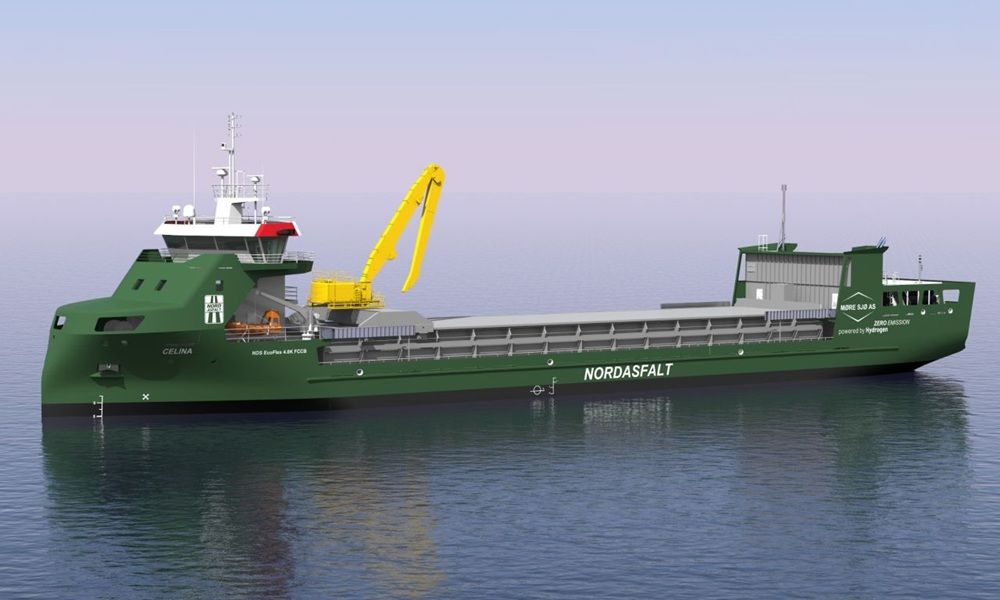
Most owners in this sector announce one hydrogen vessel and call it a fleet strategy. GMI Rederi just quietly ordered its third and fourth — on the same fuel cell technology as the first two, with eCap Marine now holding the whole hydrogen container contract.
⚡ TL;DR
- What: GMI has ordered two more hydrogen-powered bulk carriers (hulls 3 and 4), on top of the two — Celine and her sister — already under construction.
- Fuel cells: PowerCell again — the same technology partner across all four hulls, keeping the fleet on a single, consistent fuel cell platform.
- Who's building the hydrogen container: eCap Marine (Hamburg), under its own integrated H2EPS platform — compressed hydrogen storage, the PowerCell fuel cells, power management, control and safety systems, all in one contracted package.
- Shift from vessels 1 & 2: There, eCap Marine handled integration and certification around a PowerCell-branded contract. Here, eCap holds the prime contract for the full hydrogen system — PowerCell supplies the cells, but eCap owns the deal.
- New vessels: ~3,000 DWT, built by Chowgule Shipyards (India), entering service 2029, for Norwegian coastal trade.
- Existing vessels: ~4,000 DWT, 85m, built at Gelibolu Shipyard (Turkey), Bureau Veritas class, delivery early 2027, backed by Enova, the Norwegian NOx Fund and the Green Shipping Programme.
Four hulls, two yards, one fuel cell platform
GMI’s original hydrogen bulk carrier order — the one that made headlines as “the world’s first hydrogen-powered bulk carriers” — was for two 4,000 DWT, 85-metre vessels being built at Gelibolu Shipyard in Turkey. We’ve covered that deal twice already: PowerCell supplies 14 Marine System 225 fuel cell units across the pair (7 per ship, 1.6 MW each), eCap Marine handles engineering, integration and certification, and the whole thing sails on compressed hydrogen with Bureau Veritas class. One of the two now has a name — Celine — with delivery expected early 2027.
Hulls 3 and 4 are a different build in most respects. They go to Chowgule Shipyards in India, come in smaller at roughly 3,000 DWT, and won’t enter service until 2029 — three years behind the first pair. What hasn’t changed is the fuel cell technology: PowerCell is again supplying the cells inside eCap Marine’s H2EPS (Hydrogen Energy Power System) package — compressed hydrogen storage, PowerCell’s PEM stacks rated at 1.2 MW per vessel, and the power management, control and safety systems around them. The public announcements frame this as eCap’s platform and don’t spell out the fuel cell brand, but the cells themselves are PowerCell — same technology partner, all four hulls.
| Vessels 1 & 2 | Vessels 3 & 4 | |
|---|---|---|
| Deadweight | ~4,000 DWT | ~3,000 DWT |
| Length | 85 m | Not yet public |
| Shipyard | Gelibolu Shipyard (Turkey) | Chowgule Shipyards (India) |
| Fuel cells | 7× PowerCell MS-225 per vessel (1.6 MW) | PowerCell PEM stacks (1.2 MW), inside eCap’s H2EPS package |
| Contract structure | PowerCell holds the fuel cell contract; eCap Marine integrates and certifies | eCap Marine holds the full hydrogen system contract |
| Classification | Bureau Veritas | Not yet public |
| Delivery | Early 2027 | 2029 |
| Funding | Enova, Norwegian NOx Fund, Green Shipping Programme | Not yet disclosed |
Why eCap’s bigger role is the real story
The fuel cell technology staying constant is actually what makes the contracting change interesting rather than routine. On vessels 1 and 2, eCap Marine’s job was integration: taking PowerCell’s Marine System 225 modules, packaging them, and getting them certified for a specific hull, with PowerCell as the named counterparty for the fuel cell contract itself. On vessels 3 and 4, eCap holds the full hydrogen system contract under its own H2EPS name — PowerCell’s cells are still inside it, but eCap is now the prime contractor GMI is dealing with, not just the integrator working around someone else’s supply deal.
That’s eCap Marine moving up the value chain on the back of what it learned integrating the Celine-class vessels — turning a services role into a packaged product it can sell as its own platform — while GMI keeps the underlying fuel cell technology consistent across its entire hydrogen fleet. For an owner, that combination is close to the best of both: one proven fuel cell technology to build operating experience and spares commonality around, and a systems integrator whose commercial stake in getting the container right has just gone up.
eCap Marine’s managing director, Lars Ravens, framed the repeat business as a confidence signal: “The renewed order from GMI demonstrates the growing confidence in hydrogen as a viable solution” for maritime applications. GMI’s CEO, Torstein Holvik, was more explicit about where this is heading: “Our ambition is to become a leading owner of hydrogen-powered vessels. These newbuilds are another important step in that direction.”
The fleet strategy behind the headline
GMI’s own public materials back that ambition up with a roadmap, not just a slogan: the stated goal is to “build the world’s leading zero-emission coastal shipping operator — profitable, scalable and disruptive,” with first hydrogen vessel delivery targeted for 2027 and a full zero-emission portfolio by 2030. GMI also describes its propulsion concept as a “triple hybrid” — fuel cells, batteries and wind-assist sail technology contributing roughly 200 kW on average — tuned for efficient 10-knot coastal operation rather than chasing speed.
That combination matters for how seriously to take the “leader” framing. Plenty of owners have ordered a single hydrogen demonstrator vessel and stopped there; we’ve covered several on this site. Far fewer have a four-hull program spanning two shipyards, sitting inside a stated 2030 fleet-conversion target, and backed by Norwegian public funding mechanisms (Enova, the NOx Fund, the Green Shipping Programme) that typically require real commercial deployment rather than a paper feasibility study. LH2 Shipping’s six-vessel Enova award is the other multi-vessel commitment we’ve tracked in this size class — GMI is now in similar territory, and doing it on one consistent fuel cell platform across all four hulls rather than starting from scratch each time.
Open questions
No contract value has been disclosed for the eCap H2EPS deal, unlike the SEK 40M figure PowerCell published for vessels 1 and 2 — worth keeping in mind before treating this as directly comparable in scale. The public announcements around vessels 3 and 4 don’t name PowerCell as the fuel cell supplier, describing the system only as eCap’s own H2EPS platform — worth flagging as a gap between what’s publicly confirmed and what we understand to be the case. The 2029 delivery for hulls 3 and 4 is a long runway — three years past the first pair — during which GMI still needs Norwegian coastal hydrogen bunkering infrastructure (GreenH’s Halten terminal chief among it) to actually be built out to match fleet growth on this timeline. And “leading owner of hydrogen-powered vessels” is GMI’s own framing, not yet an independently verified ranking — though four committed hulls on one consistent fuel cell platform is, at minimum, a genuinely unusual position for a company this size to be in.
Sources:
- SWZ Maritime — eCap Marine to power two more bulk carriers with hydrogen
- New-Ships.com — eCap Marine to Equip Two More Hydrogen Bulk Carriers for GMI
- India Shipping News — GMI awards eCap Marine contract for two additional hydrogen-powered bulk carriers
- PowerCell Group — PowerCell to equip world’s first hydrogen-powered bulk carriers
- GMI Group