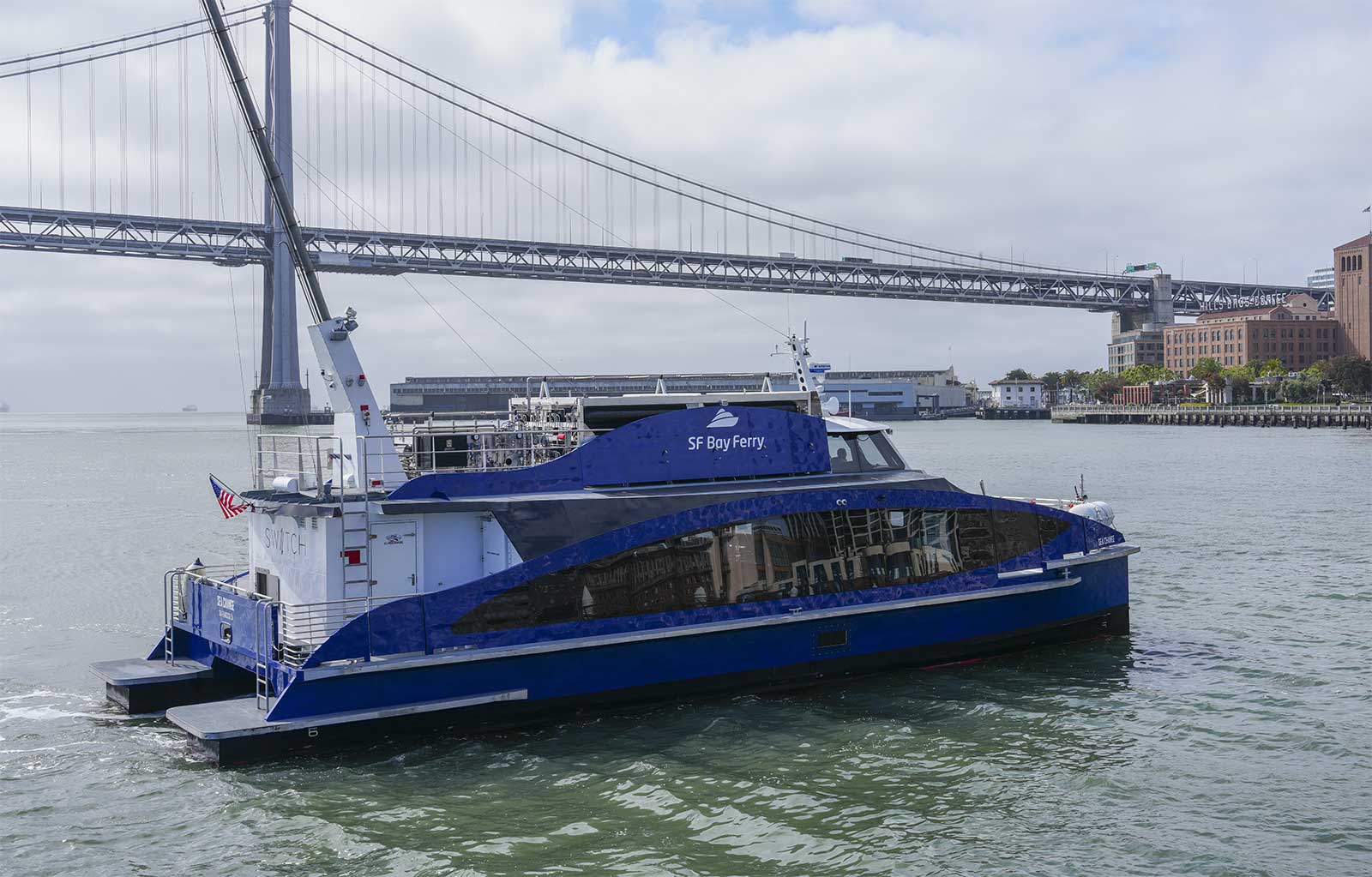
SWITCH Maritime’s Sea Change proved a hydrogen fuel cell-electric ferry could actually carry passengers under a US flag. Its successor, the 150-passenger SWITCH-150, has just cleared the regulatory step that lets a project move from concept to construction: a Design Basis Agreement (DBA) from the US Coast Guard. What makes this one worth a closer look is what the DBA is reportedly built on — not just the Sea Change precedent, but the IMO’s Interim Guidelines for hydrogen-fuelled ships, approved only five months earlier.
Update (6 November 2026): A follow-up report from The Maritime Executive confirms the hull dimensions and hydrogen storage figures we’d previously sourced only from design-stage reporting, and adds new specs — battery capacity, cruising speed, interior layout — plus on-record quotes from both companies. Details below have been updated accordingly.
⚡ TL;DR
- What: SWITCH Maritime has secured a Design Basis Agreement from the USCG for the SWITCH-150, a 150-passenger hydrogen fuel cell-electric ferry designed by Incat Crowther, announced 21 October 2026.
- Why it matters: USCG Subchapter T (vessels carrying 150 passengers or fewer) has no rules written for hydrogen fuel cell-electric propulsion. This DBA is an alternative-design equivalency finding, not a checkbox against an existing rule.
- Key data: Builds directly on Sea Change — 75 passengers, 246 kg compressed hydrogen at 250 bar, 360 kW of Cummins fuel cells, operating in San Francisco Bay since July 2024. The SWITCH-150 roughly doubles passenger capacity: a 28 m aluminum catamaran carrying 720 kg of compressed hydrogen plus 1,576 kWh of batteries, cruising at 25 knots.
- Regulatory detail: SWITCH says the framework drew on the IMO's Interim Guidelines for the Safety of Ships Using Hydrogen as Fuel, approved in May 2026 — a fast turnaround from international guideline to a national flag-state approval.
- Watch for: Whether SWITCH names a shipyard and keel-laying date, and whether PowerCell's fuel cell stack size and Hexagon Purus's storage configuration get disclosed before construction starts.
What a Design Basis Agreement Actually Gets You
A DBA isn’t a building permit and it isn’t a finished Certificate of Inspection (COI) — it’s the US Coast Guard’s agreement, reached before construction, on the regulatory basis a novel vessel will be built and assessed against. For a conventional diesel ferry under 150 passengers, that basis already exists in Subchapter T of Title 46 CFR. For a hydrogen fuel cell-electric ferry, it doesn’t: Subchapter T has no provisions written for hydrogen storage or fuel cell propulsion, so there’s no rulebook to simply comply with.
That’s exactly the gap Sea Change had to close in 2020, and the gap the SWITCH-150 project has now closed again. The process works by demonstrating an equivalent level of safety to what Subchapter T would require of a conventional vessel, using a mix of applicable codes — the US IGF Code framework for gaseous fuels, DNV class rules, IEC electrical standards, and, per SWITCH’s account of this round, the IMO’s Interim Guidelines for the Safety of Ships Using Hydrogen as Fuel. Once the USCG agrees that mix adds up to an equivalent safety case, you have a DBA, and the project can move into detailed design, construction, and eventually the sea trials that lead to a COI.
Building on Sea Change, Not Starting Over
| Sea Change (2024) | SWITCH-150 | |
|---|---|---|
| Passengers | 75 | 150 |
| LOA | 21.9 m | 28 m |
| Hull | Aluminum catamaran | Aluminum catamaran |
| Hydrogen storage | 246 kg CH2 @ 250 bar | 720 kg CH2 |
| Battery capacity | Not disclosed | 1,576 kWh |
| Cruising speed | Not disclosed | 25 knots |
| Fuel cell power | 360 kW (Cummins), 2× 300 kW motors | Not yet disclosed (PowerCell Group) |
| DBA secured | 2020 | 2026 |
| Status | Operational, San Francisco Bay, since July 2024 | DBA secured; construction not yet announced |
| Base/route | San Francisco Bay | Brooklyn Navy Yard, New York Harbor |
The jump from Sea Change to SWITCH-150 isn’t a different concept — it’s the same architecture (hydrogen fuel cell-electric, compressed gas storage, designed as a drop-in replacement for a diesel ferry of similar speed and schedule) scaled roughly 2x on passenger count and nearly 3x on hydrogen storage. SWITCH’s own framing is explicit about this: the SWITCH-150 “draws directly from the technical, regulatory, and operational framework” Sea Change already established and proved out in commercial service. That’s the right way to scale a novel propulsion type — validate the smaller vessel first, then use its operating record as the evidence base for the next regulatory approval, rather than trying to leapfrog straight to a larger, unproven design.
The Supplier List Reads Like a Who’s-Who of Maritime Hydrogen
The partners named alongside this DBA give a useful snapshot of who’s actually building the maritime hydrogen supply chain in 2026:
- Incat Crowther — naval architecture and initial regulatory matrix development
- Hexagon Purus — hydrogen storage systems
- PowerCell Group — fuel cell systems. We’ve tracked PowerCell’s maritime fuel cell orders closely this year, from Nordic coastal bulkers to this US passenger ferry — a genuinely diversified order book across vessel types and continents.
- SEAM — propulsion system integration
- Hornblower Marine — operational advisory, drawing on its experience running large US ferry and tour-boat fleets
- LH2 Shipping — hydrogen propulsion safety specialist. The name is worth a second look given the SWITCH-150 uses compressed gas, not liquid hydrogen — presumably brought in for general hydrogen-system safety expertise rather than LH2-specific work, but the press materials don’t explain the fit.
Built to Run Like the Diesel Ferry It Replaces
The vessel specs that have come in since this DBA was first reported confirm what we flagged as design-stage figures: the SWITCH-150 is a 28 m aluminum catamaran carrying 720 kg of compressed hydrogen alongside 1,576 kWh of batteries, cruising at 25 knots — enough for a full day of service without refueling. The cabin is laid out like any other commuter ferry: main-deck seating, luggage storage, a kiosk, and three bathrooms, one wheelchair accessible.
The operational pitch is deliberately unglamorous, and that’s the point: SWITCH says the SWITCH-150 is designed to match diesel ferry schedules at parallel service speeds, refueling daily from mobile hydrogen equipment rather than requiring any shoreside charging infrastructure or grid upgrades. For an operator deciding between a hydrogen and a battery-electric ferry on a route like this, that’s the practical tradeoff — hydrogen bunkering looks more like existing diesel fueling logistics, where battery-electric would mean new grid connections at every stop.
“Signing the DBA with the Coast Guard is a critical milestone in advancing the development of the SWITCH-150,” said Francisco Planells, Director of the Newbuild Program at SWITCH Maritime.
“The DBA is validation of the smart engineering and safety-focused approach built into the vessel design,” added Dan Mace, Technical Manager at Incat Crowther.
Why This Matters
Every hydrogen-fuelled newbuild we track eventually runs into the same bottleneck: a flag state or classification society has to agree on a safety basis before steel gets cut, and for hydrogen fuel cell-electric vessels under 150 passengers, the US simply doesn’t have a rulebook yet. SWITCH Maritime and the USCG have now run this equivalency process twice — Sea Change in 2020, and SWITCH-150 in 2026 — which starts to look less like a one-off workaround and more like a repeatable pathway other US ferry operators and class societies could follow. If the IMO Interim Guidelines really did serve as part of this round’s foundation, that’s a meaningfully faster bridge from international guidance to national approval than hydrogen shipping has typically managed — KR’s hydrogen ship safety guide and Lloyd’s Register’s own hydrogen safety analysis both treat exactly this kind of code gap as the industry’s central near-term obstacle.
For New York specifically, a 150-passenger hydrogen ferry based at the Brooklyn Navy Yard would be a genuinely significant addition to the US hydrogen-ferry fleet — not a demonstrator, but a vessel sized to actually move commuter-relevant passenger volumes on an existing ferry network, without requiring new shoreside charging infrastructure the way a battery-electric equivalent would.
Challenges and Open Questions
- No shipyard or construction timeline has been named. A DBA clears the regulatory path; it doesn’t commit a yard or a delivery date. The next step, per SWITCH, is detailed design development and a complete digital shipbuilding package.
- Fuel cell power output and storage pressure for the SWITCH-150 still aren’t public, even after the hull, battery, and hydrogen-storage figures were confirmed. PowerCell Group supplies the fuel cells; the stack size hasn’t been disclosed.
- The specific IMO Interim Guidelines provisions used in the equivalency case aren’t detailed in any source we found — we know they were cited as a foundation, not which sections carried the most weight.
- LH2 Shipping’s exact role, given the SWITCH-150’s compressed (not liquid) hydrogen storage, isn’t explained in available materials.
- No price or total project cost has been disclosed beyond the $2 million NYSERDA grant that funded the design phase.
Sources
- SWITCH Maritime Secures a DBA for Hydrogen Fuel-Cell Electric Ferry — QC Intelligence
- SWITCH Maritime Receives Design Basis Agreement from US Coast Guard for 150-Passenger Hydrogen Fuel Cell-Electric Ferry — Offshore Source / Business Wire
- SWITCH Maritime in DBA with USCG for 150-Passenger Hydrogen Fuel Cell Ferry — Marine Log
- Development Starts on Design of New York’s First Hydrogen Fuel Cell-Electric Ferry — Riviera Maritime Media
- Design Basis Agreement Reached for 150-Passenger NYC Hydrogen Ferry — The Maritime Executive (4 November 2026 — confirmed vessel specs and quotes)