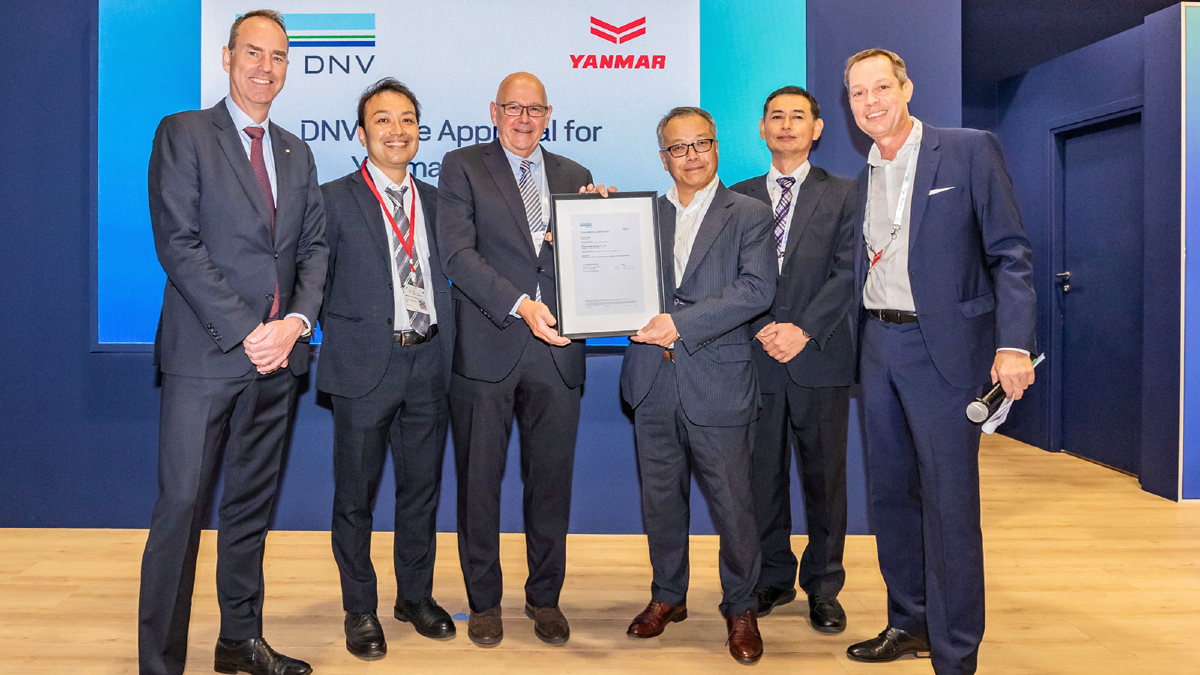
Yanmar Power Solutions’ GH-FC hydrogen fuel cell series has received DNV type approval — announced at SMM 2026 in Hamburg, more than a decade after Yanmar started the programme and three years after the technology first went to sea in Japan. The certification doesn’t launch a new product; it clears a domestically-proven one to be specified anywhere DNV class applies.
⚡ TL;DR
- What: DNV has granted type approval to Yanmar Power Solutions' (YPS) GH-FC series hydrogen fuel cell, confirming it meets DNV's rules and guidelines for maritime use.
- Announced: 7 September 2026, timed with SMM 2026 in Hamburg.
- Track record: In development since 2015, commercialised in Japan in 2023; already running in a fishing vessel, two Tokyo emergency response boats, and a 100-passenger harbour cruise vessel.
- Why it matters: Type approval is the step that lets shipbuilders, system integrators and owners outside Japan specify the GH-FC in newbuild projects under DNV class, without a vessel-by-vessel case being built from scratch.
- What's next: A 48 m net-zero dinner cruise vessel, Amane, for The Cruise Club Tokyo (NYK Group), due May 2027.
A Japanese fuel cell earns a global class certificate
Yanmar Power Solutions (YPS), a subsidiary of Yanmar Holdings, has been developing hydrogen fuel cell technology since 2015 — leaning on a much longer history in internal combustion engine design and manufacturing. The GH-FC series was first commercialised in Japan in 2023, and DNV’s new type approval confirms it complies with DNV’s rules and guidelines for marine applications. In practice, that means shipbuilders, system integrators and vessel operators can now adopt the GH-FC for maritime projects under DNV class without each one having to build a bespoke approval case.
The certificate was presented at SMM 2026, the maritime industry’s largest biennial trade fair, running this week in Hamburg — the same event where PowerCell and DLR announced a methanol-reforming fuel cell order for cruise ships. Fuel cell certification news clustering around SMM is not a coincidence: it’s where OEMs time announcements to reach the widest shipbuilding and classification audience at once.
YPS president and representative director Masaru Hirose called the approval “a major milestone” in the company’s push to offer hydrogen-powered solutions to the marine market: “Building on our operational experience in Japan, we aim to support customers around the world in their transition to zero-emission operations and realise sustainable maritime transportation.”
Where the GH-FC has already been proven
What makes this type approval different from many “first” announcements in this sector is that it isn’t backing a paper design — it’s ratifying a system with several years of in-service data behind it, all from Japan:
| Vessel | Type | Status | Role of the GH-FC |
|---|---|---|---|
| ZERO-E Kurose | Fishing vessel | In service | Hydrogen fuel cell generates electricity stored in a lithium-ion battery; roughly two days of operation per hydrogen fill |
| 2× Tokyo emergency response vessels | Emergency response | In service | Fuel cell propulsion/power |
| Hanaria | 100-passenger harbour cruise vessel | In service since 2024 | Hybrid system: Yanmar fuel cells + battery + two 450 kW diesel engines; runs on hydrogen and biodiesel, cutting CO2 by 53–100% depending on mode |
| Amane | 48 m dinner cruise vessel | Launching May 2027 | Batteries for propulsion, diesel engines, and a Yanmar fuel cell for net-zero operation |
The ZERO-E Kurose was one of the first demonstrations of Yanmar’s hydrogen fuel cell technology, backed by Japanese government funding — a fishing vessel using the fuel cell to charge a lithium-ion battery that runs the boat’s systems, good for around two days between hydrogen fills. Hanaria, backed by MOL Techno-Trade — the Mitsui O.S.K. Lines group’s innovation unit — has been sailing Tokyo’s harbour since 2024 on a hybrid setup that pairs the fuel cell and battery with two 450 kW diesel engines, switching between hydrogen and biodiesel to cut emissions by anywhere from 53% to 100% depending on operating mode.
The next vessel in the pipeline, Amane, pushes further: a 48-metre dinner cruise vessel for The Cruise Club Tokyo, an NYK Group company, due to launch in May 2027 with batteries, diesel engines and a Yanmar fuel cell combined for net-zero emissions. Between MOL’s Hanaria and NYK’s Amane, both of Japan’s largest shipping groups now have a Yanmar fuel cell vessel in service or on order — worth noting alongside Japan’s second round of zero-emission vessel subsidies, which explicitly named NYK, MOL and K Line as owners weighing alternative-fuel newbuilds against that funding.
What DNV is actually certifying
Eric Tigelaar, Yanmar Europe’s commercial marine department manager, framed the approval’s relevance for markets outside Japan: “The GH-FC series combines easy installation, operational flexibility, modularity and environmental performance, making it an ideal solution for a wide range of vessel applications.”
Olaf Drews, DNV Maritime’s head of engines and pressurized equipment, placed the certificate in the context of the class society’s broader hydrogen work: “Every step demonstrates the growing maturity of hydrogen fuel cell technology and continues to build confidence in the market and showcase its readiness for broader commercial applications. DNV is pleased to continue supporting innovative solutions that can help accelerate the transition toward zero-emission shipping.”
That “every step” framing matters. DNV issued its Recommended Practice for hydrogen as a marine fuel (RP 0703) back in May, covering crew competency and operational procedures around hydrogen systems. A type approval for a specific fuel cell product sits one layer down from that framework-level guidance: RP 0703 tells operators how to run hydrogen safely in general, while the GH-FC type approval certifies that one named product meets DNV’s technical rules — the two pieces of paper a shipowner needs are different, but they come from the same institutional push to make hydrogen fuel cells a routine class specification rather than a case-by-case negotiation.
Type approval versus fleet approval — and the storage problem that doesn’t go away
As with BeHydro’s mono-fuel hydrogen engine type approval in June, it’s worth being precise about what this certificate does and doesn’t cover. Type approval certifies the GH-FC product design against DNV’s rules — it does not automatically approve every vessel that installs it. Each newbuild or retrofit still goes through vessel-specific class approval, where integration details (storage, piping, ventilation, structural fire protection) get resolved individually. What the type approval removes is the risk of designing a vessel around a fuel cell that later turns out not to be certifiable at all — a real project risk until now.
The article also flags the storage problem that dogs every hydrogen propulsion story on this site: liquid hydrogen liquefies at −253°C, requiring dedicated cryogenic storage on board, and green hydrogen remains expensive to produce even though a fuel cell converts it to electricity with nothing but water vapour as a byproduct. None of Yanmar’s four demonstrated applications above use liquid hydrogen storage — the GH-FC’s in-service vessels to date all run on compressed gas, which sidesteps the cryogenic cost and complexity but caps range and bunkering flexibility relative to liquid hydrogen or ammonia-fuelled alternatives. Whether YPS pursues a liquid hydrogen-fed variant of the GH-FC for longer-range applications is an open question this type approval doesn’t answer.
Why this fits the pattern
Yanmar’s approach mirrors what’s become a recognisable sequence for hydrogen propulsion certification in 2026: prove the technology domestically on small, controllable applications (a fishing boat, harbour cruise vessels, emergency response craft), then use that operating history to win a type approval that opens the door to export markets and larger newbuild programmes. It’s the same logic behind BeHydro’s progression from Approval in Principle to full type approval via years of real engine testing, and it stands in useful contrast to newbuild orders like GMI’s hydrogen bulk carriers, which are betting on a fuel cell platform before extended in-service data exists.
For Yanmar specifically, the DNV certificate converts three years of Japanese domestic experience into a credential Europe-based Eric Tigelaar can now use to sell the GH-FC into vessel projects outside Japan — a smaller, less-covered story than a headline newbuild order, but arguably a more durable one: it’s a certified, in-service product rather than a design on paper.
Sources: